
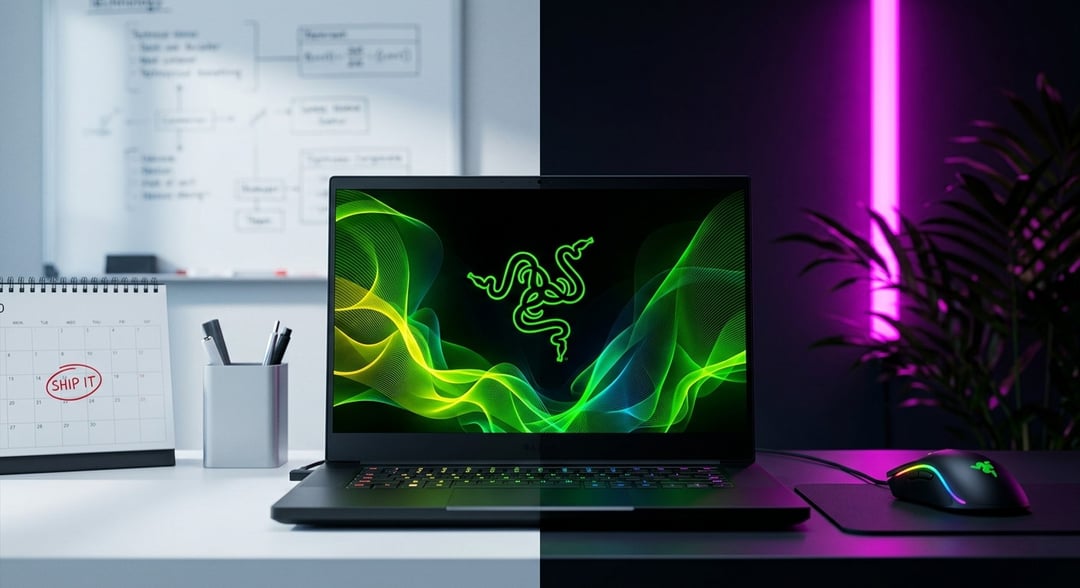
Arrow Lake Finally Comes to the Blade 18
If you've been waiting for Razer to refresh the Blade 18 with Intel's latest silicon, the wait is over. The 2026 Blade 18 runs on the Intel Core Ultra 9 290HX Plus across all three configurations — and honestly, that chip is no joke. You're looking at 24 cores, a boost clock of up to 5.5GHz, 36MB of cache, and an onboard NPU pushing up to 13 TOPS of AI compute. That's a lot of horsepower packed into a laptop that's meant to travel.
This is the kind of processor that makes you question whether you even need a desktop anymore. Razer certainly seems to think so — they're calling it their "most powerful Blade ever" and pitching it as desktop-class performance in a portable form factor. Bold claim. Let's see if the rest of the specs back that up.
Three GPU Options, Three Very Different Price Tags
Here's where things get interesting — and a little eye-watering.
RTX 5070 Ti: The "Entry-Level" at $3,999.99
The base model pairs the Core Ultra 9 290HX Plus with an Nvidia GeForce RTX 5070 Ti — 12GB of GDDR7 VRAM with a TGP of up to 140W. You also get 32GB of DDR5-6400MHz RAM and a 1TB PCIe Gen 4 SSD. For four grand, that's your starting point. And look, "entry-level" is doing a lot of heavy lifting at that price, but in the context of an 18-inch Razer flagship, it kind of makes sense.
RTX 5080: $500 More, Same RAM and Storage
Add $500 and you step up to the RTX 5080 — 16GB GDDR7 VRAM and a higher TGP of up to 175W. Everything else stays the same: 32GB of RAM, 1TB of storage. If you're doing serious GPU-heavy work or gaming at the highest settings, that bump in VRAM and power headroom might be worth it to you.
RTX 5090: The "Hold My Wallet" Tier
This is where things go full enthusiast. The RTX 5090 variant comes with 24GB of GDDR7 VRAM (also up to 175W TGP), bumped storage to 2TB, and starts at $5,130. But if you want to push it to 128GB of RAM? That'll be $6,999.99. Yes, nearly seven grand for a laptop. Razer isn't shy about who this is for.
Full Specs at a Glance
|
Spec
|
Details
|
|
OS
|
Windows 11 Home
|
|
CPU
|
Intel Core Ultra 9 290HX Plus (24 cores, up to 5.5GHz)
|
|
GPU Options
|
RTX 5070 Ti / RTX 5080 / RTX 5090
|
|
Display
|
18″ UHD+ 240Hz or FHD+ 440Hz Dual Mode, 100% DCI-P3
|
|
RAM
|
32GB DDR5-6400MHz (upgradable to 128GB)
|
|
Storage
|
1TB (5070 Ti & 5080) / 2TB (5090) PCIe Gen 4
|
|
Battery
|
99WHr, 400W AC adapter
|
|
Weight
|
3.20 kg / 7.06 lbs
|
|
Connectivity
|
Wi-Fi 7, Bluetooth 5.4, Thunderbolt 5, TB4, HDMI 2.1, 2.5Gb Ethernet
|
The Display: One Screen, Two Personalities
All three models share the same 18-inch panel, and it's genuinely impressive. It runs in two modes — UHD+ at 240Hz or FHD+ at 440Hz — which is a smart dual-mode design that lets you choose between resolution and raw refresh rate depending on what you're doing. Peak brightness hits 600 nits, response time sits at 3ms, and it covers 100% of the DCI-P3 color space with Calman Verified color accuracy. Whether you're gaming, editing video, or just watching something at the end of a long day, that panel is going to look great.
Connectivity That Actually Makes Sense
One of the things Razer gets right here is the port selection. You've got Thunderbolt 5 and Thunderbolt 4 — both — alongside three USB 3.2 Gen 2 Type-A ports, HDMI 2.1, a UHS-II SD card reader, and 2.5Gb Ethernet. Add Wi-Fi 7 and Bluetooth 5.4, and you have a machine that can genuinely replace a desktop workstation for a lot of people.
The Thunderbolt 5 inclusion is particularly notable — it opens the door to external GPU setups, ultra-fast storage, and high-bandwidth displays in ways that older Thunderbolt versions simply couldn't match.
Battery, Build, and That Ridiculous 400W Adapter
The 99WHr battery charges to 50% in 30 minutes, which is convenient. What Razer hasn't shared, though, is actual battery life numbers — and with an RTX 5090 and a Core Ultra 9 under the hood, you might want to keep your expectations grounded. The whole thing is built from a CNC-milled aluminum unibody and weighs in at 3.20kg. That's not heavy for an 18-inch gaming laptop, but it's not something you'd forget is in your bag either.
Then there's the 400W AC adapter in the box. Four hundred watts. For a laptop. It's almost funny — but it's also a sign of where high-performance mobile computing has landed.
How It Stacks Up Against the Competition
Here's the honest part: Razer charges a premium, and the Blade 18 is no exception. The Asus ROG Strix Scar 16 with an RTX 5080 comes in around $3,300 — meaningfully less than Razer's equivalent tier. The MSI Titan 18 HX, which is probably the closest direct competitor as another 18-inch machine, runs significantly higher. And if OLED is your thing, the Alienware Area-51 16 brings that to the table.
So the Blade 18 sits in an interesting position: more expensive than some rivals at the same GPU tier, but backed by a premium build quality and a design language that a lot of people genuinely prefer. Whether that premium makes sense depends on what you value.