
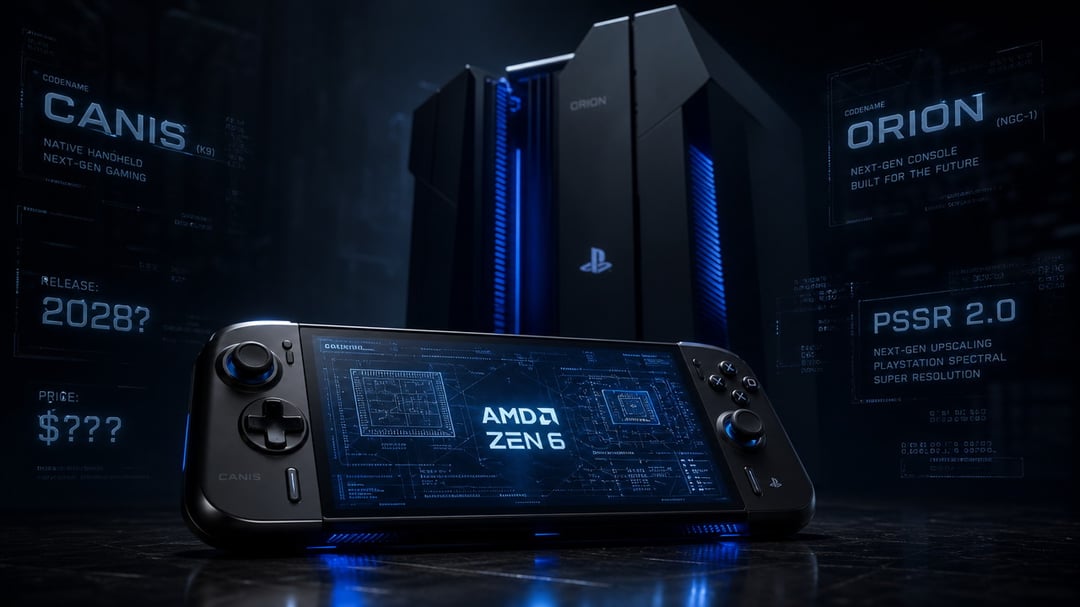
PS6 at a Glance: The Headline Details
The PlayStation 5 is still selling strongly, and the PlayStation 5 Pro now sits at the top of the lineup for anyone chasing maximum power. But attention is already shifting to what comes next. The next-generation console was originally expected to arrive in 2027, yet the ongoing memory crisis appears to have pushed that timeline back, possibly by years rather than months.
Heading into mid-2026, the questions enthusiasts are asking have changed. The conversation is no longer dominated by how powerful the machine will be or which features it will pack. Instead, it centers on when the PS6 will actually land and how much more it might cost than the already-raised PS5 prices. That said, rumors continue to swirl around every angle, including a three-tier hardware plan rumored to feature a PS6 Lite, a standard PS6 (or Pro), and a dedicated handheld.
|
Feature
|
Details
|
|
Expected Release Window
|
Late 2028 or 2029; pushed back from 2027 due to component shortages
|
|
Estimated Price
|
$350 (PS6 Lite) up to $999 (PS6 Pro/"Orion" model)
|
|
The Handheld Factor
|
A dedicated, native companion handheld (codenamed "Project Canis") is heavily rumored to arrive alongside the main consoles
|
|
Key Hardware
|
Custom AMD Zen 6 architecture, RDNA 5 graphics, dedicated "Neural Arrays" for built-in AI upscaling (PSSR 2.0), and 32GB of DDR7 RAM
|
PlayStation 6 Release Date: The 2027 vs. 2029 Dilemma
Sony has not announced an official release date for the PlayStation 6. Going by the current crop of leaks and reports, the next console still sits several years out. Drawing on Sony's previous hardware cadence, executive comments, and broader industry reporting, the most probable window lands somewhere between late 2027 and 2028.
A 2027 launch has long looked like the logical target. The PlayStation 4 arrived in 2013 and the PlayStation 5 followed in 2020, leaving a seven-year gap between generations. Repeat that pattern and a late-2027 debut fits neatly.
More recent reporting has muddied that picture. Several outlets have indicated Sony may be weighing a later launch because of climbing memory costs and wider strain across the semiconductor industry. Sony has not addressed those claims, but the chatter has fueled speculation that the company could settle on 2028 instead, with a handful of reports even floating 2029.
Sony's own public comments offer few firm clues, though they reinforce the idea that next-gen hardware remains a long-term project. Lead architect Mark Cerny has framed his work on future console technology as a multi-year effort, while company executives keep stressing a long-horizon platform strategy and continued investment in the PlayStation ecosystem.
The timing also lines up with Sony's current priorities. The PS5 is still receiving major first-party releases, and the arrival of the PS5 Pro signals there is meaningful life left in this generation. As a result, any launch before 2027 looks increasingly improbable. For now, late 2027 to 2028 remains the most frequently cited window across analysts and gaming publications. Until Sony formally unveils the hardware, treat any precise date as informed guesswork rather than fact.
Will the PS6 Cost $900? The 2026 "RAMmageddon" Effect
Sony recently rolled out a notable price increase across its current U.S. lineup, effective April 2, 2026. Before digging into how the memory shortage could send PS6 pricing soaring, it helps to see the revised figures for the PS5, PS5 Digital Edition, PS5 Pro, and PlayStation Portal.
|
Console Model
|
Previous Price
|
New Price (as of April 2)
|
Total Increase
|
|
PS5 (with Disc Drive)
|
$549.99
|
$649.99
|
+$100
|
|
PS5 Digital Edition
|
$499.99
|
$599.99
|
+$100
|
|
PS5 Pro
|
$749.99
|
$899.99
|
+$150
|
|
PlayStation Portal
|
$199.99
|
$249.99
|
+$50
|
Sony attributed the hike to ongoing pressures in the global economy and rising component costs. With its flagship console now brushing $900 in the United States, the company may be testing buyer tolerance and laying the groundwork for an equally high, if not higher, PS6 price.
Speculation aside, the broader cause is well documented. The rapid and largely unchecked expansion of generative AI data centers has carved a massive gap in the global supply of high-bandwidth memory (HBM) and DDR-class RAM, driving up prices on consumer products. Since the PS6 is rumored to carry up to 30GB or 32GB of GDDR7 RAM, Sony would be bidding for the same chips as the AI giants, which effectively rules out a baseline $600 console.
To navigate that reality, Sony is reportedly leaning into a multi-device approach with tiered pricing:
- PS6 Lite: A slightly cut-down version of the mainstream console, potentially priced between $350 and $500.
- PS6 handheld (Project Canis): A heavily rumored device aimed at the Switch 2, possibly landing between $400 and $500.
- PS6 flagship (Project Orion): The standard PS6 with top-tier hardware, estimated at $699 to $999, with the higher figure looking more likely.
If Sony can keep the PS6 under $1,000, it could undercut Microsoft's "Project Helix" next-gen Xbox, which may run between $1,000 and $1,200 and debut in late 2027 or early 2028.
One lever Sony could pull to manage cost is modularity. Reporting suggests the PS6 may follow the PS5 Slim's lead with a detachable disc drive. That approach keeps the standard console's sticker price down while generating extra revenue from physical-media collectors who buy the drive separately. There is even a chance that existing PS5 detachable drives will be compatible with the PS6.
PS6 Rumored Specs and Hardware: Timeline of Recent Leaks
The flow of PS6 information has been steady, with leakers and outlets adding new pieces month after month. Here is how the most notable claims stack up:
- August 22: Cloud Chamber pushed Bioshock 4 out of its late-2026/early-2027 window, hinting it could become a PS6 title.
- April 11, 2026: Moore's Law Is Dead suggested the PS6 might carry a more palatable $749 launch price.
- April 3, 2026: Moore's Law Is Dead claimed Sony is already deep into PS6 development and could launch sooner than expected.
- March 7, 2026: Reports indicated Sony might press ahead with the PS6 despite higher memory costs, echoing how it handled the PS5 during the 2020 pandemic.
- February 16, 2026: A Bloomberg report framed a PS6 delay as a strategic move, giving Sony room to sort out supply chains and component costs first.
- February 9, 2026: Leaker KeplerL2 claimed the PS6 could ship with 30GB of DDR7 memory, a jump that would boost overall performance.
- January 15, 2026: Bloomberg's Jason Schreier argued there may not be a big market for a PS6 in 2026, suggesting the PS5 still has room to run.
- November 4: Moore's Law Is Dead floated that Sony's push for a PS5 "low power mode" could be about running PS5 games on a handheld.
- October 20: Moore's Law Is Dead reported production beginning in early 2027, targeting a late-2027 launch.
- October 9: Sony and AMD began openly discussing their collaboration, which will likely feed into the PS6.
- September 12: Moore's Law Is Dead dropped a full PS6 specs leak.
- September 8: Insider Gaming's sources said the PS6 would launch with a detachable disc drive.
- September 2: KeplerL2 commented that the next Xbox could cost roughly twice as much as the PS6.
- August 28: Moore's Law Is Dead leaked specs for the rumored PS6 handheld and shared a fresh PS6 price estimate.
How the PS6 Rumors Evolved: A Closer Look at the Leaks
Past generations offer useful guideposts. The PS4 ran for seven years before the PS5 arrived, and the PS3 likewise lasted seven years before its successor. Since the PS5 launched in 2020, a 2027 debut would once again produce a seven-year cycle. Betting firmly on 2027 feels risky, but anything from late 2027 onward looks like a reasonable expectation.
One of the strongest historical hints came from an official Microsoft court document tied to the Activision Blizzard acquisition. It noted that by the time Sony launched its next-generation console (a date that was redacted), it would have lost access to Call of Duty. Observers connected that redaction to the deal Microsoft offered to keep Activision Blizzard games on PlayStation through 2027, implying Microsoft did not expect a new PlayStation before 2027 at the earliest.
Earlier estimates landed the PS6 in a 2027–2028 frame, and one rumored detail nudged toward 2027. An Insider Gaming report referenced a canceled, unannounced Blade Runner game targeting a September 2027 release on current and "Gen 10" platforms, hinting the PS6 would be available by then. That track record is shaky, so it is worth a generous helping of skepticism.
The Silicon Foundation: Sony and AMD's "Project Amethyst"
Sony held a business presentation on June 13 and touched on both future hardware and handhelds, though it stopped short of revealing dates. Sony Interactive Entertainment CEO Hideaki Nishino acknowledged that the console business has grown into a multi-faceted platform with a large, highly engaged player base across the PS5 and PS4 generations. He noted strong interest in the company's next-generation strategy, said no further details could be shared at that stage, and emphasized that the platform's future is a top priority.
The person most worth listening to on that strategy is architect Mark Cerny. He previously announced a major AMD partnership, Project Amethyst, aimed at improving upscaling on the PS5 Pro expected in 2026. He has since spoken about AMD's progress on next-generation GPU hardware, noting that while the new tech could be ready as soon as next year, his own planning horizon spans multiple years.
Microsoft has also partnered with AMD, but Sony's collaboration was discussed more openly by Cerny and AMD senior vice president Jack Huynh. The partnership breaks down into three pillars:
- Neural Arrays: These link Compute Units together to handle AI upscaling more efficiently, serving as the dedicated silicon foundation for PlayStation Spectral Super Resolution 2.0 (PSSR 2.0). Huynh's framing of dedicated innovations that elevate cinematic rendering strongly implies Sony is building the PS6 as an AI-first console from the ground up.
- Radiance Cores: Dedicated hardware for in-game lighting, comparable to how NVIDIA uses RT cores for ray tracing. With AMD looking to close the gap, the PS6 reportedly aims for 6 to 12 times the ray tracing performance of the base PS5.
- Universal Compression: A potential answer to NVIDIA's Neural Texture Compression that could make streaming compressed data to GPU memory more efficient, lowering power demands while improving frame rates.
Mid-to-Late 2025: The Optimistic Hardware Leaks
In June 2025, KeplerL2 returned to NeoGaf to discuss PS6 specs and timing. The claim was that both the PS6 and the next Xbox would use UDNA architecture for their GPUs, an approach said to be roughly 20% faster than the RDNA4 found in the PS5 Pro. On timing, KeplerL2 sat in the 2027 camp for both consoles, but suggested Xbox might rush to beat the PS6 to market.
In July, Moore's Law Is Dead shared leaked details about AMD's Magnus APU, which it believed could power the PS6. KeplerL2 corroborated the specs but argued the chip was destined for the next Xbox rather than the PS6, pointing out that AMD's codenames for PlayStation SoCs are drawn from Shakespeare characters.
On August 1, 2025, Moore's Law Is Dead surfaced what it described as a 2023 AMD presentation containing specs for both the PS6 and a PlayStation handheld. The document reportedly codenamed the PS6 "Orion" and proposed manufacturing in late 2027. The high-level takeaways: performance on par with an RTX 4080, roughly 3x the speed of the base PS5, enhanced ray tracing, and output of either 4K at 120FPS or 8K at 60FPS. The eye-catching part was the prediction that Sony would keep specs conservative to hit a $500 launch price. Even if accurate, those plans dated to 2023 and could easily have shifted. Later, in October 2025, Moore's Law Is Dead reported that Sony would start PS6 manufacturing in early 2027, aiming for a late-2027 release that would mirror the PS4's seven-year run.
Industry Reality Checks and the Shift Toward 2028
Bloomberg's Jason Schreier offered a more cautious read on the Xbox Expansion Podcast. He acknowledged that a seven-year cycle is now traditional, but called the idea of starting a new generation soon hard to justify, noting that the PS5 feels like it has barely gotten going.
Former PlayStation executive Shuhei Yoshida struck a similar chord in conversation with VentureBeat. Mapping the average console lifecycle, which would place the end of the PS5 era around 2027, he said it felt a touch early to call. He stressed he has no inside knowledge of the next PlayStation, but added that the PS5 generation was slowed by manufacturing issues, and a 2028 launch felt right to him. While Yoshida lacks specific insider information, his three decades at PlayStation, including a stint as SIE president, give weight to his sense of the company's timelines.
April 2026: Thermal Management and the Final Chipset
A more recent KeplerL2 report on NeoGaf raised the possibility of a 2027 release, slightly earlier than most expected. That estimate stemmed from claims that the PS6 chipset is nearly complete and close to fabrication. Historically, the gap between a finalized chipset entering fabrication and a console launching is about two years, which is how the 2027 figure emerged. On the silicon itself, KeplerL2 pointed to a Zen 6 chip built on N2 architecture paired with an early fork of gfx13, otherwise known as AMD RDNA5.
Collectively dubbed "Project Orion," the new architecture is not just about raw speed. It also represents a significant step forward in thermal management, which is central to the entire PS6 experience. By using more efficient die sizes, Sony aims to deliver extreme graphical fidelity while keeping operating temperatures in check. Reporting also indicated the SoC is in pre-silicon validation, a stage that typically carries a two-year lead time, lining up with a 2027 target. In plain terms, even the conservative reading points to hardware that comfortably outclasses the PS5, though all of it remains rumor until Sony makes things official.
Why Is There So Much Confusion About the PS6 Launch Date?
The disagreement traces back to when the various leaks appeared. Hardware leaks from 2023 and early 2024 confidently pointed to 2027, a date that meshed perfectly with Sony's seven-year cadence. The 2026 memory crisis upended that math. Securing millions of high-bandwidth memory units has become a serious headache for the bill of materials, making a late-2028 or even 2029 release far more plausible. The potential silver lining is that memory supply could ease by the end of the year, an optimistic read given current conditions, in which case the PS6 might arrive sooner than the gloomier estimates suggest.
PlayStation Release History: Will the PS6 Break the Seven-Year Cycle?
Looking back at Sony's release rhythm helps frame expectations, with the caveat that generations have steadily grown longer, so these gaps guide rather than predict.
|
Console
|
Release Year
|
|
PlayStation 1
|
1994
|
|
PlayStation 2
|
2000
|
|
PlayStation 3
|
2006
|
|
PlayStation 4/PS4 Pro
|
2013/2016
|
|
PlayStation 5/PS5 Pro
|
2020/2024
|
|
PlayStation 6
|
Late 2028 or 2029 (Estimated)
|
Every previous generational gap ran six or seven years, including the PS4 era with its Pro model. Carry that trend forward and 2027 emerges, but the data is not predictive. Given the 2026 memory crunch, there is a real chance the PS6 breaks the historical cadence by at least a year if conditions do not improve.
PS6 Specs and Power: Decoding the AMD Leaks
Exact specifications remain thin, but the silicon foundation looks essentially locked. Moore's Law Is Dead has stated with full confidence that Sony will keep partnering with AMD for both the PS6 and PS5 Pro. That continuity makes sense, since reusing the chipset family simplifies backward compatibility and cross-generation games. Reuters reported in September 2024 that Intel lost a 2022 bid to design the PS6 chipset to AMD, reinforcing the expectation that AMD silicon will ease backward compatibility given that the PS5 and PS5 Pro both run on custom AMD chips.
A new SSD seems likely, since cutting load times was a major PS5 priority, though nothing concrete has leaked. Storage of at least 2TB feels reasonable by the time the console ships, especially if it leans digital-only. A translated leak attributed to Zhangzhonghao suggested the PS6's RDNA5 is now branded UDNA, sharing an architecture with the M1400 and RX9000, with the GPU heading into mass production in the second quarter of 2026.
Moore's Law Is Dead also detailed a rumored spec sheet for the flagship PS6 (Project Orion):
- 7–8 x Zen 6c plus 2 x Zen 6 LP, with 9–10 cores
- Up to 32GB of DDR7 memory (older leaks claimed 40GB, but April 2026 supply-chain realities point to 32GB)
- 52–54 AMD RDNA 5 CUs clocked between 2.6GHz and 3GHz, 10MB of L2 cache, and up to 40 TFLOPS of GPU compute
- Backward compatibility with PS4 and PS5
- Rasterization roughly 2.5–3x greater than the PS5
- Ray tracing performance 6–12x greater than the PS5
The standout upgrade is not the raw TFLOPS figure but the leap to 32GB of cutting-edge DDR7 RAM, a meaningful jump from the PS5's 16GB of GDDR6 that should largely eliminate data-streaming bottlenecks. For sprawling open-world games, such as a theoretical Grand Theft Auto 6 expansion, assets could stream into GPU memory almost instantly, leaving the PS6 dramatically faster than its predecessor.
PS6 Features: PSSR 2.0 and an AI Gameplay Assistant
Sony has already rolled out PlayStation Spectral Super Resolution 2.0 (PSSR 2.0) globally for the PS5 Pro in March 2026. The feature sharpens image clarity, cuts shimmer, and improves gameplay stability. It reduces visual artifacts using neural networks trained on billions of frames to predict how pixels should appear, and it supported a wide range of titles at launch.
The PS6 is rumored to introduce hardware-level AI frame generation. Architect Mark Cerny has confirmed in an interview that frame generation is coming to PlayStation, backed by stronger specifications and raw processing power to keep input latency low, though he did not specify which consoles would receive it.
Beyond that, Sony appears to be developing an AI-based "ghost assistant" capable of watching gameplay in real time and serving up dynamic on-screen tips, assistance, or help. For context, Xbox has already announced its Gaming Copilot, currently in beta on PC and mobile, while Android phones offer the Google Play Games Sidekick. Sony also seems to be rethinking how players interact with hardware, with a recent patent revealing a "buttonless" gamepad concept. Given how forcefully gamers tend to hammer their controllers, a fully touch-based pad reads as more ambitious than practical.
Project Canis: The Rumored PS6 Native Handheld
Alongside the main console, plenty of rumors point to a new PlayStation handheld arriving as part of the PS6 "family." Positioned as a companion device, it signals that Sony is not stepping away from the home console space. UK outlet Metro has claimed Sony is developing two chipsets for the PS6 lineup, lining up with the multi-device strategy. The prevailing industry view is that Sony is building a fresh handheld to challenge the Steam Deck and Nintendo Switch 2.
According to leaker KeplerL2, this handheld would use a 15W SoC on a 3nm process. In practical terms, it would not approach a full PS6, but it could comfortably run PS5 games, just at lower resolutions or frame rates due to reduced memory bandwidth. KeplerL2 pegged its power somewhere between the Xbox Series S and Series X. Moore's Law Is Dead has also tied the PS5's Low-Power Mode to the handheld, suggesting that feature could be especially handy for a compact device.
More recent details indicate Sony could pair an AMD RDNA5-based GPU featuring 28–32 compute units with 16GB of LPDDR5X RAM and 20MB of cache (4MB L2 plus 16MB MALL), backed by a more modest SoC for portable play. Reports also point to support for advanced AI upscaling and ray tracing. Crucially, the device is expected to run games natively rather than merely streaming them like the PS5 Portal. If that holds, the PS6 generation could mark a genuine return to the hybrid hardware approach last seen with the PS Vita, giving Nintendo real competition.
Returning to the June 13 business meeting, Nishino addressed handheld plans directly. After noting that PlayStation Portal sales are progressing steadily and have unlocked additional engagement across the player base, he reaffirmed Sony's commitment to exploring new ways for players to access its content and services. The remarks were non-committal, but they acknowledged the Portal's success and Sony's appetite for engagement options beyond the living room.
The August 1 leak from Moore's Law Is Dead also pulled in 2023 plans for the handheld, codenamed "Canis." It reportedly features a USB-C port with output capabilities, implying a dock akin to the Switch 2. The handheld would be built alongside the PS6 for a simultaneous release, presumably in 2028, with roughly half the power of the PS5, which would still place it above the ROG Xbox Ally X while priced closer to the Switch 2. A later spec dump from Moore's Law Is Dead filled in more detail:
- Monolithic die of around 135mm²
- 4 x Zen 6c plus 2 x Zen 6 LP (six cores total), with 4MB of L3 for the Zen 6c CCX
- 192-bit LPDDR5X-8533 memory controller targeting 16GB of unified RAM
- 16CU RDNA 5 iGPU clocked at roughly 1.20GHz in handheld mode and 1.65GHz when docked
- Backward compatibility for PS4 and PS5 games
- A MicroSD slot
- Haptic vibration, dual mics, and a touchscreen
- Manufacturing planned for 2027, with a possible 2028 release alongside the mainline console
That breakdown reinforces a dockable design in the vein of the Switch 2, but with far more muscle than rival handhelds. Docked, the PS6 handheld would reportedly match the power of a PS5. On pricing, Moore's Law Is Dead floated a relatively reasonable $400 to $500, citing the $450 Switch 2 as the primary competitor and a desire to price closer to it than to the pricier PC-based handhelds.
Other PS6 Rumors and Speculation
The hardware chatter has been matched by talk about the games that could define the generation. GTA 6 is currently slated for a late-2026 launch on the PS5 and PS5 Pro. Rockstar could follow that with a dedicated PC version to reach the mass market, then ship a fully optimized PS6 edition once the console arrives, potentially even bundling it with the hardware.
On Naughty Dog's side, with The Last of Us Online canceled, the studio has moved on. It is known to be working on an Intergalactic title, but as of April 2026, multiple insiders claim a secret game is also in development, possibly an Uncharted revival, which could end up as a flagship PS6 launch title. Meanwhile, Cloud Chamber's decision to delay Bioshock 4 out of its late-2026/early-2027 window has sparked speculation that it could land on the PS6. If the console does arrive in 2028, that theory holds together, though it leans heavily on assumptions about both the game and the hardware.