
The Witcher 4 path tracing demo highlights Nvidia’s new forest rendering approach
Nvidia published its full GDC 2026 presentation focused on upcoming path tracing and micropolygon tools, offering a closer look at assets and engine functionality planned for the PC version of The Witcher 4. The demonstration centers on a dense forest scene and shows how Nvidia’s latest rendering features are designed to make path tracing more practical in environments packed with vegetation.
The core idea is straightforward: heavily forested scenes are difficult to render with high-quality ray tracing and path tracing because of the sheer amount of geometry involved. Nvidia’s presentation outlines a new method intended to manage that complexity more efficiently, especially in scenes filled with trees and fine foliage detail.
How RTX Mega Geometry works with Unreal Engine 5 Nanite
Nanite reduces pop-in by adjusting object detail dynamically
Unreal Engine 5’s Nanite system dynamically adds and removes polygons based on how far objects are from the camera. That helps reduce the pop-in effect often seen in large game environments, where distant objects suddenly snap into sharper detail as the player moves closer.
RTX Mega Geometry improves how polygons behave with ray tracing
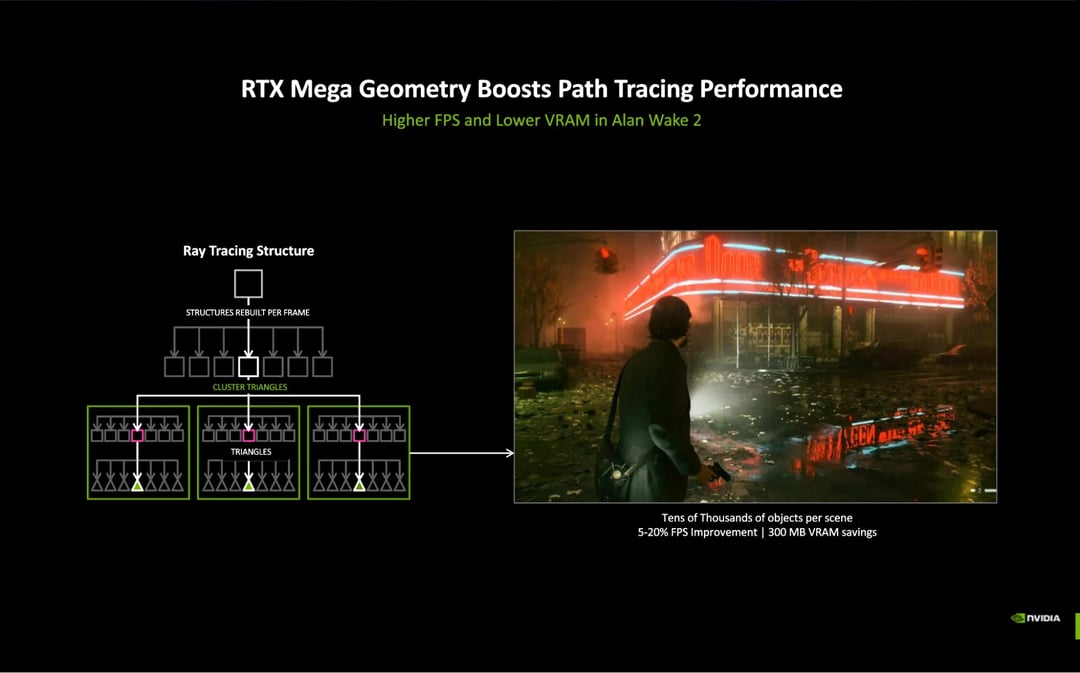
Nvidia’s RTX Mega Geometry builds on that foundation by optimizing how those polygons interact with ray tracing. In the presentation, Nvidia explains that updates to RTX Mega Geometry are meant to enable high-quality path tracing in dense forests, something it describes as a first for scenes of this kind.
This matters because forests are one of the hardest environments to render well. Trees, branches, needles, and layered vegetation all add up quickly, and traditional approaches can struggle to maintain both detail and performance.
Dense forest path tracing in The Witcher 4 demo
The scene uses around 1 million trees
Using The Witcher 4 tree assets, Nvidia showcased a forest scene containing roughly 1 million trees. That scale alone gives a sense of what the company is trying to solve: how to preserve visual complexity across a huge environment without overwhelming the hardware.
Distant trees become voxels while nearby trees reach extreme detail
Nvidia said the demo uses a new voxel-based level-of-detail system. Trees farther away are simplified into basic voxels, while trees close to the camera retain far more detail. At the highest level of detail, individual trees can reach up to 10 million polygons, allowing individual pines to be rendered without depending on flat cards.
That shift in detail is the key to the entire demonstration. Instead of keeping the same geometric burden across the whole scene, the system dramatically simplifies distant elements while preserving dense, high-quality geometry where it matters most.
Performance results on RTX 5090 and RTX 4070
RTX 5090 reaches around 80 fps in 1440p upscaled to 4K
The 5-by-5-kilometer forest scene runs at about 80 frames per second on an RTX 5090 in 1440p, upscaled to 4K. The demo does not include characters or game logic, so the performance figures reflect the rendering workload of the environment rather than a full gameplay scenario.
RTX 4070 runs the scene at about 58 fps with DLSS Balanced
The more striking result is the RTX 4070 figure. Nvidia showed the scene running at roughly 58 frames per second in 1440p using DLSS Balanced mode. In that configuration, the image is upscaled from an internal resolution of 960p, and the workload fits within the GPU’s 12GB of VRAM.
That makes the demo notable not because it targets only top-end hardware, but because Nvidia is presenting path-traced forest rendering on a mid-range graphics card at a frame rate that looks reasonably playable.
How this builds on earlier Unreal Engine 5 work
Epic previously showed UE5 handling thick vegetation with ray tracing
Epic Games previously demonstrated Unreal Engine 5 updates that let developers apply Nanite to trees and other plants. Using character models and scenes from The Witcher 4, Epic and CD Projekt Red showed that UE5 could handle ray tracing in dense vegetation at 60 frames per second on the standard PlayStation 5.
Nvidia pushes the same concept further on PC with path tracing
Nvidia’s demo takes that same basic direction and pushes it further on PC by moving from ray tracing into path tracing. The emphasis is not just on rendering trees with high detail, but on doing so in a way that makes path-traced lighting workable in a thick forest scene.
That’s really the heart of the showcase. It’s less about a finished game sequence and more about demonstrating that the rendering stack can scale to environments that would normally be among the toughest cases for path tracing.
What the demo includes and what it does not
The showcased environment spans 5 by 5 kilometers, but it does not include characters or gameplay logic. That limitation is important because it frames the results correctly. The performance numbers come from a technical environment demo rather than a complete game build.
Even so, the presentation gives a meaningful look at the rendering technology behind the planned PC version of The Witcher 4. It also offers a clearer view of how Nvidia is positioning RTX Mega Geometry and its path tracing tools for future releases.
Open-source plans and future games using the technology
Nvidia plans to open-source the technology later this year. Remedy Entertainment is set to use it in the PC version of Control Resonant, which is scheduled to launch sometime in 2026.
The Witcher 4 is also expected to use path tracing and RTX Mega Geometry, though it is not expected to arrive before 2027.
The bigger takeaway for path tracing on mid-range GPUs
The most important takeaway from the demonstration is that Nvidia is trying to show path tracing in dense forest environments as something that can extend beyond flagship GPUs. The RTX 5090 result is impressive, but the RTX 4070 result is what makes the demo feel more relevant.
A scene with around 1 million trees, a voxel-based level-of-detail system, and close-up assets reaching up to 10 million polygons per tree paints a clear picture of where Nvidia wants PC graphics to go next: more geometric detail, more advanced lighting, and better handling of the kind of heavy foliage that has traditionally been difficult to render well.