
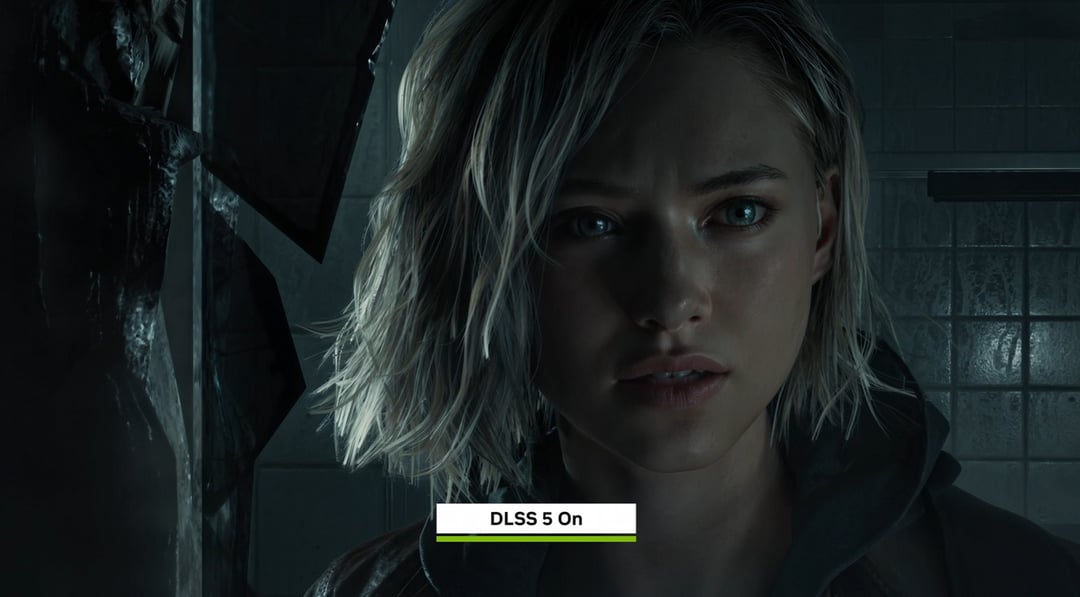
DLSS 5 and the Shift Toward Neural Rendering
You know that moment in a game when the lighting just feels… off? The shadows don’t quite land. Reflections look a little flat. And you can tell it’s still a game.
DLSS 5 is NVIDIA’s attempt to erase that feeling.
At GTC 2026, NVIDIA officially introduced DLSS 5, the next evolution of its Deep Learning Super Sampling technology. But this isn’t just another performance bump. The real shift is something called neural rendering—and that’s where things get interesting.
What Neural Rendering Actually Means for Games
Here’s the big change: instead of relying entirely on traditional rendering methods, DLSS 5 uses AI to generate parts of a scene.
We’re talking about:
- Lighting
- Materials
- Surface detail
- Reflections
In other words, the elements that make a world feel believable.
Rather than calculating every ray of light the old-fashioned way, the system uses trained AI models to help produce photorealistic lighting effects and more accurate material responses. The result? Scenes that look dramatically more lifelike—especially in ray-traced environments—without crushing frame rates.
It’s not just sharper. It’s smarter.
Photorealistic Lighting Powered by AI
Lighting is everything in games. It shapes mood. It defines realism. It tells your brain, “Yes, this world makes sense.”
DLSS 5 leans heavily into this with AI-assisted lighting generation.
Transformational Lighting Improvements
According to reporting from Digital Foundry, NVIDIA described the lighting improvements in its demo as “transformational.” That’s not a small claim.
The neural rendering system enhances how light interacts with:
- Surfaces
- Materials
- Reflections
- Environmental details
Instead of approximating how light should behave, DLSS 5’s AI models generate more convincing results—particularly in complex, ray-traced scenes.
And here’s the important part: it’s doing this while maintaining high frame rates. That balance—visual fidelity and performance—has always been the tension in PC gaming. DLSS 5 is trying to relax that tension.
The Dual RTX 5090 Demo Setup
Now this is where things get a little wild.
The DLSS 5 demo wasn’t running on a typical gaming PC.
Two GeForce RTX 5090 GPUs Working Together
To showcase DLSS 5, NVIDIA reportedly used two GeForce RTX 5090 GPUs:
- One GPU ran the game itself
- The second GPU handled the DLSS 5 neural-rendering workload
That setup tells us something important.
Neural rendering isn’t lightweight. It’s computationally demanding enough that, at least in a demo environment, NVIDIA separated the AI workload from the core game rendering pipeline.
For enthusiasts and industry watchers, this raises real questions about hardware requirements and optimization. But it also signals just how ambitious DLSS 5 really is.
RTX 50-Series GPUs and DLSS 5 Availability
NVIDIA hasn’t officially confirmed which GPU architectures will support DLSS 5 across the board. What we do know is this:
DLSS 5 will arrive alongside the RTX 50-series GPUs later this year.
Expected Rollout Timeline
Based on reported details:
- DLSS 5 is tied to the RTX 50-series launch
- The feature is expected to roll out around Fall 2026
That timing aligns DLSS 5 directly with NVIDIA’s next-generation hardware push. And that makes sense. Neural rendering at this level likely depends on architectural advancements in the 50-series cards.
If DLSS has been a pillar of NVIDIA’s ecosystem, DLSS 5 looks like the next foundational upgrade.
How DLSS 5 Builds on NVIDIA’s AI Graphics Ecosystem
DLSS has already become central to modern PC gaming. It reconstructs higher-resolution images and boosts performance using AI models running on RTX GPUs.
DLSS 5 doesn’t replace that foundation—it expands it.
From Super Sampling to Scene Generation
Earlier versions of DLSS focused on:
- Upscaling resolution
- Generating additional frames
- Improving performance efficiency
DLSS 5 pushes beyond reconstruction. It actively participates in scene creation.
By introducing neural rendering techniques, NVIDIA is shifting AI from a performance enhancer to a visual co-creator inside the rendering pipeline.
That’s a meaningful evolution.
And if it scales well beyond demo environments, it could redefine how developers approach lighting, materials, and ray tracing altogether.