
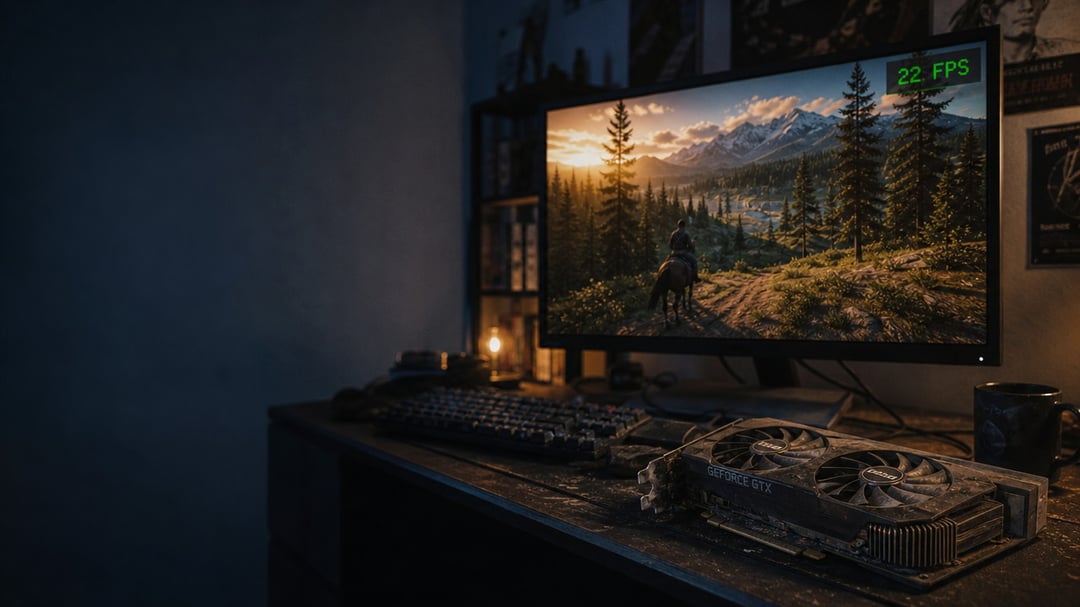
You check the store page. Minimum spec: GTX 1650. You're comfortably above that. You buy the game, load into the first open area, and watch the frame counter settle at 22.
Nothing's broken. You just read the number wrong.
What "Minimum Requirements" Actually Promises
Minimum specs are a promise that the game will launch. That's the entire promise. The unwritten contract underneath is 1080p, low preset, somewhere around 30fps — and increasingly, that's measured with upscaling already switched on and not mentioned anywhere on the page.
Publishers set that floor at the widest install base they can defend, not at a good experience. Forza Horizon 6 lists a GTX 1650 at 1080p Low, a 2019 card running a 2026 open-world racer with a map five times the size of Horizon 5's — real optimization work, and still a potato tier by any honest measure.
Read minimum as a floor. Read recommended as the number someone actually tested and enjoyed.
The GPU Floor Is Lower Than the Panic Suggests
Here's what most people are actually gaming on. As of the June 2026 Steam Hardware Survey, the RTX 4060 Laptop GPU is the single most common graphics card at 3.81%, ahead of the desktop RTX 3060 at 3.73% — the first time in the survey's history that mobile silicon has taken the top spot. Combined RTX 40- and 50-series share still sits below 30% of all discrete GPUs.
That's not a footnote. That's the market developers ship into, and they cannot afford to ignore it.
Cards like the RTX 3060 and 3070 are approaching six years old and remain the backbone of PC gaming — a longevity that would have been unthinkable a generation ago. Upscaling is the usual explanation, and it's the right one. DLSS, FSR, and XeSS stopped being a bonus and became infrastructure. Your card renders at 1080p internally and hands you a 1440p image.
So the practical GPU floor for modern games: an RTX 3060 or RX 6600-class card gets you 1080p at high settings with upscaling engaged. Below that you're living on low presets.
The real pinch isn't raw compute. It's VRAM. An 8GB card doesn't collapse — it just makes you turn textures down, and textures are the setting you notice.
The Three Things That Actually Gate You
Ray tracing capability is now a ticket, not a toggle
This is the shift that matters most and gets discussed least. Indiana Jones and the Great Circle set the precedent by putting a ray-tracing-capable GPU in its minimum requirements. GTA 6's ray-traced global illumination reads as a core visual pillar rather than an optional setting, and ray tracing roughly doubles the GPU you need for the same resolution and frame rate.
In plain terms: a GTX 1080 Ti was a monster in its day. It cannot launch these games. Not "runs badly" — won't start. If you're on pre-RTX hardware, this is the wall, and no amount of settings tweaking climbs it.
An SSD, and there's no argument left
HDDs are essentially gone for gaming in 2026, and SSDs now appear in minimum specs rather than recommended ones. Modern streaming architecture assumes fast storage. Run one of these games off a spinning disk and you get texture pop-in and traversal stutter that no graphics card fixes.
Good news: this is the cheap fix. Budget 1TB PCIe 4.0 drives still land around $70–90.
16GB of RAM — and a genuinely painful footnote
16GB remains the most common memory configuration on Steam at 40.86%, with 32GB close behind at 37.55%. 8GB is finished. 16GB is the working floor and 32GB is the comfortable answer.
Now the twist. The cheapest component in a gaming PC became one of the most expensive, and it happened in months. TrendForce revised its Q1 2026 forecast for PC DRAM contract prices to a 105–110% quarter-over-quarter increase — the steepest single-quarter surge on record — driven by AI data centers absorbing memory production. Suppliers have warned the shortage runs through at least 2027.
Which flips the usual advice. If you have 16GB and your games run, this is the worst moment in a decade to buy more for the sake of it. Put the money in the GPU and wait out the memory market.
The Parts You're Probably Overthinking
CPU anxiety is mostly misplaced. Six-core processors are still the most common configuration among Steam gamers, with eight-core adoption climbing steadily — and six cores clears the bar for the large majority of titles.
Where the CPU genuinely bites is narrower than people think: dense simulation, sprawling open worlds, and streaming while you play. Flight Simulator 2025 streams 2.5 petabytes of map data in real time and will hit your CPU ceiling before it troubles your GPU.
On memory speed, DDR5-6000 is the sensible target. The step from JEDEC 4800 to 6000 is meaningful; the step from 6000 to 7200 is a rounding error.
And Windows 10 still runs games perfectly well. Microsoft ended free security support in October 2025, so that's a security decision rather than a performance one.
Placing Your Own Rig in Ninety Seconds
Skip the spec sheet. Use the method:
- Pick an honest target. 1080p at 60fps is the mainstream goal. No apology required.
- Check ray tracing capability first. It's binary. It decides whether the rest of the conversation happens at all.
- Check VRAM second. 8GB means textures come down a notch.
- Treat upscaling as the default, not a defeat. The whole industry already does.
- Benchmark against a known-brutal title rather than trusting a store page.
The number on that page was never a promise. It's a floor a legal team approved. The spec you actually need is the one that runs the game you're actually playing at a frame rate you can live with — and in 2026, that's usually a card you already own with upscaling switched on.