
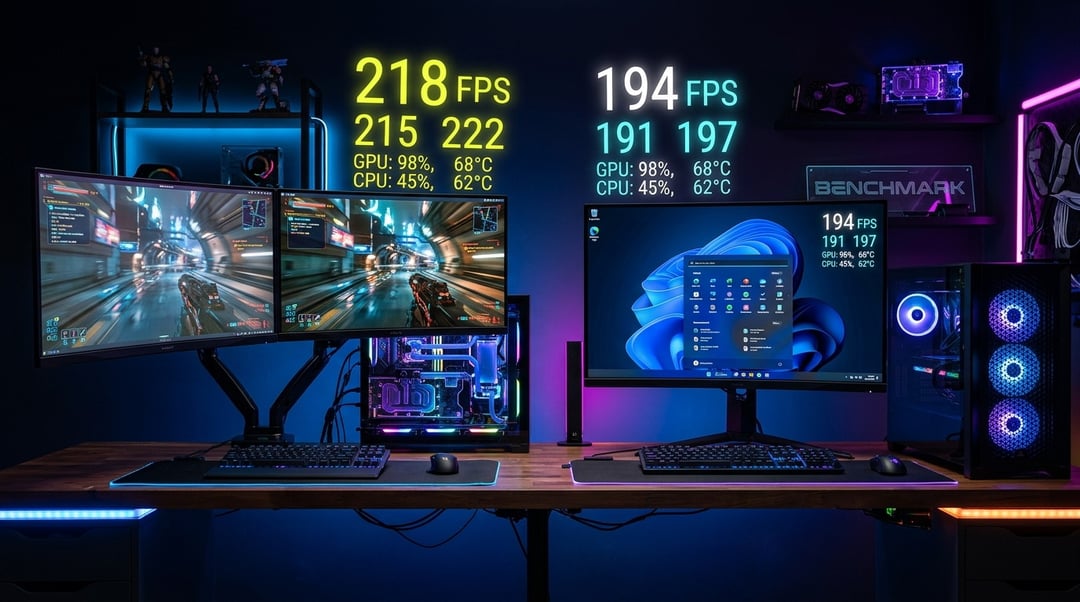
CachyOS Shows Strong Linux Gaming Results Against Windows 11
Recent head-to-head testing suggests Linux gaming is no longer sitting far behind Windows. In a comparison covering more than 10 major games, the Arch-based distribution CachyOS often delivered better gaming performance than Windows 11, even though the games in the test did not include native Linux versions.
That detail matters. These results were achieved through Proton, Valve's compatibility layer for running Windows games on Linux. Instead of acting like a rough workaround, Proton appears to be delivering performance that is competitive and, in several cases, clearly ahead.
Test System and Software Configuration
The comparison used the same hardware on both operating systems. The setup included:
- AMD Ryzen 5 5600X
- Radeon RX 6700 XT
- 16GB DDR4 memory
- 2TB NVMe SSD
- Corsair RM1000x power supply
- Gigabyte X570 Aorus Elite motherboard
On the software side, Windows 11 used AMD Adrenalin 26.3.1 drivers, while CachyOS used Mesa 26.0.3.
Game Benchmark Results on CachyOS and Windows 11
Crimson Desert Performance
In Crimson Desert, Windows 11 averaged 59 FPS. CachyOS reached 63 FPS. Linux also posted stronger 1% low performance, which points to fewer severe frame drops during gameplay.
Warhammer 40,000: Space Marine 2 Results
The gap widened more noticeably in Warhammer 40,000: Space Marine 2. Windows 11 reached 68 FPS, while CachyOS climbed to 81 FPS. Linux again produced better 1% lows, adding to the sense of smoother overall performance.
Red Dead Redemption 2 at 1080p Max Settings
Red Dead Redemption 2 also ran faster on CachyOS. At 1080p with Max settings, Linux averaged 85 FPS, compared with 81 FPS on Windows 11.
Cyberpunk 2077 at 1080p Ultra Without Upscaling
Cyberpunk 2077 showed another Linux win. At 1080p Ultra without upscaling, CachyOS hit 98 FPS, while Windows 11 reached 91 FPS.
The First Descendant Favors Windows 11
The First Descendant did not follow the same pattern. Tested at 1080p Ultra with FSR 3 Native upscaling, Windows 11 performed better at 63 FPS. CachyOS trailed at 54 FPS.
The Division 2 Delivers Mixed Results
The Division 2 landed in the middle. Both platforms averaged 128 FPS, but Windows held a small advantage in low-frame performance, posting 97 FPS lows compared with 93 FPS on Linux.
Why Proton Performance on Linux Stands Out
These Games Were Not Built for Linux
One of the biggest takeaways is that none of the tested games were native Linux titles. Every result came through Proton. That makes the outcome more notable, because the performance gains were not limited to software designed specifically for Linux.
Linux Often Led by 3% to 10%
Across most of the tests, CachyOS came out ahead. The performance advantage was often in the range of roughly 3% to 10% over Windows 11. Side-by-side comparisons further highlighted how far Proton has come as a gaming solution.
How Linux Gaming Has Changed
A decade ago, Linux gaming was mostly associated with niche open-source titles like SuperTuxKart or The Battle for Wesnoth. That picture looks very different now. Ongoing optimization in Proton, along with work from community-focused distributions such as CachyOS, has reduced much of the long-standing performance gap with Windows.
In some cases, the gap does not just look smaller. It looks reversed.
What These Results Mean for Windows 11 vs Linux Gaming
Windows still holds the advantage in broader developer support. That remains an important part of the discussion. But when a compatibility layer can match or outperform the platform games were originally built for, the old assumption that Windows is automatically the best OS for gaming starts to feel much less certain.
The results do not show a universal Linux win in every title. Some games still favor Windows, and some produce near-identical outcomes. But the bigger shift is hard to miss: Linux gaming is now part of a real performance conversation, not a side note.