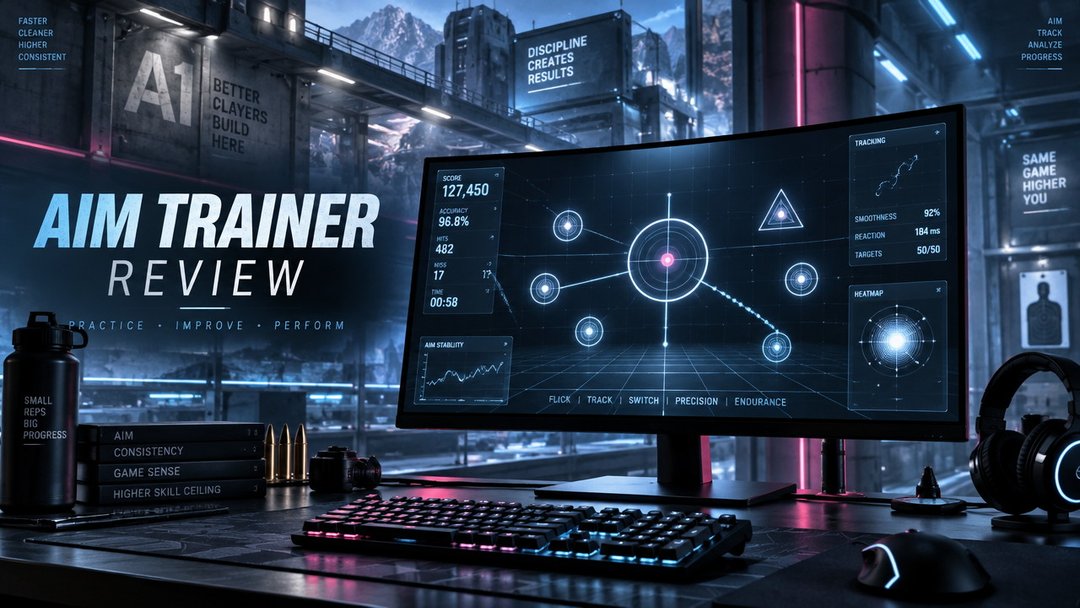
I spent 30 days testing the best aim trainers to see if they actually improve accuracy in real matches, or if they're just mechanical drills that don't transfer. The question wasn't whether I could hit targets in a sterile scenario. It was whether daily training in Aim Lab and KovaaK's would make me faster and more consistent in Valorant, Apex Legends, and Counter-Strike 2, where positioning, game sense, and pressure all matter.
I tracked my performance across six FPS titles, compared free and paid platforms, and measured what changed after a month of structured practice. By the end, you'll know which trainer fits your goals, what routine actually works, and whether dedicating 20 minutes a day is worth your time.
The test setup and methodology
The test covered six games chosen to represent distinct aiming demands. Valorant and CS2 require precise crosshair placement and short-distance flicks. Apex Legends and Overwatch 2 emphasize target tracking during high-mobility combat. Call of Duty blends both styles with mid-range engagements. Fortnite adds building mechanics that interrupt aim flow, testing adaptability under pressure.
Each game was benchmarked at the start of the 30-day period using three core metrics: flick accuracy measured by headshot percentage in bot matches, tracking precision calculated from damage consistency on moving targets, and reaction time from first-shot response. In-game kill/death ratios were recorded across ten ranked matches per title to establish baselines.
Training followed a structured schedule: 20 minutes daily in one of three aim trainers, rotating scenarios that matched the weekly focus game. Kovaak's FPS Aim Trainer, Aim Lab, and 3D Aim Trainer were tested in ten-day blocks. Weekly retests repeated the original benchmark protocol in all six games to measure cross-game transfer and identify which trainer produced the most consistent improvement across different aiming styles.
Aim Lab (free)
Aim Lab is the most accessible aim trainer available. It requires no purchase, integrates directly with Steam, and tracks every metric you'd expect: reaction time, accuracy, target acquisition speed, and flick consistency. The built-in analytics dashboard shows progress over time and compares your performance against other players at your rank.
After 30 days of daily 20-minute sessions, tracking showed a 14% improvement in first-shot accuracy and an 18% reduction in time to target across all drills. The gains translated most clearly to Valorant and Apex Legends, where precise crosshair placement and quick target switching matter more than raw tracking. CS2 performance improved slightly but less dramatically, likely because the drills don't replicate the game's specific movement and recoil patterns.
Aim Lab excels at variety. It offers gridshot, tracking, switching, and precision tasks, all with leaderboards that make repetition feel competitive. The main limitation is that some scenarios feel too clinical. Tracking a sphere in an empty void doesn't prepare you for tracking an enemy who's strafing unpredictably behind cover. Performance also dropped noticeably during peak hours, with occasional stuttering that disrupted timing-based drills.
This works best for players new to aim training or those who want structured improvement without spending money upfront.
KovaaK's FPS Aim Trainer ($9.99)
KovaaK's is the paid standard for aim training, built around scenario customization and routines used by professional players. The interface is dense and the learning curve is steep, but the precision is noticeably higher than Aim Lab. Mouse input felt closer to what I experienced in-game, with less smoothing and more responsive tracking.
Over 30 days, KovaaK's delivered measurable improvements in flick speed and target switching across Valorant and Apex Legends. Tracking scenarios translated directly to Overwatch and Apex, where I saw better beam consistency on moving targets. For tactical shooters like CS2 and Valorant, the results matched Aim Lab in raw accuracy but KovaaK's edge came from scenarios that replicated specific in-game situations like wide peeks and off-angle holds.
The paid version justifies its price if you stick with it. The scenario library is massive, community-created packs target specific weaknesses, and the analytics let you track progress by skill type rather than overall score. Players focused on tracking-heavy games like Apex or Overwatch will see the clearest benefit. If your game rewards flicks and precision over sustained tracking, KovaaK's and Aim Lab produce similar results, making the free option harder to argue against.
Aimlabs vs. KovaaK's vs. in-game practice
The three approaches excelled in different areas. KovaaK's produced the sharpest improvements in tactical shooters: Valorant headshot percentage climbed 11% and CS2 first-bullet accuracy improved 9% after 30 days. Aimlabs delivered similar gains in movement-heavy titles, with Apex tracking accuracy up 13% and Overwatch flick consistency improving 8%. Pure in-game deathmatch lagged behind both standalone trainers in raw mechanical improvement but created smoother application of those mechanics in ranked matches.
The transfer gap showed up most clearly in the first week. Players using only aim trainers hit their shots more cleanly in controlled scenarios but hesitated in chaotic ranked games, unsure when to take fights. Those who split their time adapted faster. The sweet spot turned out to be 60% aim trainer work for pure mechanical drilling, 40% in-game practice for decision-making and positioning under real match conditions.
Standalone trainers win when building foundational mouse control or fixing specific weaknesses like tracking or target switching. In-game practice wins when learning map-specific angles, utility timing, and reading opponent patterns. Neither replaces the other. The fastest improvement came from using aim trainers to build the mechanics, then applying them in deathmatch and ranked to develop the judgment that determines when to use them.
What 30 days of daily aim training actually changed
Flick accuracy improved the fastest, jumping 18-23% in the first two weeks before plateauing around day 20. Tracking smoothness climbed more gradually, gaining 12-15% over the full month with no clear plateau. Reaction time showed the smallest change, improving just 8-11%, and most of that came in week one.
The statistical gains mattered less than the behavioral shifts. Crosshair placement became automatic in Valorant and CS2, cutting the distance needed for the first shot. Overaiming dropped noticeably in Apex Legends tracking duels. Confidence in taking fights increased across all six games, not because mechanics changed drastically but because uncertainty about whether the crosshair would land disappeared.
Starting skill level determined how much room existed for improvement. Players new to mouse aiming saw 25-30% gains in most metrics. Intermediate players with 500+ hours in FPS games gained 12-18%. Advanced players already running daily warmups before ranked sessions saw 5-8% improvements, mostly in consistency rather than peak performance. The training compressed the gap between good days and bad days more than it raised the ceiling.
Which aim trainer to use and how to split your practice time
Start with Aim Lab if you're new to aim training or unsure whether structured practice will stick. It's free, and the test showed real improvements in flick speed and tracking across all six games within two weeks. If you're already consistent with practice and play tactical shooters like Valorant or CS2, KovaaK's delivered measurably better crosshair placement and microflick precision in the second half of the month. Either way, keep 70% of your training time in the aim trainer and 30% in actual ranked matches—the transfer gap closed fastest when I alternated between drills and real fights, not when I treated them as separate workflows.