
Best Used Graphics Card Deals Worth Buying in 2026

Best Used GPU Deals to Buy in 2026

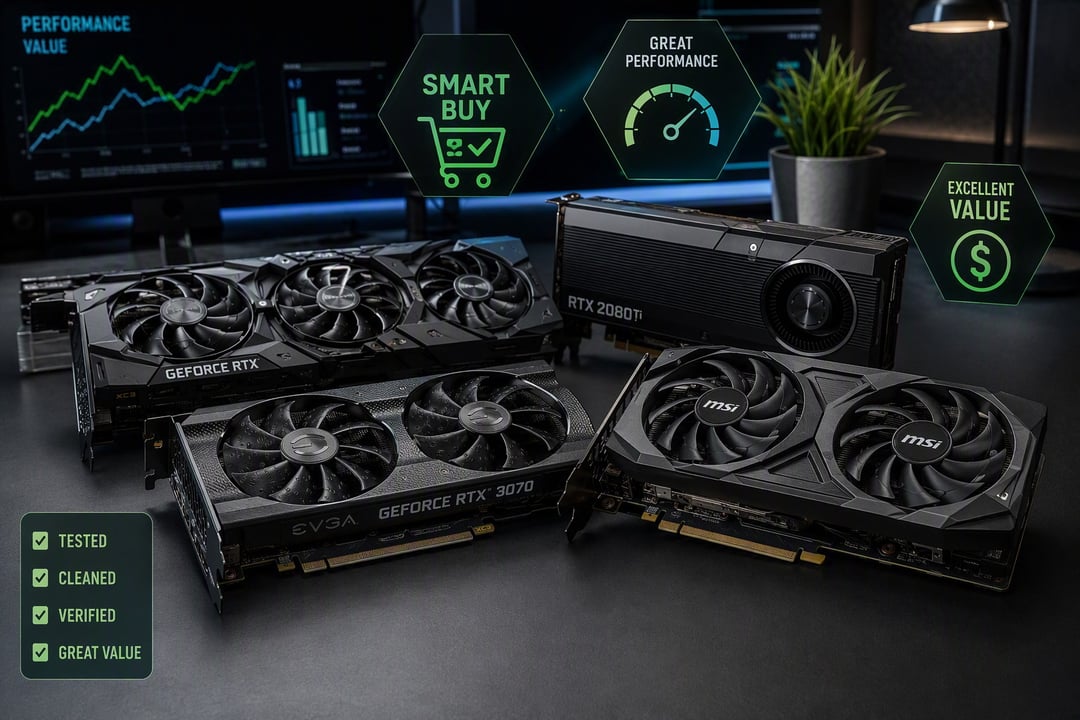
Buying a used GPU in 2026 can save hundreds, but the wrong listing may leave you with outdated features, excessive power draw, or a card worn down by years of heat. This guide to the Best Used Graphics Card Deals Worth Buying in 2026 focuses on models that still deliver strong gaming value without overlooking condition, pricing, warranty coverage, and modern features.

We rank the GeForce RTX 4070 Super, Radeon RX 7800 XT, GeForce RTX 3080 10GB, GeForce RTX 3060 Ti, and Radeon RX 6700 XT by real-world performance, VRAM, efficiency, ray tracing, upscaling support, and typical second-hand pricing. By the end, you’ll know which used GPU best fits your resolution, budget, and upgrade plans.

How We Ranked These Used Graphics Card Deals

Value and Performance Criteria

We weigh each card’s current US used price against gaming performance, VRAM, power efficiency, feature support, driver longevity, and resale value. Price targets use recent completed sales on reputable marketplaces such as eBay and current established-refurbisher listings; verify live 2026 pricing before publication. Include shipping, tax, and marketplace fees, then favor cards offering meaningful savings over new alternatives.

Rankings also reflect the buyer’s needs. A cheaper 1080p high-refresh card should not outrank a stronger 1440p or 4K option solely on price. Match each card to resolution, refresh rate, settings, budget, and whether ray tracing, upscaling, or AV1 encoding matters.

Used-Market Risk Checks

Condition can erase a bargain. We assess seller history, return protection, warranty transferability, repair records, fan noise, temperatures, physical damage, and evidence of sustained cryptocurrency mining. Testing proof and a return window may justify paying more for a clean card. Missing warranty, vague photos, or overheating signs should reduce both the acceptable price and expected resale value.

GeForce RTX 4070 Super

Why It Ranks First

The RTX 4070 Super is the strongest all-around used choice for high-refresh 1440p and entry-level 4K gaming, provided its price is clearly below comparable new-generation cards. Its 12GB of VRAM handles demanding textures well, while DLSS 3 frame generation can improve smoothness in supported games. Strong ray-tracing performance, relatively modest power consumption, and broad software support also make it useful beyond gaming. CUDA compatibility benefits video editing, 3D rendering, image generation, and other modern creative or AI workloads.

Fair Used Price and Buying Checks

In the United States, a realistic used range is roughly $425–$525, varying with cooler design, condition, and included packaging. At the upper end, demand at least a 15–20% discount versus a newer card offering similar performance; otherwise, paying more for current-generation hardware is usually the better warranty and longevity decision. A clean $450 listing with transferable coverage is more compelling than a heavily used $400 card with uncertain history.

Before buying, verify:

  • Gaming temperatures and hotspot readings under sustained load
  • Fan noise, bearing rattle, and whether all fans start correctly
  • The 12VHPWR adapter or power connectors for looseness, scorching, or melted plastic
  • Warranty transferability using the serial number
  • PCB, bracket, heatsink, and backplate damage, plus corrosion or repair marks

Radeon RX 7800 XT

Best 1440p Value

The RX 7800 XT is a strong used-market choice for traditional rasterized gaming, particularly when 16GB of VRAM matters more than premium ray-tracing features. At 1440p, it generally delivers performance in the same broad class as the RTX 4070 Super in conventional titles, while its larger memory buffer can provide more headroom for high-resolution textures and future releases. A sensible used-price ceiling is about $400; above that, its value advantage over newer Radeon cards and competing GeForce options becomes difficult to justify.

At 4K, the gap depends heavily on the game and settings. The card can produce playable results with tuned quality presets, but the RTX 4070 Super is usually the stronger option in ray-traced workloads and in games supporting DLSS rather than FSR. DLSS often delivers better image stability at comparable performance, making the GeForce card more attractive for demanding 4K or RT use.

Limitations to Consider

  • Higher power consumption than the RTX 4070 Super means greater heat and case airflow demands.
  • Ray-tracing performance is a clear weakness, especially when upscaling support favors DLSS.
  • Inspect fans, fins, and shroud damage, then verify temperatures under load; unusually high hotspot readings can indicate degraded thermal paste or mounting problems.

GeForce RTX 3080 10GB

Why It Still Delivers

The RTX 3080 remains a compelling used performance deal for high-refresh 1440p or budget 4K gaming, but only when its asking price is substantially discounted. Its strong rasterization performance handles demanding 1440p settings comfortably, while capable ray-tracing performance and DLSS support can preserve smoother frame rates in supported games. That combination makes it more versatile than many similarly aged cards, and broad availability across the US secondhand market makes it easier to compare condition, warranty status, and seller history.

The value case is strongest when the card can deliver near-premium performance without approaching the cost of newer hardware. Before buying, request:

  • The exact model and original power connectors
  • A recent gaming or stress-test temperature report
  • Evidence that all fans start, stop, and operate without grinding
  • Confirmation of the power supply’s wattage and required connector setup

When to Walk Away

The 10GB VRAM capacity limits longevity, particularly at 4K with high-resolution textures, heavy ray tracing, or poorly optimized new releases. Its high power draw also produces substantial heat, increasing demands on the case and power supply. Aging thermal pads can worsen memory temperatures even when the core temperature appears acceptable. Avoid listings that conceal temperatures, show unstable fan behavior, use questionable adapters, or cannot establish whether the card endured heavy cryptocurrency mining.

GeForce RTX 3060 Ti

Best Budget Nvidia Pick

The RTX 3060 Ti is a sensible used purchase for affordable 1080p and 1440p gaming when Nvidia features matter but current midrange 2026 pricing does not fit the budget. DLSS can improve frame rates in supported games, while its raster performance remains strong per dollar for high settings at 1080p and sensible settings at 1440p. Compact dual-fan versions are widely suited to modest gaming PCs with smaller cases and mainstream power supplies.

Set a strict used-price target of $220 or less for a tested, fully working card with no abnormal fan noise or overheating. At $240–$260, the deal should usually be rejected if a newer GPU with 12GB or more VRAM is available for only a small premium. That extra capacity and newer feature support provide more useful longevity than saving a few dollars.

Performance Expectations

Expect smooth 1080p play and generally capable 1440p performance, especially when DLSS is available. The 8GB framebuffer is the main limitation: demanding newer games may require reduced textures or settings, and 4K gaming is better treated as an occasional compromise than a target. Its headroom also narrows as heavier ray tracing and larger assets become normal.

Radeon RX 6700 XT

Best Low-Cost 12GB Option

The RX 6700 XT remains a value-focused choice for 1080p and standard 1440p gaming when 12GB of VRAM matters more than ray tracing. Its larger memory buffer helps in high-texture releases and supports longer settings headroom than cards restricted to 8GB. Target a used price of $220 or less; around $200 is preferable because this GPU is aging, has weaker ray tracing, and uses an older media-engine feature set without modern AV1 encoding.

Against the RTX 3060 Ti, the RX 6700 XT is generally the better fit for rasterized games, open-world titles, and texture-heavy 1440p workloads. The RTX 3060 Ti is preferable for ray-traced games, DLSS-supported releases, and users who stream or edit video using newer Nvidia media features. At this price, the Radeon’s value depends on playing mostly conventional raster workloads rather than demanding RT presets.

Deal-Breakers

Before buying, request a repeatable gaming or benchmark test and check:

  • Stable core and memory clocks without crashes or driver resets
  • No reported memory errors, flickering, or texture corruption
  • Hotspot temperatures that do not climb excessively under sustained load
  • Fans without grinding, clicking, or severe bearing noise
  • A clearly stated return window covering testing after delivery

Avoid listings that provide only idle screenshots or refuse return protection.

Buying considerations

Start by setting a realistic price ceiling based on your resolution, refresh rate, and the games or applications you use most. For 1440p gaming, prioritize the RTX 4070 Super or RX 7800 XT when their prices are close; older cards such as the RTX 3080 and RX 6700 XT become compelling only with a meaningful discount. The RTX 3060 Ti remains a sensible budget option, but its lower VRAM can limit longevity.

Next, verify the card’s condition before paying. Ask for benchmark results, temperatures, fan noise, and proof that all outputs work. Inspect photos for corrosion, damaged connectors, or excessive dust, and favor sellers offering returns or remaining warranty coverage. Finally, confirm your power supply has the required capacity and connectors. A slightly cheaper card is not a deal if it needs immediate repairs or a PSU upgrade.


Join the Community

Get the latest tech news, reviews, and exclusive insights delivered straight to your inbox. Join a community of tech enthusiasts who trust Informer Tech.

Weekly digest

No spam

Unsubscribe anytime