
The Best Drones for Beginners in 2026 That Are Actually Easy to Fly

Best Beginner Drones in 2026 (Actually Easy to Fly)

Most people's first drone flight goes one of two ways: it either lands safely back in their hand, or it disappears into a tree, a pond, or a neighbor's roof within the first minute. For years, that second outcome was the norm. Beginner drones demanded steady hands and quick reflexes that new pilots simply didn't have yet.

That's no longer the case. In 2026, auto-stabilization, GPS positioning, and obstacle sensing have matured to the point where "easy to fly" is a legitimate product category, not just marketing language. The best beginner drones now do much of the flying for you, correcting drift, holding position, and stopping short of obstacles automatically. Below are seven real, currently available models that make good on that promise, organized by budget and use case rather than raw specs.

What Actually Makes a Drone Beginner-Friendly in 2026

A handful of features separate a genuinely beginner-friendly drone from one that just looks like it should be. One-key takeoff and landing removes the two moments where new pilots are most likely to overcorrect and crash. GPS or position hold keeps the drone stable in one spot the moment you let go of the sticks, instead of letting it drift with the wind. Obstacle sensing, once a premium feature, is now common even on mid-range models, giving the drone a chance to stop or steer around something before you can react.

Weight matters too. Drones under 250 grams generally fall into lighter regulatory categories in the US, UK, and EU, which usually means simpler registration requirements. Rules do vary and change, so it's worth checking current local regulations before you fly, but as a general rule, lighter drones mean less paperwork.

The 7 Best Beginner Drones in 2026

DJI Ryze Tello — Best for Absolute First-Timers or Kids

The Tello is about as low-stakes as drones get. It's small, comes with propeller guards, and is controlled entirely through a smartphone app. There's no GPS and no camera to speak of beyond a basic one, but that simplicity is the point. It's an inexpensive way to learn the fundamentals of flight without worrying about an expensive repair bill after an inevitable early crash.

Holy Stone HS900 — Best Budget Camera Drone

The HS900 represents a real step up for Holy Stone, with noticeably better image quality and flight performance than the brand's earlier budget models. It sits in a sweet spot for someone who wants to start capturing photos or video without jumping straight into DJI pricing.

DJI Neo — Best No-Controller Option

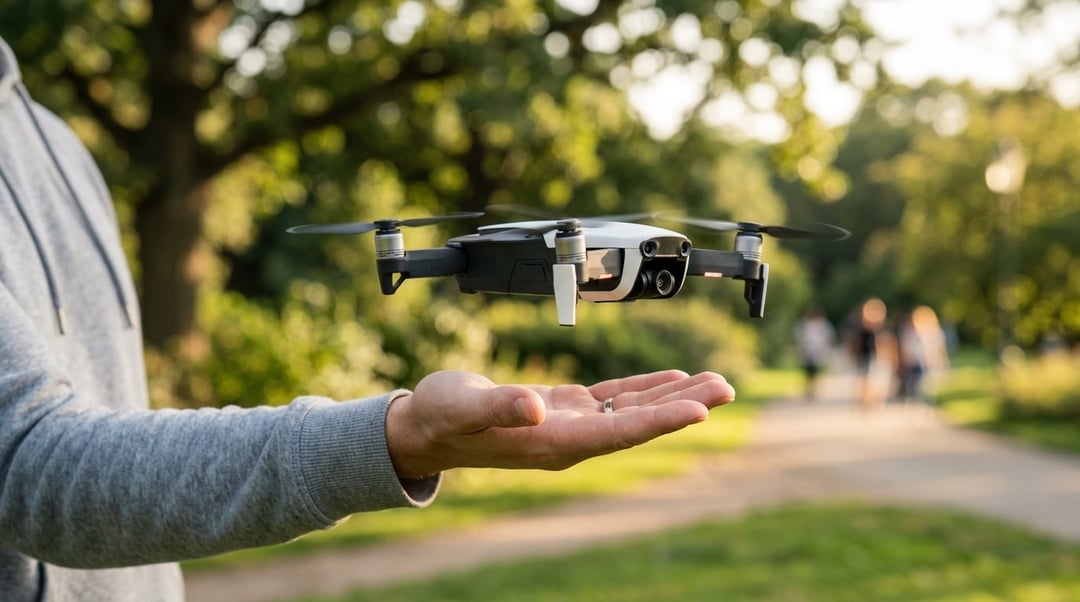
The Neo can launch from the palm of your hand and fly itself through basic shots using AI subject tracking, no remote required. A phone or an optional controller adds more precise control when you want it. Flight time per battery is short, so plan on picking up spares, but for sheer approachability, it's hard to beat.

Potensic Atom — Best Budget Alternative to DJI

The Atom is built to compete directly with DJI's entry-level lineup at a lower price. GPS-assisted stability gives new pilots the same drift-free hovering that's become standard on pricier drones, without the DJI price tag attached.

DJI Mini 4K — Best Affordable 4K Entry Point

This is DJI's first genuinely entry-level model to include 4K video capture, and the image quality holds up well against its price point. It's a natural pick for someone who's flown a basic trainer drone already and wants their next one to double as a real camera.

DJI Flip — Best for Safety-Conscious Beginners

At roughly $355 and 249 grams, the Flip pairs a 4K camera with built-in propeller guards that make it genuinely difficult to damage furniture, pets, or fingers during those early, less-controlled flights. Its main weakness is wind resistance, so it's better suited to calm days or indoor spaces.

DJI Mini 5 Pro — Best Overall Beginner Drone

The Mini 5 Pro is the drone most worth growing into. It stays under the 250-gram threshold, carries a 1-inch sensor capable of RAW image capture, and can fly for around 36 minutes per battery, all well beyond what most beginner drones offer. The tradeoff is that its light frame can struggle in strong wind. For a beginner who wants a drone they won't outgrow in six months, it's the strongest all-around pick on this list.

How to Pick the Right One for You

The right choice depends less on specs and more on how you'll actually use it. A budget under $100 points toward the Tello or the Holy Stone HS900. Anyone who wants to skip fiddly controls entirely should look at the DJI Neo. If photo and video quality matters most, the Mini 5 Pro is the clear leader. And if you're flying around kids, pets, or tight indoor spaces, the Flip's protective cage earns its keep.

The Bottom Line

Skip the temptation to buy based on the spec sheet alone. Buy for the environment you'll actually be flying in, and the right drone on this list will make your first flight look easy, because it genuinely is.


Join the Community

Get the latest tech news, reviews, and exclusive insights delivered straight to your inbox. Join a community of tech enthusiasts who trust Informer Tech.

Weekly digest

No spam

Unsubscribe anytime