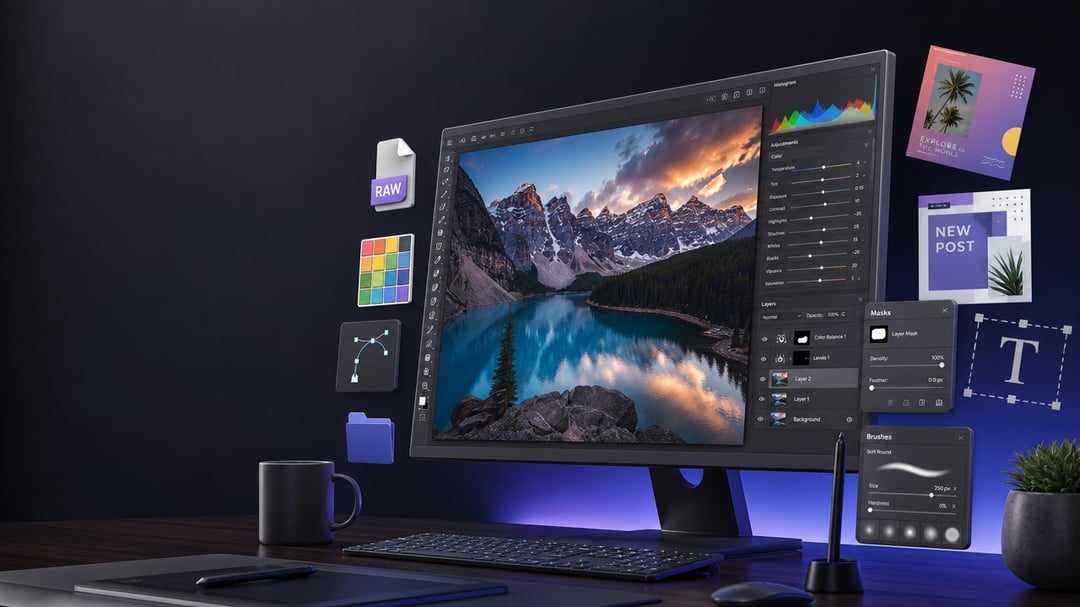
Best Free Photoshop Alternatives: 7 Powerful Editors Worth Using

7 Best Free Photoshop Alternatives for Photo Editing

Photoshop is still the name most people reach for when they need to edit an image. But paying for a subscription does not make sense for everyone. Maybe you need to clean up product photos, design social posts, edit a layered PSD file, or work through a folder of RAW images. The right free tool can handle that job surprisingly well.

The catch is simple: no single free app matches every part of Photoshop. Some excel at photo retouching. Others make digital painting feel effortless. A few work right in your browser when you just need to finish something quickly.

Here are the best free Photoshop alternatives, with a clear look at where each one shines and where it falls short.

What Makes a Good Free Photoshop Alternative?

Photoshop does a lot under one roof: image retouching, compositing, typography, digital painting, layer management, masking, color correction, and more. That makes “Photoshop alternative” a broad label.

A useful free alternative should offer at least some combination of layers, selection tools, masks, color controls, flexible exports, and reliable performance. But your choice should start with the kind of work you actually do.

A photographer working with RAW images needs non-destructive exposure and color adjustments. A YouTube creator may only need thumbnails and background removal. An illustrator needs responsive brushes and tablet support. And someone opening a client’s PSD needs compatibility above almost everything else.

1. GIMP: Best Overall Free Photoshop Alternative

GIMP has been the standard recommendation for free Photoshop-style editing for years. There’s a reason for that. It is a fully free, open-source desktop editor with serious image-manipulation tools and support for Windows, macOS, and Linux.

You get layers, masks, blend modes, selection tools, paths, brushes, filters, retouching controls, and a large library of community plugins. It can handle everything from basic image resizing to detailed composite artwork. For users who want their work stored locally instead of inside a browser workspace, that matters.

GIMP is also a good long-term choice because it does not lock you into a monthly fee. You can learn its workflow once and keep using it as your needs grow.

Still, it has a learning curve. Its interface does not feel exactly like Photoshop, so experienced Adobe users may need time to rebuild familiar habits. PSD files can open in GIMP, though complex documents may lose Adobe-specific features such as smart objects, adjustment behavior, or advanced effects.

Who Should Use GIMP?

GIMP works well for bloggers, students, marketers, small businesses, and anyone who wants a capable desktop image editor without paying for creative software.

  • Best for: Layer-based editing, retouching, composites, and offline work
  • Pros: Fully free, open source, cross-platform, highly capable
  • Cons: Interface can feel unfamiliar; complex PSDs may need cleanup

2. Photopea: Best for Editing PSD Files Online

Photopea is one of those tools that feels almost too convenient. Open the website, drag in a file, and you are working in a familiar Photoshop-like editor without installing anything.

It supports PSD files, layers, masks, blending modes, text, vector shapes, smart objects, and a long list of exports, including JPG, PNG, SVG, and PDF. That makes it especially useful when a client sends a PSD and you need to update a headline, swap an image, or export a web-ready version.

The layout will feel comfortable to Photoshop users because it follows a similar panel-based approach. For quick design tasks, it is hard to beat.

But browser-based editing has limits. Large files with dozens of layers can strain your computer, especially on lower-spec machines. The free version also shows ads. That is manageable for occasional work, though it can become distracting during longer sessions.

Who Should Use Photopea?

Choose Photopea if PSD compatibility is your priority or if you need an editor on a shared, school, or work computer.

  • Best for: PSD editing and quick browser-based design work
  • Pros: No install required, familiar interface, strong file support
  • Cons: Ads in the free tier; large projects can feel slow

3. Krita: Best Free Photoshop Alternative for Digital Painting

Krita is built for artists. It can edit images, but its real strength is drawing, painting, and illustration. If Photoshop feels like a crowded workshop, Krita feels more like sitting down at a clean drawing desk with every brush already within reach.

Its brush engine is excellent. You get customizable brushes, brush stabilizers, color-management tools, layers, masks, drawing assistants, and pressure-sensitive tablet support. It also includes animation features, which gives illustrators and hobbyist animators more room to experiment.

Krita is free and open source, with versions for Windows, macOS, and Linux. It is a strong option for comic artists, concept designers, game-asset creators, and anyone who wants to create images from scratch.

It is less suited to heavy RAW photography workflows or high-volume commercial retouching. You can open PSD files, but complex documents should be checked carefully after import.

Who Should Use Krita?

Krita is the right call when your work begins with a blank canvas, a stylus, and an idea that needs shaping.

  • Best for: Digital painting, comics, concept art, and illustration
  • Pros: Excellent brushes, tablet support, animation tools, free forever
  • Cons: Not designed primarily for photo development or retouching

4. Darktable: Best Free Option for RAW Photo Editing

Darktable is not a direct Photoshop replacement. It is closer to Adobe Lightroom, and that distinction matters.

Photoshop edits rendered pixels. Darktable develops RAW files non-destructively. In plain terms, it lets you adjust exposure, color, shadows, lens distortion, noise, and detail without permanently changing the original photo. You can return later, undo a decision, or create a different version without starting again.

That workflow is especially valuable for photographers who shoot weddings, events, landscapes, products, or anything else where the original image needs to stay intact. Darktable also includes asset-management features, so you can organize and process large image libraries.

For more involved retouching, pair Darktable with GIMP. Develop the RAW image in Darktable, export a high-quality TIFF or PNG, then use GIMP for pixel-level edits.

Who Should Use Darktable?

Darktable suits photographers who care about image quality, repeatable edits, and preserving originals.

  • Best for: RAW development and non-destructive photo editing
  • Pros: Powerful exposure and color tools, local workflow, no subscription
  • Cons: Not ideal for compositing, graphic design, or layered retouching

5. RawTherapee: Best for Technical RAW Processing

RawTherapee is another free RAW processor, though it takes a more technical route than Darktable. It gives you detailed control over how your camera’s RAW data becomes a finished image.

You can fine-tune white balance, exposure, sharpening, noise reduction, tone mapping, color, and demosaicing. That last term sounds intimidating, but it refers to how software converts the information from a camera sensor into a full-color image. It can affect fine detail, color accuracy, and texture.

RawTherapee will not feel as friendly as Canva or Pixlr. It is built for people willing to slow down and inspect details. That can be a real advantage for landscape photographers, product photographers, and anyone working with high-resolution files.

Like Darktable, it works best alongside a separate editor for detailed retouching or graphic composition.

Who Should Use RawTherapee?

Use RawTherapee when you want more granular control over RAW image processing and do not mind a denser interface.

  • Best for: Precision RAW development and detailed image rendering
  • Pros: Deep technical controls, strong image-quality tools, free software
  • Cons: A steep learning curve; no full Photoshop-style editing workspace

6. Canva: Best for Fast Marketing Graphics

Canva belongs on this list because plenty of people do not need Photoshop. They need a clean Instagram post, a presentation cover, a sale graphic, or a YouTube thumbnail before the day gets away from them.

Canva uses templates, drag-and-drop design tools, stock assets, text controls, and simple photo adjustments to speed up visual work. It removes a lot of small design decisions that can slow down beginners.

That is Canva’s advantage. It is not trying to give you every pixel-level tool. It is trying to help you publish something polished quickly.

The free plan has limits, and some assets or AI-powered features sit behind a paid plan. It is also not the tool for complex retouching, precise masks, advanced color work, or layered PSD revisions. Still, for content teams and small businesses, it can save a huge amount of time.

Who Should Use Canva?

Canva works best for social media managers, educators, startup teams, and small business owners who need fast, attractive visuals.

  • Best for: Social posts, presentations, flyers, thumbnails, and marketing assets
  • Pros: Very easy to use, templates save time, strong collaboration features
  • Cons: Limited control for advanced editing and high-end retouching

7. Pixlr: Best for Quick Everyday Image Edits

Pixlr sits somewhere between Canva’s simplicity and Photopea’s more advanced workspace. It is browser-based, approachable, and useful for everyday edits that do not need a full desktop application.

You can crop, resize, adjust colors, apply filters, remove backgrounds, create simple collages, and work with layers in Pixlr’s more advanced editor. It is a useful option for making banners, cleaning up product photos, creating blog graphics, or preparing quick images for social channels.

Pixlr is not designed for demanding professional compositing or deeply technical photography work. But that is not really the point. It is built for speed. When you have an image that needs fixing now, a lighter editor often beats a powerful tool that takes an hour to master.

Who Should Use Pixlr?

Pixlr suits users who want a flexible browser editor for fast, practical image work.

  • Best for: Quick edits, thumbnails, banners, and basic product-photo cleanup
  • Pros: Easy access, browser-based, useful layers and effects
  • Cons: Free-tier restrictions; fewer advanced controls than GIMP or Photopea

Which Free Photoshop Alternative Should You Choose?

The best free Photoshop alternative depends on the kind of work sitting in front of you.

  • Choose GIMP for broad desktop editing and image manipulation.
  • Choose Photopea when PSD files and browser access matter most.
  • Choose Krita for illustration and digital painting.
  • Choose Darktable for non-destructive RAW photo editing.
  • Choose RawTherapee for meticulous image processing.
  • Choose Canva for quick marketing design.
  • Choose Pixlr for everyday browser-based image edits.

And honestly, you do not need to force one tool to do everything. A free creative stack often works better. Use Darktable or RawTherapee for RAW development. Use GIMP for final retouching. Use Canva or Pixlr when you need a simple graphic before your coffee gets cold.

Pick two options, test them on a real project, and keep the one that makes your work feel easier.


Join the Community

Get the latest tech news, reviews, and exclusive insights delivered straight to your inbox. Join a community of tech enthusiasts who trust Informer Tech.

Weekly digest

No spam

Unsubscribe anytime