
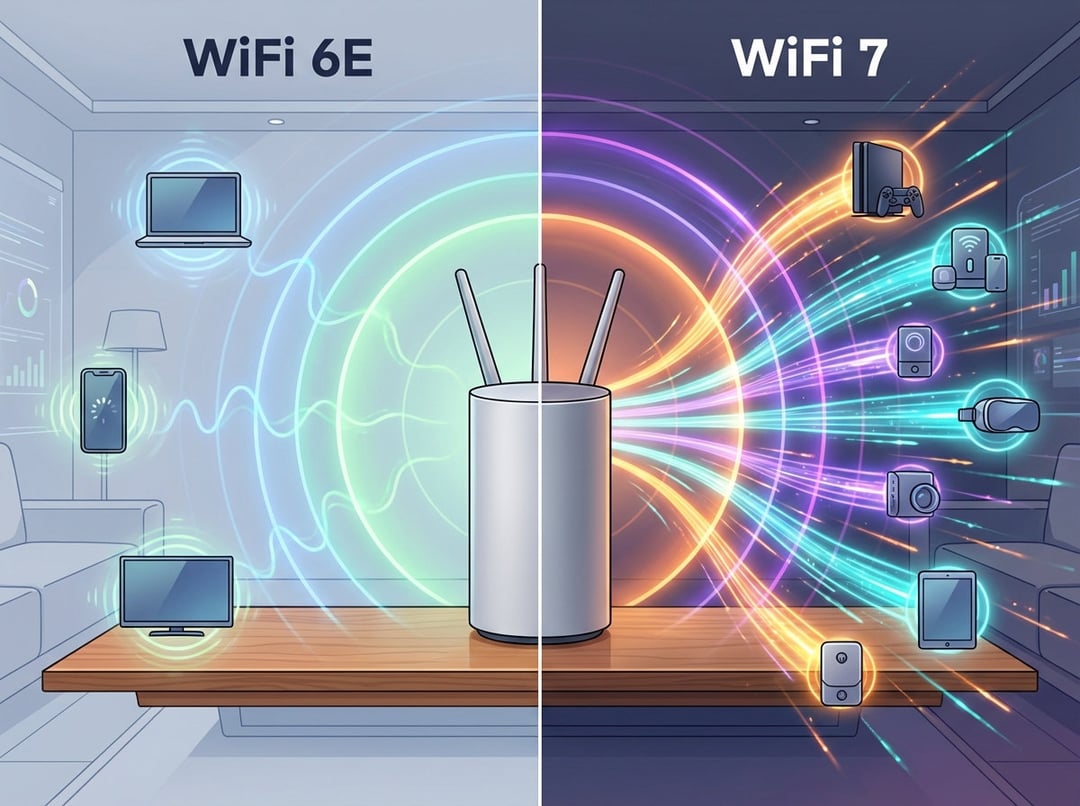
You've probably heard the buzz about WiFi 7, and if you're like most people, you're wondering whether it's time to upgrade from your WiFi 6E router—or if you should even bother. After all, WiFi 6E felt like yesterday's big thing, and now there's already something newer and shinier on the market. Let me cut through the marketing hype and give you the straight story on whether WiFi 7 is worth your hard-earned money.
The Real Performance Gap: Numbers That Actually Matter
Here's what you need to know upfront: WiFi 7 isn't just incrementally better—it's legitimately faster. In real-world testing, WiFi 7 routers delivered around 5,400 Mbps at close range compared to WiFi 6E's 4,600 Mbps. That's roughly a 17% speed boost when you're sitting near your router.
But speed isn't everything. The more interesting story emerges when you look at latency—the delay between your device requesting data and actually receiving it. WiFi 7 clocks in at about 2ms of latency at close range, while WiFi 6E sits at 4ms. That might sound trivial, but if you're gaming competitively or jumping on back-to-back video calls, those milliseconds add up to a noticeably smoother experience.
Where WiFi 7 Actually Shines (And Where It Doesn't)
The biggest advantage of WiFi 7 isn't raw speed—it's how it handles chaos. If your household is anything like mine, you've got smartphones, laptops, smart TVs, security cameras, and probably a few smart speakers all fighting for bandwidth. WiFi 7 uses something called Multi-Link Operation (MLO), which lets devices connect across multiple bands simultaneously.
Think of it like this: WiFi 6E is a three-lane highway where your car has to pick one lane. WiFi 7 lets your car use all three lanes at once. When testing with five devices streaming simultaneously, WiFi 7 routers maintained a total bandwidth of 3.2 Gbps compared to WiFi 6E's 2.4 Gbps—a meaningful difference when everyone's home streaming, gaming, and working.
That said, here's the reality check: most people won't max out even a WiFi 6E connection. If you're streaming Netflix in 4K, browsing social media, and occasionally hopping on Zoom calls, WiFi 6E already gives you more bandwidth than you'll use.
The Price Reality: What You'll Actually Pay
This is where things get uncomfortable. WiFi 7 routers currently range from around $400 to $1,500 depending on features and brand. Quality WiFi 6E routers? You can snag solid options for $200-$400. That's a significant premium for technology that most home users won't fully utilize.
The Amazon eero Max 7 mesh system—one of the better-reviewed WiFi 7 options—recently dropped to $420, which is competitive. But you're still paying double what you'd spend on a capable WiFi 6E system. And here's the kicker: unless you have WiFi 7-compatible devices (spoiler: you probably don't), you won't see those headline speeds anyway.
Device Compatibility: The Elephant in the Room
Let's talk about the biggest gotcha with WiFi 7: your devices need to support it. As of late 2024, very few consumer devices actually have WiFi 7 chips. The iPhone 16 Pro supports it, some flagship Samsung phones do, and a handful of high-end laptops have started including it. But your 2023 MacBook? Your PlayStation 5? Your smart TV? They're all WiFi 6 or 6E at best.
This creates an awkward situation where you're paying for WiFi 7 performance but getting WiFi 6E speeds because that's what your devices can handle. It's like buying a Ferrari to drive in a school zone—technically impressive, but practically pointless.
Who Should Actually Upgrade Right Now
Despite my skepticism, there are legitimate reasons to jump on WiFi 7 today:
You're a serious gamer or content creator. If you're streaming to Twitch while gaming, or uploading massive video files regularly, that lower latency and higher throughput make a tangible difference. WiFi 7's jitter performance (0.5ms vs 1.2ms) means fewer dropped frames and smoother uploads.
You have a genuinely crowded network. I'm not talking about four or five devices—I mean 15+ devices constantly connected. Smart home enthusiasts with dozens of IoT gadgets, security cameras, and multiple 4K streams running simultaneously will actually benefit from WiFi 7's superior multi-device handling.
You're future-proofing a new home. If you're building or renovating and installing networking infrastructure that you won't touch for 5-7 years, WiFi 7 makes sense. By 2027, most new devices will support it, and you'll be glad you invested early.
Who Should Stick With WiFi 6E (Or Even WiFi 6)
For most households, WiFi 6E remains the sweet spot. You get access to the less-crowded 6GHz band, speeds that exceed what most internet connections can deliver, and prices that won't make you wince. If your current WiFi 6 router is working fine, there's genuinely no compelling reason to upgrade yet.
The honest truth? WiFi 7 router prices will drop 30-50% over the next 12-18 months as competition increases and manufacturing scales up. Unless you have specific pain points that WiFi 7 addresses, waiting makes financial sense.
The Verdict: Worth It For Some, Overkill For Most
WiFi 7 represents a genuine technological leap—the performance improvements are real, not just marketing fluff. But "better" doesn't always mean "worth buying right now." For power users with compatible devices and specific needs, it's a worthwhile investment. For everyone else, it's an expensive solution to problems you probably don't have.
My recommendation? If your WiFi 6E router is working fine, pocket that $400-$1,500 and wait another year. Prices will drop, device compatibility will improve, and you'll get a better product for less money. But if you're building a new network from scratch and have the budget, WiFi 7 offers enough future-proofing to justify the premium—just don't expect miracles on day one.
The upgrade isn't about what WiFi 7 can do today. It's about what it'll enable over the next five years. Whether that's worth paying double right now depends entirely on your patience and your wallet.