
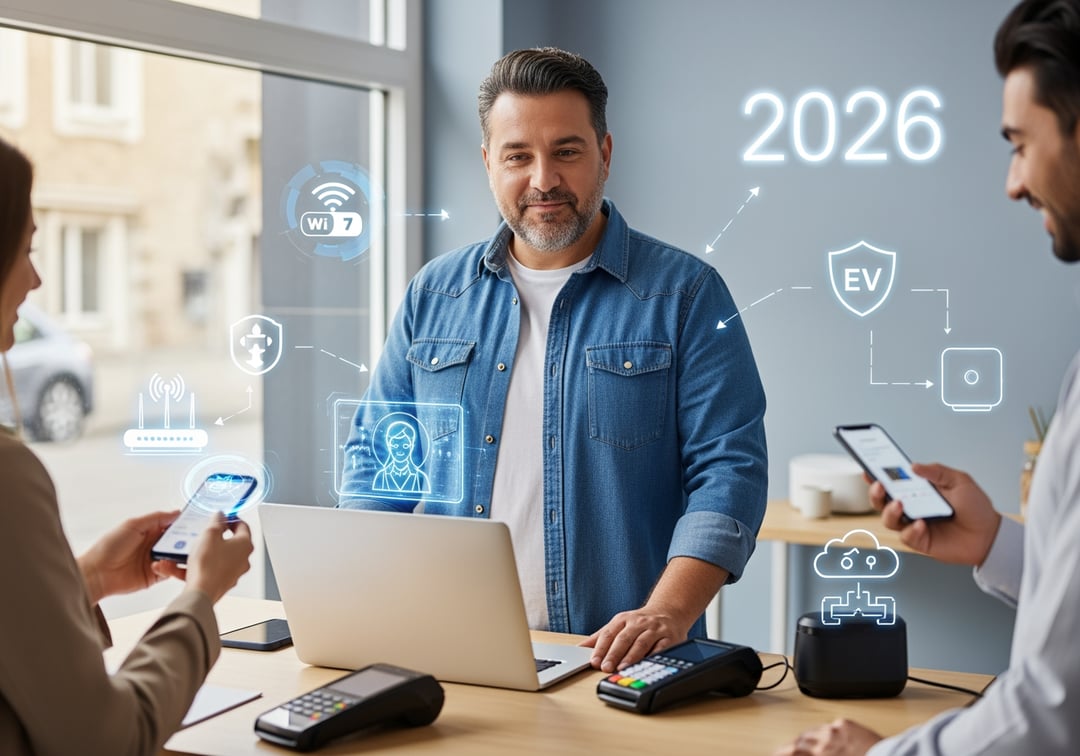
The gap between cutting-edge research and everyday impact is closing fast. While tech headlines often chase hype cycles that never materialize, 2026 brings genuine transformations backed by billions in R&D investments and production-ready infrastructure. These aren't distant possibilities. They're evidence-based trajectories already reshaping how consumers live and small businesses compete.
Here's what actually matters for the year ahead.
1. Quantum Computing Delivers Its First Practical Wins
IBM projects 2026 as the year quantum computers demonstrably outperform classical systems on real-world problems. This isn't about theoretical supremacy anymore. Think faster drug discovery timelines, sharper financial modeling, and supply chain optimization that actually works.
For SMBs, cloud-based quantum-as-a-service platforms eliminate the need for million-dollar infrastructure investments. You'll access quantum-enhanced cybersecurity and logistics optimization through subscription models. The technology remains complex, but the barrier to entry is finally dropping.
2. AI Systems Matter More Than Individual Models
Here's the shift most people miss: the competitive advantage in 2026 won't come from having the best AI model. It comes from orchestrating multiple models, tools, and workflows into cohesive systems.
Companies like OpenAI and Google already deploy sophisticated routing architectures that delegate tasks between smaller specialized models and larger general-purpose ones. For consumers, this means AI assistants that seamlessly coordinate across your devices without you managing anything. For businesses, it means automated customer service that intelligently escalates complex issues while handling routine inquiries effortlessly.
3. Hardware Efficiency Becomes the New Battleground
The 2025 chip shortage forced a strategic pivot. Rather than chasing unlimited compute power, organizations now optimize around availability and efficiency. Edge AI processing moves from experimental to essential.
Expect faster response times on personal devices, extended battery life, and AI capabilities running locally without cloud dependency. SMBs benefit from reduced hardware costs and domain-specific models that deliver enterprise-grade performance without massive infrastructure. GPUs remain important, but ASIC accelerators and specialized AI chips are gaining serious ground.
4. Autonomous AI Agents Transform Business Operations
Multi-agent systems executing complex workflows with minimal human oversight become operational reality in 2026. These aren't simple chatbots. They're goal-oriented systems that plan, select tools, and adapt their approach based on outcomes.
IBM's research highlights the emergence of "super agents" operating across your browser, editor, and inbox from a single control plane. For SMBs, procurement automation handles everything from requirements identification through vendor negotiation. Marketing agent swarms coordinate campaigns across channels and optimize spend dynamically.
The governance challenge? Each agent needs clear authorization boundaries and activity monitoring. Non-human identities will significantly outnumber human users in organizational environments.
5. Embedded AI Outpaces Standalone Tools
Deloitte's TMT Predictions forecast that passive AI usage—embedded invisibly within search engines and productivity apps—will exceed standalone AI tool interactions by 300%. This makes sense. Most people don't want another app. They want their existing tools to work smarter.
Search engines already incorporate generative AI into results pages. Productivity suites handle writing, analysis, and summarization within familiar workflows. For SMBs, this means AI capabilities arrive through software you already use rather than requiring separate subscriptions and complex integrations.
6. Robotics and Physical AI Gain Real Momentum
Industrial robot shipments have plateaued around 500,000 units annually, but growth catalysts are emerging. Labor shortages combined with AI-enhanced flexibility could double shipments to 1 million by 2030.
Consumers encounter autonomous delivery robots handling last-mile logistics. Home automation robots gain genuinely useful intelligence. Manufacturing automation becomes accessible to smaller operations through AI-enhanced systems that adapt to varied tasks without extensive reprogramming.
7. AI Sovereignty Becomes Strategic Priority
Geopolitical tensions and regulatory requirements drive over $100 billion in commitments to sovereign AI infrastructure by 2026. Countries want independent AI ecosystems. Companies need modular architectures enabling workload migration between trusted regions.
For SMBs operating internationally, data governance frameworks become essential for compliance across jurisdictions. The complexity of multi-regional operations demands automated compliance enforcement and sophisticated vendor management.
8. Video Podcasts and Micro-Series Dominate Content
Micro-series revenues are projected to exceed $7.8 billion in 2026, while video podcast advertising approaches $5 billion globally. Mobile-first serialized content challenges traditional streaming platforms.
Independent creators leverage AI production tools to compete with major studios. For SMBs, branded micro-series and video podcasts provide authentic audience engagement without traditional production budgets. The content creation barrier has never been lower.
9. Satellite Internet Expands Dramatically
Over 15,000 low-Earth-orbit satellites will circle the planet by 2026, with global subscribers surpassing 15 million. Direct-to-device connectivity eliminates specialized hardware requirements.
Agricultural operations, remote businesses, and transportation companies gain enterprise-grade connectivity regardless of location. Emergency communication capabilities provide resilience during infrastructure failures.
10. SaaS Pricing Models Get Disrupted
AI integration forces traditional seat-based subscriptions toward hybrid usage-based and outcome-based pricing. Software as a Service evolves toward Service as Software—value tied to business outcomes rather than user access.
For SMBs, variable cost structures align better with business growth and seasonal fluctuations. The total cost of ownership analysis becomes more complex, requiring evaluation across usage, outcomes, and actual business value.
11. Identity Management Gets Completely Rethought
Autonomous AI agents operating across systems require unique identities, credentials, and authorization boundaries. Traditional identity management frameworks designed for human users can't scale to thousands of autonomous agents.
This becomes a board-level concern. Organizations must answer three critical questions: Do you know every AI agent that exists? Do you understand what each agent accesses? Are you confident in what they're doing?
12. Trust Becomes the Ultimate Differentiator
Data breaches and unauthorized AI usage erode enterprise trust, creating competitive opportunities for security-focused solutions. AI trustworthiness—including explainability, fairness, and security—becomes a primary selection criterion.
Consumers increasingly select vendors with demonstrated AI safety credentials. SMBs require transparent AI systems with audit trails for automated decisions. Compliance-ready AI tools become table stakes rather than differentiators.
What This Means for You
The tech predictions for 2026 that actually affect consumers and SMBs share a common thread: the transition from experimental to operational. Quantum computing moves beyond labs. AI agents handle real business processes. Embedded intelligence replaces standalone tools.
Organizations developing capabilities in these areas now will outperform competitors. Those maintaining wait-and-see approaches face genuine competitive disadvantages as implementation barriers continue falling.
The window for preparation is narrowing. These transformations arrive whether you're ready or not.