
Picking between RAG vs fine-tuning sounds like a tooling choice. It is not. It is a commitment to where “truth” lives in your system and how fast you can change it without breaking everything else. If you treat the decision casually, you end up with an expensive stack that still hallucinates, still drifts, and still fails audits.
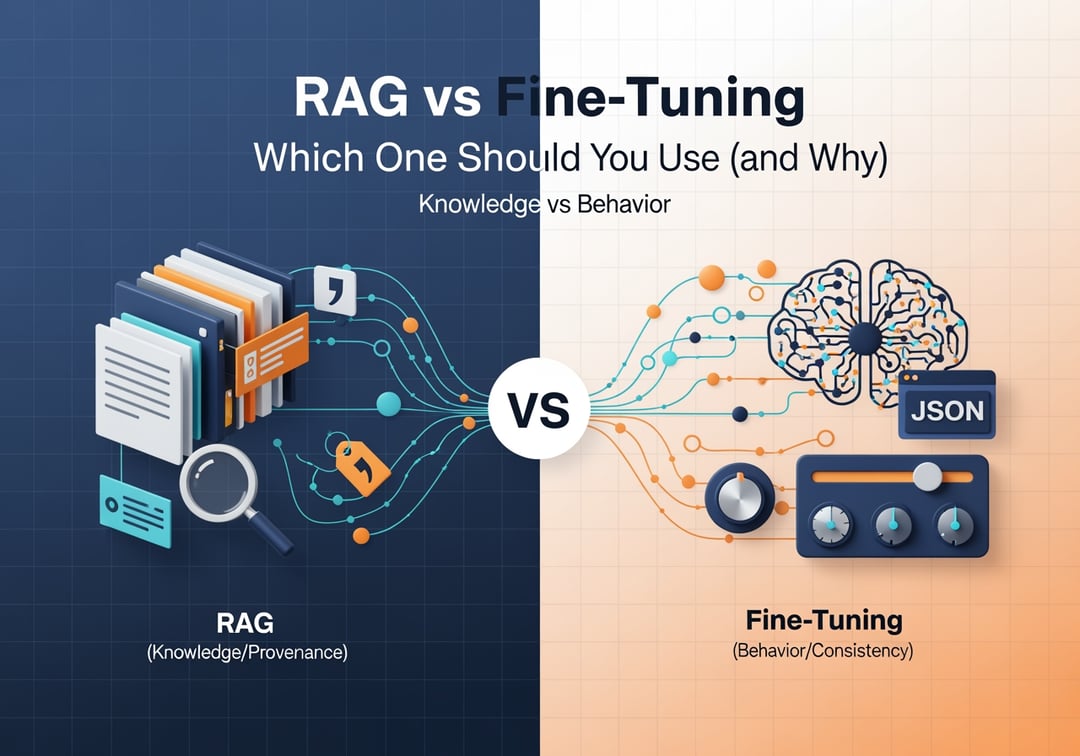
Here’s the clean way to think about it. Use RAG to control knowledge and provenance. Use fine-tuning to control behavior and consistency. When you need both, combine them deliberately instead of piling them together and hoping quality emerges.
RAG vs Fine-Tuning: Memory vs Behavior, Not Hype vs Hype
RAG, or retrieval-augmented generation, injects external context into the model at inference time. Fine-tuning updates model weights to change how the model responds. That difference maps to a deeper split: non‑parametric memory versus parametric behavior.
Non‑parametric memory means the system can fetch the latest approved policy, the correct SKU list, or the newest incident report and then answer with that material in view. Parametric behavior means the model becomes better at a repeatable skill such as producing JSON that validates, classifying tickets, or writing in a controlled brand voice.
The original RAG framing makes this motivation explicit: large models struggle with factual reliability and updating knowledge. Retrieval offers a path to grounded answers with traceable sources. See Lewis et al. for the canonical baseline: https://arxiv.org/abs/2005.11401
When to Choose RAG Over Fine-Tuning
RAG wins when your problem is not “the model cannot write.” Your problem is “the model cannot know what changed yesterday.”
Knowledge volatility and update cadence
If your knowledge changes weekly, fine-tuning turns into a treadmill. Each retrain locks in a snapshot that starts decaying the moment the business updates. RAG lets you refresh documents and indexes on a schedule that matches reality. Minutes. Hours. Daily. Whatever your governance allows.
Provenance and auditability requirements
If you need citations, RAG gives you a defensible chain from answer to source. That matters in regulated domains and it also matters internally when stakeholders ask, “Where did this come from?” Fine-tuning can improve fluency yet it rarely gives you attribution.
Hallucination budget close to zero
When a wrong answer triggers a security incident or a legal escalation, you need grounding. RAG does not eliminate hallucinations, though it reduces them when retrieval works. Consequently, it shifts the core risk from “model invents facts” to “system retrieved the wrong thing.”
When to Choose Fine-Tuning Over RAG
Fine-tuning shines when your pain sits in repeatability rather than freshness.
Behavior consistency and format compliance
If you need stable JSON, reliable tool calls, or strict output schemas, fine-tuning often beats prompt gymnastics. Prompts help, but they do not guarantee compliance across edge cases. A targeted fine-tune can reduce variance and make the system less sensitive to phrasing drift.
Stable tasks with well-defined correctness
Fine-tuning works best when you can say what “correct” means. Classification, routing, extraction, and structured rewriting fit. Conversely, open-ended knowledge Q&A about shifting policies does not. That is where people try to “fine-tune in the facts” and then rediscover staleness.
Predictable latency and unit economics
RAG adds retrieval latency and it can add long contexts. Fine-tuning can shorten prompts and reduce tokens, which stabilizes cost at scale. It also reduces tail latency variability because you avoid round trips to retrieval infrastructure.
Why RAG Fails in Practice Even When It Is the Right Answer
Most weak RAG systems do not fail at generation. They fail at retrieval hygiene.
Retrieval mismatch and chunking damage
If your chunking breaks procedures into fragments, the model reads nonsense. If your embedding strategy does not match query reality, retrieval returns plausible but irrelevant text. A common failure looks like this: the user asks about the current vacation policy and the system retrieves a 2022 draft PDF because it contains more keyword overlap.
Context stuffing and prompt injection
More context does not mean more truth. Long retrieved dumps bury the useful signal and amplify risk. Untrusted documents can also inject instructions that conflict with system constraints. Mitigate with allowlisted sources, versioned documents, deduplication, and explicit separation between “instructions” and “evidence.”
Evaluation that ignores retrieval quality
If you only score final answers, you will misdiagnose problems. You need retrieval metrics such as recall@k and you need groundedness checks that verify the answer aligns with retrieved passages.
Why Fine-Tuning Looks Great Until It Hits Production
Fine-tuning collapses messy realities into training data. That is both its power and its trap.
Staleness disguised as confidence
A fine-tuned model can answer confidently in the style you want while remaining wrong in substance. If the business changes and you cannot retrain quickly, the model becomes a polished liar. That is harsh language, but production incidents earn it.
Regressions and hidden coupling
Fine-tuning can cause behavior regressions, especially when training data narrows the model’s response space. It can also couple the model to training prompt scaffolding. Then your production prompt evolves and quality drops sharply.
RAG vs Fine-Tuning Decision Rubric: Seven Constraints That Actually Matter
- Knowledge volatility: high volatility favors RAG.
- Explainability: citations favor RAG.
- Latency: strict low variance can favor fine-tuning.
- Data reality: clean docs favor RAG. Labeled examples favor fine-tuning.
- Security model: ingestion risk grows with RAG. Memorization risk grows with fine-tuning.
- Evaluation effort: RAG requires multi-stage testing. Fine-tuning requires regression suites.
- Operational maturity: choose what you can maintain, not what you can demo.
Practical Architectures: How to Combine RAG vs Fine-Tuning Without Confusion
The most common strong pattern is RAG-first for knowledge and fine-tuning for format. RAG fetches the evidence. Fine-tuning enforces the behavior layer that converts evidence into a consistent output. You get both traceability and stability.
A second pattern improves relevance before touching the generator. Tune the retriever or add a reranker. You often gain more grounded accuracy per unit effort because retrieval quality dominates the system.
A third pattern distills for scale. Use RAG to answer the long tail and then fine-tune a smaller model on frequent, high-confidence traces. Keep RAG as a fallback for anything rare or high risk.
Evaluation Blueprint: Decide With Evidence, Not Preference
Define success as task completion under constraints: accuracy, citation correctness, refusal correctness, and cost per successful run. For RAG, evaluate corpus quality, retrieval metrics, and groundedness. For fine-tuning, enforce time-based splits when knowledge drifts and run a broad regression suite that catches formatting failures and instruction-following regressions.
Conclusion: Which Should You Use and Why
Use RAG when the system must stay aligned with changing truth and must show its sources. Use fine-tuning when the system must behave consistently under strict constraints. When you need grounded answers in a rigid structure, combine them intentionally. That choice turns the RAG vs fine-tuning debate into a simple interface contract: retrieval supplies evidence, while tuning shapes behavior.