
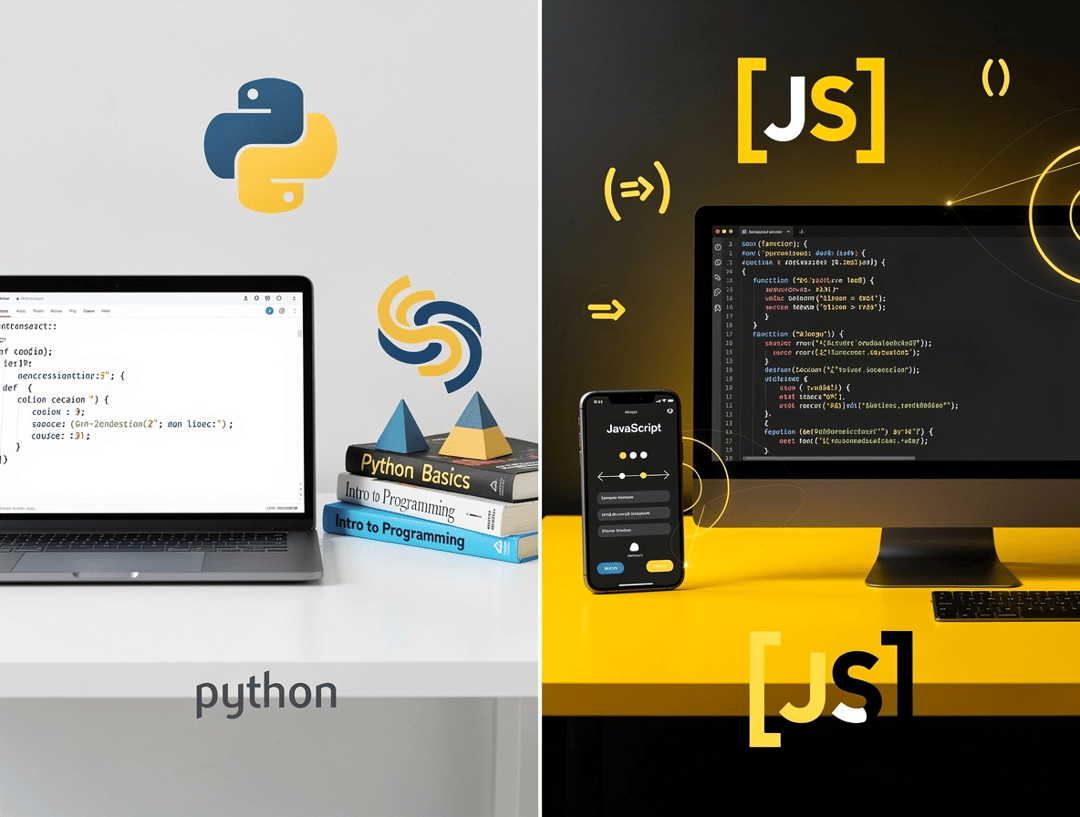
If you're standing at the threshold of your coding journey, you've probably heard the same advice a hundred times: "Just pick a language and start!" But when that language could shape your entire career trajectory, the choice feels anything but simple. Python and JavaScript dominate the conversation for good reason—they're both beginner-friendly, wildly popular, and open doors to lucrative careers. So which one deserves your precious learning time?
Here's my take after watching countless beginners navigate this exact crossroads: the "right" choice depends less on which language is objectively better and more on where you want your code to live. Let me explain.
The Tale of Two Philosophies
Python and JavaScript were born from different needs, and that origin story matters more than you might think.
Python arrived in 1991 with a simple mission: make programming readable and accessible. Its creator, Guido van Rossum, wanted code that looked almost like English. The result? A language that feels like having a conversation with your computer. When you write if user_is_logged_in: in Python, even your non-programmer friend can guess what's happening.
JavaScript emerged in 1995 to solve a specific problem: making web pages interactive. It was built in just 10 days (yes, really) to run inside browsers. Over time, it evolved from a simple scripting tool into a full-stack powerhouse that now runs on servers, mobile apps, and even IoT devices.
This fundamental difference shapes everything else.
Where Your Code Lives Matters Most
Here's the honest truth that most comparison articles bury: JavaScript owns the browser, and Python dominates almost everywhere else.
If you want to build anything users interact with directly in a web browser—whether that's a portfolio site, a web app, or interactive data visualizations—you'll eventually need JavaScript. There's no way around it. Every single website you visit uses JavaScript for buttons, forms, animations, and dynamic content. It's the only language browsers natively understand.
Python, meanwhile, thrives on the server side and in specialized domains. Data science? Python. Machine learning and AI? Python. Automation scripts? Python. Backend web development? Python is a top contender (though JavaScript via Node.js competes here too).
My recommendation: Think about what you want to build in your first six months. If you dream of creating websites people can see and use immediately, JavaScript gives you that instant gratification. If you're drawn to data analysis, automation, or backend systems, Python is your friend.
The Learning Curve: Syntax and Sanity
Let's address the elephant in the room: Python is genuinely easier to learn first.
According to recent developer surveys, Python's clean syntax and readability make it the most beginner-friendly language available. Here's a simple comparison:
Python:
def greet_user(name):
return f"Hello, {name}!"
JavaScript:
function greetUser(name) {
return `Hello, ${name}!`;
}
They look similar, right? But JavaScript has quirks that trip up beginners. Concepts like this binding, callback hell, and type coercion can feel like learning a language where the grammar rules keep changing. Python's philosophy of "there should be one obvious way to do it" means fewer surprises.
That said, JavaScript's challenges aren't dealbreakers. Millions of developers learned JavaScript first and turned out just fine. The language has matured significantly, and modern JavaScript (ES6+) is far more approachable than its earlier versions.
Career Prospects: Show Me the Money
Both languages offer excellent career prospects, but the numbers tell an interesting story.
Python developers currently command salaries ranging from $110,000 to $150,000 annually in the United States, with specialized roles in AI and machine learning pushing even higher. Python's adoption has accelerated dramatically—Stack Overflow's 2025 survey shows a 7 percentage point increase in just one year. With 45.7% of recruiters actively seeking Python developers, demand is undeniable.
JavaScript developers earn competitive salaries around $111,922 on average in the US. As the most popular programming language globally, JavaScript skills remain in constant demand. The rise of full-stack JavaScript development (using React, Node.js, etc.) means you can build entire applications with one language.
The job market reality? Both languages offer abundant opportunities. Python edges ahead in data science and AI roles, while JavaScript dominates web development positions. Your earning potential depends more on your skill level and specialization than your initial language choice.
The Ecosystem and Community
Both languages boast massive, supportive communities and rich ecosystems of libraries and frameworks.
Python's ecosystem includes Django and Flask for web development, NumPy and Pandas for data science, TensorFlow and PyTorch for machine learning, and thousands of specialized libraries. The Python Package Index (PyPI) hosts over 500,000 packages. You'll find tutorials, courses, and Stack Overflow answers for virtually any problem.
JavaScript's ecosystem is equally impressive, if not more overwhelming. React, Vue, and Angular dominate frontend development. Node.js and Express power backends. The npm registry contains over 2 million packages. The JavaScript community moves fast—sometimes too fast—with new frameworks and tools emerging constantly.
One caveat: JavaScript's rapid evolution can feel chaotic for beginners. What's trendy today might be outdated next year. Python's ecosystem feels more stable and mature.
My Honest Opinion: Start with Python (Usually)
After weighing everything, I believe most beginners should start with Python—but with important exceptions.
Choose Python if you:
- Want the gentlest learning curve
- Are interested in data science, AI, or automation
- Prefer a stable, mature ecosystem
- Like clear, readable code
- Want to focus on problem-solving rather than language quirks
Choose JavaScript if you:
- Want to build websites and see immediate visual results
- Are specifically interested in web development
- Don't mind a steeper initial learning curve
- Want to eventually become a full-stack developer
- Prefer learning one language that works everywhere in web development
Here's the secret nobody tells you: your second language will be easier than your first. The programming concepts you learn—variables, loops, functions, data structures—transfer between languages. Once you understand how to think like a programmer, picking up a new syntax is just a matter of weeks.
The Path Forward
Rather than agonizing over this decision for weeks, give yourself a deadline. Spend 2-3 weeks with one language. Build a few small projects. If it clicks, keep going. If it feels like fighting uphill, try the other.
Both Python and JavaScript will serve you well. Both open doors to rewarding careers. Both have vibrant communities ready to help you succeed.
The best language for beginners isn't the one with the perfect syntax or the highest salaries—it's the one that keeps you motivated to code every day. Pick the one that aligns with your goals, dive in, and start building. Your future self will thank you for starting, regardless of which language you chose.
The bottom line: You can't make a wrong choice here. You can only make a choice and get started. So what are you waiting for?


