
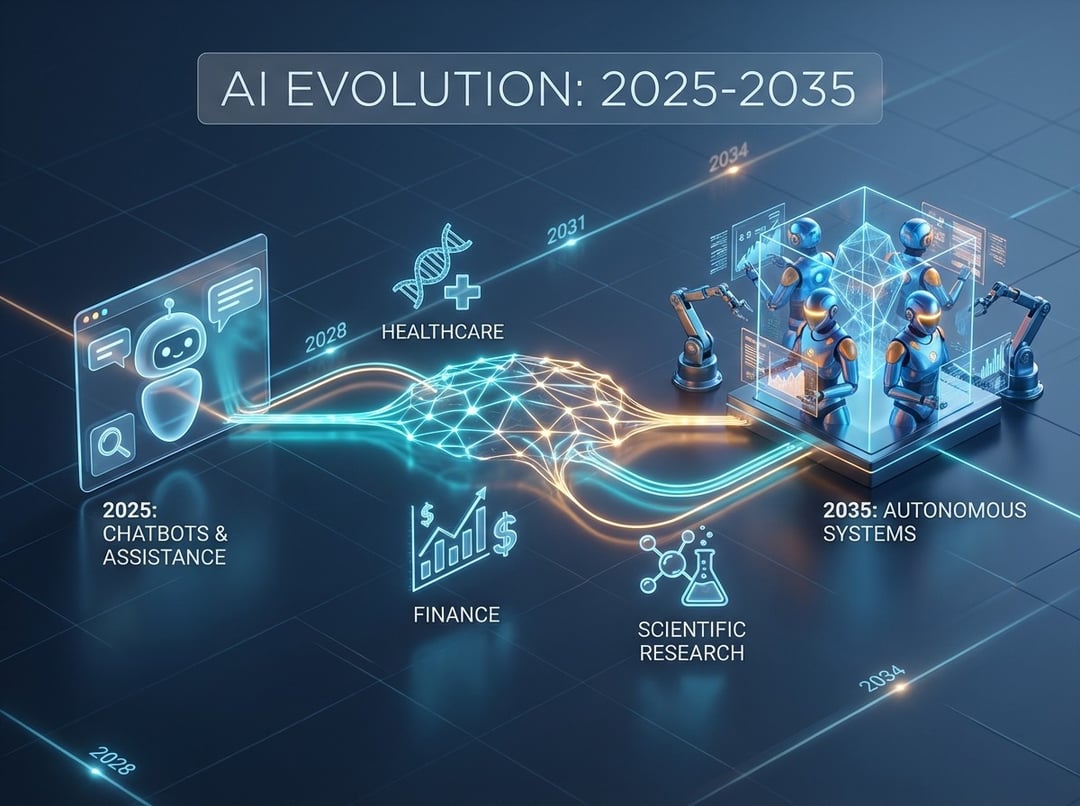
The past few years have been wild for artificial intelligence. We've gone from chatbots that sometimes worked to AI that can write code, create art, and pass professional exams. Standing at this threshold it's natural to wonder what's next. The next decade promises to fundamentally reshape how we interact with technology. Let's explore what AI development predictions experts are making for the years ahead.
The Rise of Agentic AI: From Chatbots to Autonomous Agents
Think of agentic AI as the shift from a helpful assistant to an autonomous colleague. Today's AI mostly responds when we ask questions. Tomorrow's AI will take initiative.
Agentic AI systems can make decisions and complete tasks without constant human direction. They won't just tell you what's in your calendar—they'll schedule meetings, negotiate times, and handle conflicts. By 2028 we'll see these systems move from experimental projects to everyday tools that businesses rely on.
This transformation means CIOs will stop managing systems and start orchestrating how work flows through organizations. Instead of maintaining software servers they'll oversee fleets of AI agents handling customer service, data analysis, and project management.
But this brings real challenges. Shadow AI—people using unsanctioned AI tools to work faster—already poses security risks. When autonomous agents start moving data around without clear oversight organizations will need robust governance frameworks. Trust will become the biggest question as AI takes on more independent action.
Smaller, Smarter: Why Specialized AI Will Win
Here's something counterintuitive: bigger isn't always better in AI. While companies race to build the largest models a quieter revolution focuses on specialized AI trained for specific industries.
Domain-specific models trained on healthcare data outperform general models in medical diagnosis. Financial services AI built on banking history catches fraud patterns a general model would miss. These smaller specialized systems deliver better accuracy and relevance because they understand the language and context of their specific field.
The costs matter too. General-purpose models require enormous computing resources while specialized AI can run on smaller infrastructure. This makes AI more accessible to mid-sized organizations not just tech giants with billion-dollar budgets.
By 2030 expect most businesses to run hybrid systems. A general model might handle broad conversations while specialized modules tackle domain-specific tasks. Think of it like hiring a general contractor who brings in expert plumbers electricians and carpenters as needed.
AI as Your Research Assistant
Science might see the biggest transformation from AI in the coming decade. Researchers already use AI to analyze massive datasets but next-generation systems will do something more profound—they'll help generate new ideas.
Imagine describing a software problem in plain language and having AI implement the solution. Or asking AI to review thousands of biology papers and spot connections humans missed. By 2030 AI could implement complex scientific software from natural language descriptions and help mathematicians formalize proofs.
Productivity gains in research fields could reach 10-20% as AI handles time-consuming tasks like literature reviews and basic analysis. This acceleration matters because scientific progress compounds—faster discoveries lead to faster discoveries.
The real breakthrough? AI might democratize scientific capabilities. A researcher at a small university with access to powerful AI tools could compete with teams at well-funded institutions. This could shift where innovation happens and who gets to participate.
The Hidden Infrastructure Challenge
All this AI needs something we rarely think about: massive amounts of computing power and energy. The next decade will see hundreds of billions invested in AI infrastructure.
Inference workloads—the actual use of AI models after training—will account for two-thirds of all AI computing by 2026. This shift changes everything from how data centers are built to where they're located. We'll need gigawatts of power not just for training AI but for running it every day.
Storage demands are equally staggering. AI storage needs could increase 500 times compared to 2025 levels. By 2035 AI data might account for more than 70% of global storage. This creates opportunities and challenges for companies that provide storage solutions and raises questions about energy sustainability.
The hardware landscape will change too. While Nvidia dominates today companies like AMD are emerging as credible alternatives with chips like the MI300. Competition usually drives innovation and could make AI infrastructure more affordable.
Ethics and the Path Forward
Technology outpaces policy and AI is no exception. The next decade will see the evolution of ethical frameworks and regulatory approaches to AI governance.
Most researchers believe true Artificial General Intelligence—AI that thinks like a human—remains out of reach by 2035. This gives us time to build the right guardrails. The focus shifts from whether AI can do something to whether it should.
Jobs will change. Some roles will disappear while new ones emerge. The real question isn't whether automation happens but how society manages the transition. Countries that get this right could see economic benefits while others might struggle with cultural disruption and inequality.
International cooperation will be essential yet challenging. AI as a strategic asset means countries won't easily share research or agree on common rules. But some coordination seems inevitable given AI's global impact.
What This Means for You
So what should you expect from AI in the next decade? First embrace the change rather than resist it. AI will become integrated into almost every interaction with technology. Your phone computer and workplace tools will all get smarter sometimes without you noticing.
Second focus on skills AI can't easily replicate. Creative thinking emotional intelligence and complex problem-solving become more valuable as AI handles routine cognitive tasks. The best workers will be those who know how to use AI effectively.
Third stay curious. AI development is moving so fast that predictions today might seem quaint in five years. The organizations and individuals who thrive will be those who adapt quickly and continuously learn.
The next decade of AI development isn't just about what the technology can do. It's about how thoughtfully we integrate it into human life. The potential is enormous but so is the responsibility to get it right. Maybe that's the most important prediction of all.