
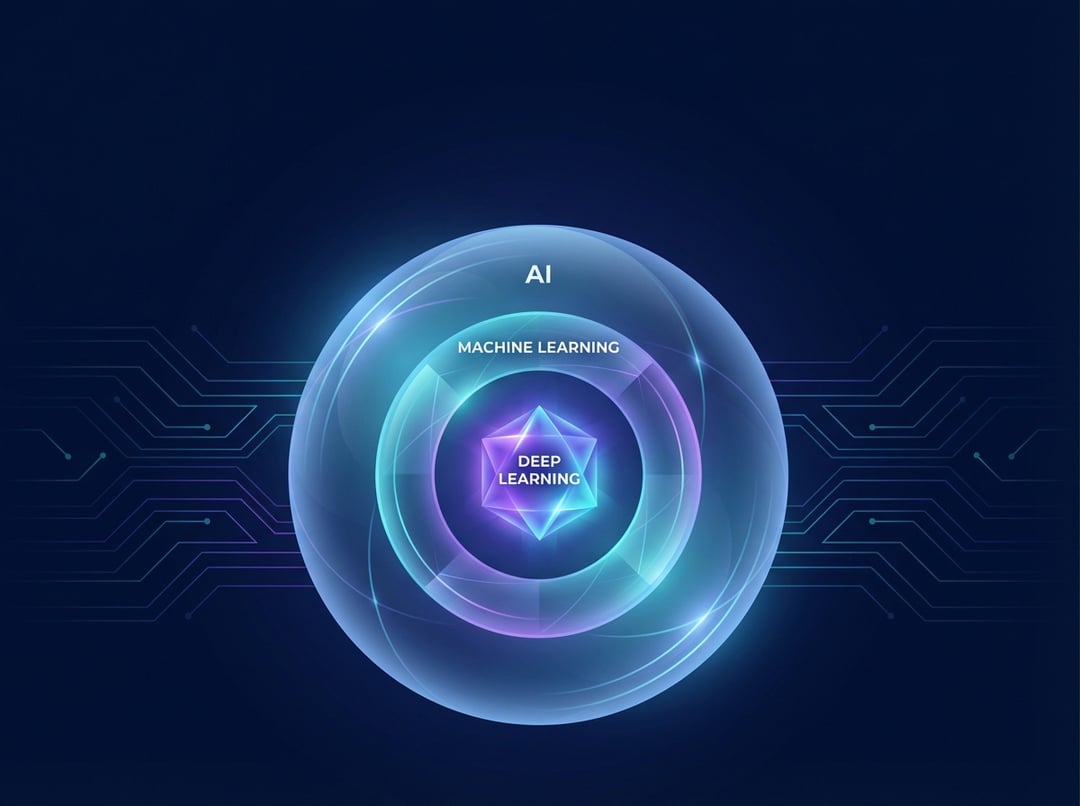
People use AI, machine learning, and deep learning like they mean the same thing. They do not. The confusion rarely comes from intelligence gaps. It comes from category mixing. One term describes a goal. The other terms describe ways to reach it.
This guide clarifies machine learning vs deep learning vs AI with definitions, examples, and a simple decision framework.
Why “AI vs Machine Learning vs Deep Learning” Confuses Smart People
Most explanations fail because they answer the wrong question. They describe the tools without naming the container.
The category error behind most explanations
Artificial intelligence (AI) describes a broad objective. You want a machine to perform tasks that look intelligent in context. Machine learning (ML) describes a strategy for building AI. You let the system learn patterns from data rather than hand-coding rules. Deep learning (DL) describes a specific ML strategy. It uses multi-layer neural networks.
A quick hierarchy resolves most debates:
- AI includes many approaches.
- ML is a subset inside AI.
- DL is a subset inside ML.
The vocabulary problem
Marketing teams often label any automation as “AI.” Engineers often label any neural network as “AI.” Both moves flatten important differences in cost, reliability, and capability.
If someone says “our AI does X,” ask one precise follow-up. Did it learn from data, or did someone encode rules? That single distinction often separates ML-based AI from non-ML AI.
What you can do after this guide
You will classify systems correctly. You will also spot when “AI” acts as branding rather than a technical claim.
AI (Artificial Intelligence): The Broad Goal, Not a Single Technique
AI is best understood as a goal category. It describes systems that make decisions, solve problems, or generate outputs that people associate with intelligent behavior.
Definition-level clarity for AI
Most deployed AI today counts as narrow AI. It performs well in one bounded domain. Speech recognition fits here. Medical image triage fits here. Artificial general intelligence (AGI) remains a research ambition, not a commercial reality.
Three major families inside AI
AI systems commonly come from three families:
- Symbolic AI: explicit rules, logic, and knowledge representation.
- Probabilistic AI: reasoning under uncertainty using probability models.
- Learning-based AI: systems that improve performance through data-driven learning.
Modern products lean heavily on learning-based AI because data and compute became abundant.
AI examples that do not require machine learning
Some AI systems never learn from data:
- Rule-based expert systems that encode policies for approvals or troubleshooting.
- Search and planning that explore possible actions and choose good sequences.
- Game-playing agents that rely on scripted evaluation functions.
These systems can feel intelligent. They still do not qualify as machine learning.
Machine Learning: AI That Learns Patterns From Data
Machine learning builds AI by learning a mapping from inputs to outputs. The system trains on examples. It then generalizes to new cases.
The core idea behind machine learning vs AI
Traditional programming says, “Here are rules, now execute.” ML says, “Here are examples, now learn rules that fit.” Training optimizes model parameters. Testing checks whether learning generalizes.
Consequently, ML success depends less on clever code and more on data design and evaluation discipline.
The main machine learning paradigms
Four paradigms cover most practical ML work:
- Supervised learning: labeled examples teach prediction or classification.
- Unsupervised learning: the model finds structure without labels.
- Reinforcement learning: the agent learns by trial, reward, and feedback loops.
- Self-supervised learning: the system creates learning signals from raw data.
Self-supervision underpins many modern language and vision models.
Common machine learning models that are not deep learning
Many strong ML systems use non-neural methods:
- Linear regression and logistic regression for interpretable baselines.
- Decision trees and random forests for robust performance on tabular data.
- Gradient boosting for high accuracy on structured business problems.
- Support vector machines for boundary-focused classification.
These models often win when data is tabular, noisy, or limited.
Where machine learning fails in practice
ML projects fail in predictable ways:
- Data leakage inflates offline results.
- Concept drift breaks models after deployment.
- Spurious correlations create brittle shortcuts.
- Bad metrics reward the wrong behavior.
A model can score high and still harm outcomes.
Deep Learning: Machine Learning Using Multi-Layer Neural Networks
Deep learning is machine learning that uses neural networks with many layers to learn representations.
Deep learning vs machine learning in one sentence
Deep learning is machine learning that learns complex features automatically using deep neural networks.
Why representation learning changes the game
Classic ML often requires feature engineering. You transform raw inputs into meaningful signals. Deep learning reduces that burden. It learns feature hierarchies directly from unstructured data like images, audio, and text.
This shift matters because humans struggle to hand-design features for language nuance or visual abstraction.
What makes a neural network “deep”
Depth means multiple stacked layers. Training adjusts millions or billions of parameters using gradient-based optimization. That scale enables powerful pattern learning. It also increases opacity.
Furthermore, deep models can generalize surprisingly well despite huge parameter counts. Researchers still debate the full story, which makes DL both effective and conceptually fascinating.
Deep learning architectures you hear about
Several architectures dominate:
- CNNs for image and spatial pattern recognition.
- RNNs and LSTMs for sequences, now mostly historical.
- Transformers for language, vision, and multi-modal systems.
- Diffusion models for high-quality generative synthesis.
If someone asks “is deep learning AI,” the precise answer is yes. Deep learning sits inside AI through ML.
Deep learning’s tradeoffs
Deep learning brings costs:
- It often needs more data and more compute.
- It usually explains decisions poorly.
- It can fail spectacularly outside training distributions.
Those constraints matter more than the hype.
Machine Learning vs Deep Learning vs AI: A Practical Comparison Framework
A clean classification rule prevents endless argument.
The fastest way to classify a system
Use this checklist:
- If it uses hand-coded rules or search, it can be AI without ML.
- If it learns from data, it is ML-based AI.
- If it learns with multi-layer neural networks, it is deep learning.
Four criteria that settle real-world choices
When choosing between ML and DL, evaluate four constraints:
- Data type: tabular data often favors classic ML. Unstructured data favors DL.
- Compute and latency: edge devices penalize heavy neural inference.
- Explainability: regulated domains often demand interpretable models.
- Iteration speed: boosting models train fast. Deep models can take weeks.
On the other hand, if you already have a pre-trained model, you can quickly improve it by fine-tuning.
Real-World Use Cases That Show the Real Differences
Examples make the distinctions concrete.
Fraud detection
Banks often start with classic ML on tabular features. Deep learning helps when sequences matter, like transaction streams. Rule-based AI still plays a role for policy constraints and hard blocks.
Medical imaging
Deep learning dominates image detection and segmentation. ML often supports risk scoring using structured clinical variables. Safety demands careful validation and monitoring.
Customer support automation
AI workflow systems route tickets. Deep learning models handle summarization and intent detection. ML models predict churn risk and escalation probability.
Predictive maintenance
ML works well with engineered sensor features. Deep learning can learn directly from raw waveforms. AI planning then schedules maintenance actions.
The “AI” You Actually Use Today: Generative AI and Foundation Models
Generative AI mostly runs on deep learning. Foundation models are large deep networks trained on broad datasets. Teams adapt them to tasks with prompting, fine-tuning, or retrieval.
Google’s public guidance still emphasizes people-first value and trustworthy content. This matters because modern “AI” systems amplify misinformation risks when teams skip governance and evaluation. See Google Search Central’s helpful content guidance: https://developers.google.com/search/docs/fundamentals/creating-helpful-content
A Simple Mental Model: Umbrellas, Engines, and Fuel
Picture one scene:
- Umbrella: AI describes the goal and system behavior.
- Engines: ML is one engine type. Deep learning is a powerful engine design.
- Fuel: data fuels learning. Compute accelerates training and inference.
Choose the engine that fits the road, not the billboard.
Common Myths About Machine Learning vs Deep Learning vs AI
Myth: AI always means neural networks
False. Rules and search can produce AI behavior without ML.
Myth: Deep learning always beats machine learning
False. Tabular business data often favors gradient boosting and simpler models.
Myth: More data always means better models
False. Label quality and distribution shift often matter more than quantity.
Myth: High accuracy means the system works
False. Calibration, error costs, and failure modes decide real value.
Conclusion: Machine Learning vs Deep Learning vs AI—Use the Right Term and the Right Tool
AI is the umbrella goal. Machine learning is AI that learns from data. Deep learning is machine learning built with deep neural networks.
If you want a fast sanity check, describe a system you use or plan to build. Include the data type, constraints, and risk tolerance. The correct label will become obvious.