
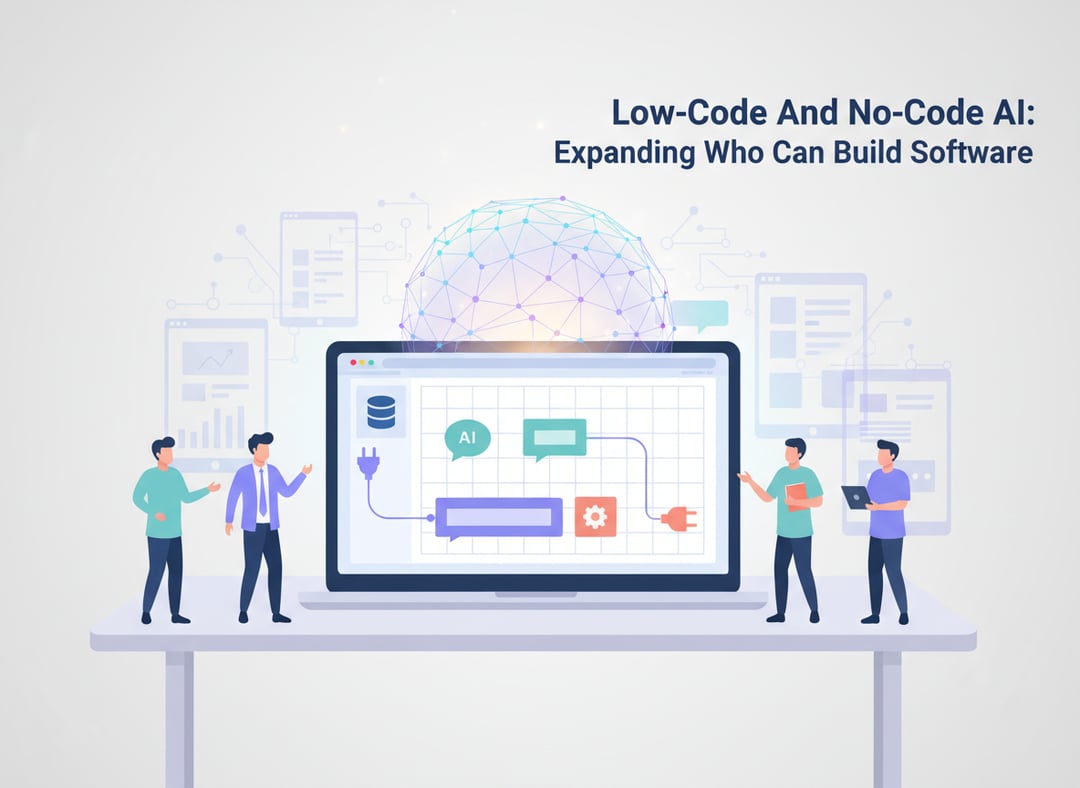
Low-code and no-code AI tools are quietly changing who gets to build software. Tasks that once required a full development team now sit within reach of people who know the work best. That shift is not only technical. It changes how organizations solve problems and who gets a say in the solutions.
This guide explains what low-code and no-code AI actually are. It shows how they expand who can build software and where they fit alongside traditional development. You will see practical examples plus simple steps to get started with your first project.
What Low-Code And No-Code AI Actually Mean
Core Definitions For Low-Code And No-Code AI
Low-code AI platforms give you visual building blocks for apps and workflows. You drag components onto a canvas configure them then connect them. When you hit a limit you can add small pieces of code for custom logic. The platform handles hosting integration and much of the technical plumbing.
No-code AI platforms move further. You work through forms templates and step by step wizards. You might choose a data source pick a goal such as “classify messages” then let the system handle model training and deployment. You never touch code. You focus on describing the problem and tuning the behavior.
In both cases artificial intelligence appears as ready to use features. You might see blocks labeled “classify text” “extract entities” or “predict outcome.” Some tools connect to external AI services behind the scenes. Others ship with built in models that you can fine tune using your own data.
Key Capabilities That Make Low-Code And No-Code AI Different
Low-code and no-code AI tools do more than offer a nicer interface. They wrap several hard tasks into guided flows. You can design workflows by dropping steps onto a canvas. You link those steps to data sources like spreadsheets CRMs or help desk tools. The platform auto generates APIs user interfaces and background jobs.
Many platforms include simple dashboards that track how your AI features behave. You might see accuracy metrics for a classifier or response times for a chatbot. That level of monitoring once required custom engineering. Now it appears as a standard screen in the product.
Low-Code And No-Code AI In Practice
To understand Low-Code And No-Code AI: Expanding Who Can Build Software it helps to look at the before and after. Before only developers and data scientists could build AI powered systems. They wrote code designed data pipelines and managed infrastructure. Business teams mostly waited in line.
Now operations managers marketers teachers and small business owners can assemble useful tools themselves. Complexity still exists. It just sits behind a layer of abstraction. The platform hides repetitive technical work so more people can focus on the problem instead of the plumbing.
Why Low-Code And No-Code AI Are Growing Now
Converging Trends Behind The Shift
Several trends make Low-Code And No-Code AI: Expanding Who Can Build Software possible today. Cloud infrastructure is mature which means platforms can scale up and down without each customer managing servers. Standard APIs let tools talk to email services payment systems and databases with little effort.
Advances in large language models and automated machine learning turned AI into a service. Instead of building models from scratch teams can call powerful models through an API. Low-code and no-code AI platforms wrap those capabilities in guided interfaces. At the same time organizations face pressure to digitize processes faster than IT teams can handle.
The Productivity Imperative
Most organizations now need far more software than they can build through traditional projects. Backlogs grow. Simple internal tools compete with core products for limited developer time. Low-code and no-code AI platforms address that gap. They let teams prototype in days not months. People closest to the work can try ideas run small pilots and refine them based on real usage.
This does not eliminate the need for professional developers. It shifts their focus toward core systems shared services and complex integrations. Routine workflow apps move into the hands of “citizen developers” who understand the day to day problems in detail.
The Economic Logic
From an economic standpoint Low-Code And No-Code AI: Expanding Who Can Build Software reduces the cost per experiment. You can test ten small ideas instead of betting on one large project. You also distribute innovation across the organization. Instead of a central group owning every new tool you get many small initiatives led by people with direct context.
Who Now Builds Software With Low-Code And No-Code AI
Citizen Developers As New Software Creators
A “citizen developer” is someone who does not identify as a programmer yet builds software like tools to improve their own work. Picture an operations manager who creates an AI assisted intake form that routes requests. Or a marketing specialist who builds a lead scoring flow that uses AI to rank inbound inquiries. These people know their processes deeply. Low-code and no-code AI give them a way to turn that knowledge into working systems.
Cross Functional Collaboration
Developers still play a critical role. They choose and secure the platforms. They define data standards and build reusable components. Non technical staff then combine those components into complete solutions. The pattern looks closer to a toolkit than a black box service. Developers enable. Business users assemble and iterate.
Real World Style Scenarios
Consider a customer support manager at a growing company. Using a no-code AI chatbot builder they upload a set of help articles connect an inbox and publish a support assistant on the website. The assistant answers common questions and passes tricky issues to humans with full context.
In another case a school administrator creates a student help bot. Students ask questions about schedules or deadlines. The bot pulls answers from existing documents. The administrator updates content through a simple dashboard without waiting on IT.
A small retail business owner might use a low-code AI tool to forecast inventory. They connect sales data from a spreadsheet. The platform trains a basic model that predicts demand for the next few weeks. It does not rival enterprise forecasting systems yet it beats guessing.
What You Can Build With Low-Code And No-Code AI
Common Use Cases
Low-code and no-code AI shine in clear repeatable tasks. You can build chatbots for websites or internal portals. You can classify incoming emails or support tickets and route them to the right team. You can create simple prediction models that flag likely churn risks or high value leads. You can automate workflows that trigger AI decisions such as summarizing a document then sending the result to a manager.
Where These Tools Work Best
These platforms work best when your process is well understood and your risk is moderate. Internal tools often fit that profile. So do prototypes for new ideas. You get something working quickly. If it proves valuable you can decide whether to keep it as is or rebuild with a traditional stack.
Where Traditional Development Still Matters
There are clear limits. Highly complex systems with strict performance or regulatory requirements still demand professional engineering and rigorous oversight. Deep custom products complex real time systems and heavily regulated workflows cannot rely only on drag and drop builders. In those spaces low-code AI can still help with internal dashboards or support tools while the core remains custom built.
Benefits Risks And How To Get Started
Low-Code And No-Code AI: Expanding Who Can Build Software brings several benefits. Teams move faster. People feel more ownership of the tools they use. Experimentation becomes cheaper and more common. Tools often match real work better because creators live inside the process they are improving.
Risks appear when efforts grow without coordination. Many untracked apps can create “shadow IT” where data flows through tools that security teams do not know about. Poorly configured AI models can leak data or make biased decisions. Vendor lock in is another concern since moving away from a platform can be hard once many workflows depend on it.
A simple governance approach can manage most of these issues. Choose a small set of approved platforms. Provide basic training on data privacy and responsible AI. Ask teams to document what they build. Set up a light review step before tools handle sensitive data or large volumes of users.
To start explore one reputable low-code or no-code AI platform. Pick a small problem such as repetitive email replies or basic request routing. Map the current steps then recreate them in the tool. Test with a small group gather feedback and refine. Through that process the idea of Low-Code And No-Code AI: Expanding Who Can Build Software becomes concrete. Software creation stops being a rare specialist skill and starts to look like another way people solve everyday problems at work.