
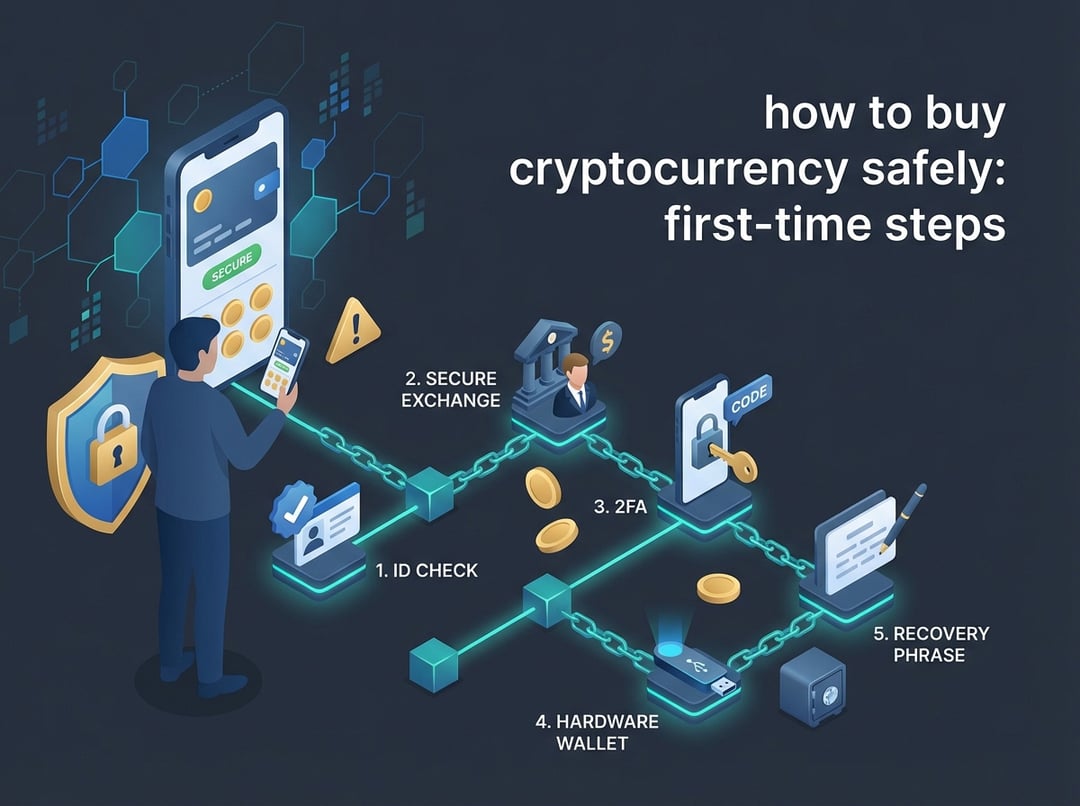
Buying crypto for the first time feels simple right up until it isn’t. One wrong click can send money to the wrong place. One fake “support” message can drain your account. Consequently, “safe” needs a clear definition before you buy anything.
In practice, buying cryptocurrency safely means you control three risks at once: platform risk (the exchange), account risk (your login), and user-error risk (irreversible transfers). The steps below build a setup that reduces all three.
Not financial advice. This is a practical security workflow for first-time buyers.
Before You Buy: Define What “Safe” Means
Safety in crypto works like airport security. One checkpoint helps, yet you still need the next two.
- Platform risk: an exchange can get hacked, freeze withdrawals, or fail.
- Account takeover risk: attackers steal logins using phishing, SIM swaps, or reused passwords.
- Irreversible mistake risk: blockchain transfers typically do not reverse. One wrong network or address can permanently lose funds.
If you only “pick a popular app” then you cover platform risk partially. You still need to harden your account and design your first transfer to prevent mistakes.
Step 1: Choose What to Buy First (Keep It Simple)
For a first crypto purchase, optimize for simplicity and liquidity. Liquidity means you can buy or sell close to the market price without weird spreads.
A reasonable “first buy” approach:
- Start with a widely supported asset like Bitcoin or Ethereum because most reputable exchanges support them and wallets handle them predictably.
- Avoid obscure tokens early. They raise scam risk and execution risk.
- If you feel tempted by a trendy coin, pause and ask one question: “Can I explain what this does in one sentence without marketing words?”
This step sounds boring because it should. Safety loves boring.
Step 2: Pick a Reputable Exchange (Your First Safety Gate)
For most first-time buyers, a regulated, mainstream centralized exchange offers the safest on-ramp. It gives you fiat deposits, fraud controls, and customer support. It also creates a new problem: custodial risk. You do not fully control coins held on an exchange.
Use a quick diligence checklist:
- Clear security features: multi-factor authentication, device/session management, and withdrawal controls.
- Transparent fees: you should understand trading fees and the “spread” on instant buys.
- Track record: when issues happen, does the exchange communicate and resolve responsibly?
Security-oriented overviews often recommend keeping funds on an exchange only when actively trading then moving longer-term holdings to a wallet you control. Security.org explains that crypto is not FDIC-insured and that losses can be hard to recover. It also emphasizes 2FA and self-custody for longer-term storage.
Step 3: Create Your Account Like You Expect to Be Targeted
Crypto accounts attract attackers because they convert cleanly into money. Treat account setup as part of the purchase.
Do this during signup:
- Use a password manager.
- Create a unique long password for the exchange.
- Secure the email tied to the exchange because password resets flow through email.
Then enable multi-factor authentication immediately. Prefer an authenticator app over SMS when possible because SMS can fail under SIM-swap scenarios. Save your backup codes offline.
Step 4: Complete Identity Verification (KYC) Early
Most reputable exchanges require identity checks. If you skip verification, you can get trapped later when you want to withdraw quickly.
Plan for:
- A government ID and a selfie.
- A possible waiting period before full approval.
Note: Verification can take 24–48 hours on some platforms and recommends enabling 2FA during setup.
Step 5: Fund Your Account With the Lowest Friction and Fewest Hidden Costs
Funding methods usually trade speed for cost.
- Bank transfer: often cheaper, sometimes slower.
- Debit or credit card: often fastest, typically more expensive due to fees and spreads.
For your first-time buyer workflow, start with a smaller amount to validate that deposits post correctly. Keep receipts or export confirmations because you will want records later.
Step 6: Buy Crypto Using the Right Order Type
Most exchanges offer two paths:
- Instant buy: easiest, usually costs more.
- Advanced trading: more control, often better pricing.
If you want maximum simplicity, use instant buy for a small test amount. If you want better execution, use advanced trading and place:
- a market order for immediate fill, or
- a limit order to control price.
Confirm you bought the correct asset. Confirm the amount. Then stop. Overtrading is how beginners turn a clean purchase into a stressful one.
Step 7: Choose Where Your Crypto Will Live (Exchange vs Wallet)
Here is the key custody rule: do not store long-term holdings on an exchange by default. Use the exchange to buy. Then move holdings you plan to keep into a wallet you control.
Two wallet categories matter:
- Hot wallet: software wallet on phone or computer. Convenient, more exposed.
- Cold wallet: hardware wallet kept offline. Less convenient, significantly safer for holding.
If you’re buying a small amount to learn, you can temporarily keep it on the exchange while you set up a wallet. If you plan to buy meaningful amounts, prioritize a hardware wallet.
Step 8: Withdraw to Your Wallet Without Making a Permanent Mistake
Withdrawals cause most first-time losses because blockchains do not forgive typos.
Use this withdrawal protocol:
- Verify the network on both sides. This matters as much as the address.
- Copy and paste the address. Do not type it.
- Send a small test transaction first.
- Confirm it arrived. Then send the remainder.
If anything looks off, stop and verify using the exchange’s official help center from a bookmarked URL. Do not trust random “support” DMs.
Step 9: Avoid the Scams That Target First-Time Buyers
The most common traps look boring. That’s why they work.
- Phishing sites: lookalike URLs and fake login pages.
- Fake wallet apps: advertised links or sponsored results.
- Seed phrase theft: any request for your recovery phrase is a scam.
One rule covers nearly all of it: never enter your seed phrase into a website. Not for support. Not for “verification.” Not for “recovery.”
Step 10: Make Your First Month Boring on Purpose
After you buy cryptocurrency safely once, keep it safe by reducing decision pressure:
- Decide your plan: hold, dollar-cost average, or stop after the first purchase.
- Keep security settings on. Do not disable 2FA for convenience.
- Do not brag about holdings. Privacy reduces targeting.
Quick Checklist: Safe Way to Buy Crypto for Beginners
- Choose a reputable exchange.
- Use a password manager and unique password.
- Enable authenticator-based MFA.
- Complete KYC before you need withdrawals.
- Prefer low-fee funding methods when possible.
- Use an order type you understand.
- Move long-term holdings to a wallet you control.
- Test withdrawals with a small transaction.
- Never share or type your seed phrase online.
FAQ
What is the safest way to buy cryptocurrency for the first time?
A reputable exchange plus strong account security and a plan to move long-term holdings into a wallet you control.
Should I leave crypto on an exchange?
Only for active trading or short-term convenience. Self-custody reduces exchange counterparty risk over time.
What’s the biggest mistake first-time buyers make?
Rushing withdrawals and mixing up networks or addresses. A small test transfer prevents expensive errors.