
You've probably noticed Netflix suggesting shows that feel oddly perfect for you. Or maybe your email inbox somehow knows which messages are junk before you even open them. These aren't happy accidents—they're examples of machine learning quietly working in the background of your daily life.
But what exactly is machine learning? And how does it actually work?
This guide breaks it down into clear, simple steps. No advanced math required. No computer science degree needed. Just a straightforward explanation of how machines learn from data and get smarter over time.
What Is Machine Learning Exactly?
Machine learning is a type of artificial intelligence where computers learn from experience instead of following strict instructions.
Think about how you learned to recognize a cat as a child. Nobody sat you down and explained the exact ratio of ear length to face size or the precise angle of whiskers. You saw cats. Lots of them. Over time your brain figured out what makes a cat a cat.
Machine learning works similarly. You feed an algorithm thousands or millions of examples. The system identifies patterns in that data. Then it uses those patterns to make predictions about new information it's never seen before.
Traditional programming follows explicit rules. A developer writes code that says "if this happens, do that." Machine learning flips this model. Instead of programming rules, you provide examples and let the system discover the rules itself.
This shift matters because some problems are too complex to code manually. Facial recognition, language translation, and self-driving cars would be nearly impossible with traditional programming. There are too many variables and edge cases. Machine learning handles this complexity by learning patterns directly from data.
The Step-by-Step Machine Learning Process
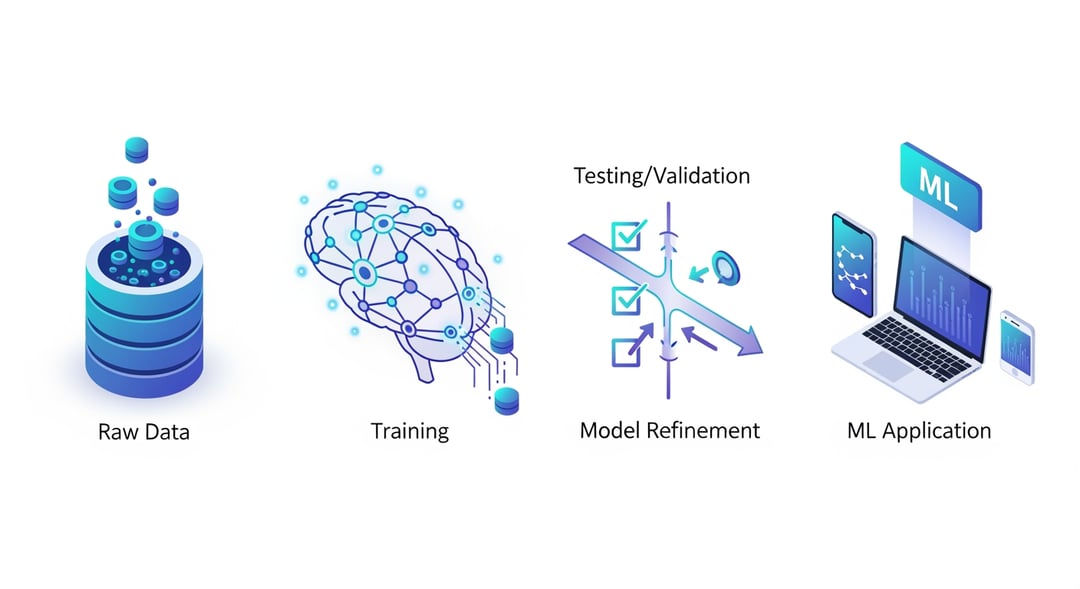
Understanding how machine learning works means looking at the process from start to finish. Here's what happens behind the scenes.
Step 1: Collecting and Preparing Data
Every machine learning project starts with data. This could be images, text files, spreadsheets, audio recordings, or any other information the system needs to learn from.
Quality matters enormously here. A model trained on messy, biased, or incomplete data will produce messy, biased, or incomplete results. That's why data scientists often spend 60 to 80 percent of their time just cleaning and preparing datasets before any actual learning happens.
Imagine building a spam filter. You'd need thousands of emails labeled as either "spam" or "not spam." The model studies these examples to learn what spam looks like.
Step 2: Choosing and Training the Model
Once you have clean data, you select an algorithm appropriate for your task. Different problems require different approaches. Classification problems like spam detection use one type of algorithm. Prediction problems like forecasting sales use another.
Training is where the actual learning happens. The algorithm processes your data, makes predictions, compares those predictions to the correct answers, and adjusts its internal parameters to reduce errors.
Picture learning to throw darts. You throw one and see it lands too far left. You adjust your aim and throw again. Each throw gives you feedback. Each adjustment brings you closer to the bullseye. Machine learning iterates like this—often thousands or millions of times—until it achieves acceptable accuracy.
Step 3: Testing and Validation
A common mistake is assuming a model that performs well on training data will perform well in the real world. This isn't always true.
Sometimes a model simply memorizes the training data without learning generalizable patterns. This is called overfitting. It's like a student who memorizes practice test answers but can't solve new problems on the real exam.
To prevent this, data gets split into separate sets. One portion trains the model while another portion tests it. The model never sees test data during training. Its performance on test data reveals whether it truly learned or just memorized.
If a medical diagnosis AI shows 99% accuracy on training data but only 70% on test data, something's wrong. That gap signals the model hasn't actually learned meaningful patterns.
Step 4: Deployment and Continuous Improvement
After validation, the model deploys into real applications. It might power product recommendations, detect fraudulent transactions, or enable voice assistants to understand speech.
But the work doesn't end at deployment. Real-world conditions change over time. Customer preferences shift. New types of spam emerge. Economic conditions fluctuate. Models need regular updates and retraining with fresh data to stay accurate.
Real-World Machine Learning You Use Daily
Machine learning isn't just some futuristic technology. It's already embedded in services you interact with constantly.
Streaming platforms like Netflix analyze what you watch, when you pause, and what you abandon. They use these patterns to recommend content you're likely to enjoy.
Social media platforms determine what appears in your feed based on engagement patterns. Google Maps predicts traffic and optimizes routes using historical data and real-time inputs. Email providers categorize incoming messages and filter spam automatically.
Online retailers use collaborative filtering to suggest products. When Amazon shows "customers who bought this also bought," that's machine learning identifying purchasing patterns across millions of transactions.
Why Understanding Machine Learning Matters
Machine learning shapes decisions that affect your life. It influences what information you see online, whether your loan application gets approved, and how healthcare systems prioritize patients.
Understanding the basics helps you ask better questions. How was this model trained? What data was used? Could there be bias in the system? These questions matter as machine learning becomes more pervasive.
The next time your phone recognizes your face or a streaming service recommends your new favorite show, you'll know what's happening. A system learned from massive amounts of data, iterated through feedback, and applied those learned patterns to your specific situation.
That's machine learning in action—and now you understand how it works.