
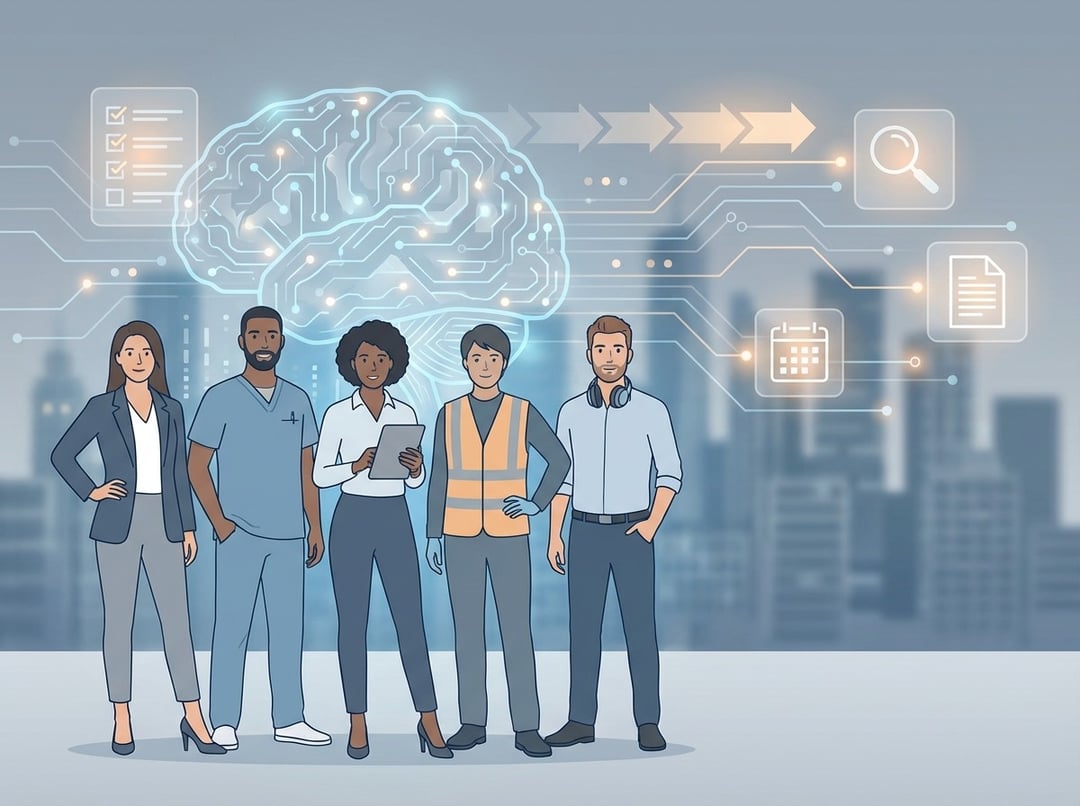
The real question isn’t “Will AI take jobs?” It’s “Which tasks will vanish, and which roles will evolve?”
When people ask how AI will impact jobs in the next decade, they usually picture a dramatic swap. Humans out. Machines in. But work rarely changes that cleanly. Jobs behave like messy bundles of tasks, relationships, tools, and responsibility. AI tends to peel tasks away first. Then it forces the job to reorganize around what remains.
So a better lens looks like this: tasks get automated, workflows get redesigned, and jobs get re-scoped. Once you see that progression, you can stop arguing about whether AI “replaces” a job and start mapping which parts of a role get cheaper, faster, or more reliable.
If there’s one pattern to expect, it’s this: routine cognitive work shrinks. Judgment-heavy work grows.
Why AI and the future of work will move faster than past automation waves
Older automation mostly replaced muscle or repetitive motion. AI scales something different. It scales cognitive throughput. That means it can draft, summarize, translate, classify, and generate options at a speed that makes humans feel oddly slow. Not unintelligent. Just… outpaced.
Think about a typical workflow: you gather information, you produce a first draft, you revise, you check, and you ship. AI compresses the “first draft” stage to seconds. Consequently, the bottleneck shifts to problem framing and verification. You spend less time producing raw material and more time deciding what’s correct, what’s risky, and what actually matters.
Adoption speed matters as much as capability. AI rides existing distribution channels: office suites, browsers, CRMs, help desks, and developer tools. Conversely, governance and liability slow down deployment in regulated industries. Companies want the productivity boost. They also want audit trails and predictable failure modes. That tension will shape how automation will change careers across sectors.
A practical model to predict how automation will change careers
You can forecast AI job impact with three variables: Routinization × Stakes × Context.
- Routinization: Does the task follow repeatable patterns or templates?
- Stakes: What happens if the output is wrong?
- Context: Does the task depend on relationships, tacit knowledge, or local nuance?
When a task scores high on routinization and low on stakes, AI usually automates it quickly. When stakes rise, AI shifts from “do the work” to “suggest and assist.” When context dominates, AI becomes a sidekick. It can help you think. It cannot carry the accountability.
This is where “AI job displacement vs. job creation” becomes a misleading debate. The same job can lose 30% of its tasks and gain new responsibilities that did not exist before. Work does not only disappear. It mutates.
Where the biggest changes will land: sector-by-sector AI impact on employment
Knowledge work: fewer hours drafting, more hours deciding
In marketing, finance, HR, operations, and legal work, AI will chew through first-pass outputs. It will produce drafts, summaries, spreadsheet formulas, basic analyses, and standardized documents. That sounds like replacement. It often ends up as triage.
Marketing teams will shift from writing everything to supervising brand-consistent production and running faster testing loops. Finance teams will move from manual reporting toward exception handling: spotting anomalies, pressure-testing assumptions, and communicating tradeoffs. Legal work will see faster document review. Yet higher-stakes interpretation and strategy will remain human-led because liability does not outsource easily.
Customer support and sales: AI becomes the front door
Support will change fast because the economics are obvious. AI can handle repetitive questions cheaply and instantly. That pushes human agents up the ladder: complex troubleshooting, emotional de-escalation, retention, and edge cases.
Sales follows a similar pattern. AI will research accounts, draft outreach, and summarize calls. Humans will still do the trust work: reading a room, negotiating, and building long-term relationships. Put differently, AI improves the “prep.” It does not magically become credible.
Software and IT: coding changes less than the workflow around coding
The generative AI impact on jobs in tech will not look like “no developers.” It will look like fewer developers spending time on boilerplate. Engineers will prototype faster. They will refactor more aggressively. They will also spend more time on architecture, testing strategy, and security review because AI-generated code can introduce subtle failure modes.
This rewards people who can think in systems. It punishes people who only copy and paste.
Healthcare and education: documentation and triage first, judgment later
Healthcare and education run on context and trust. That slows full automation. Still, AI will reduce administrative load: clinical note drafting, patient summaries, scheduling, and triage support. The hard part is governance. Health systems need privacy controls, rigorous evaluation, and clear accountability. A wrong answer can harm someone.
In education, AI will help teachers plan lessons and generate practice materials. It will also force assessment to evolve. If a model can produce a competent essay, schools will need more oral defense, project work, and authentic evaluation.
Trades and logistics: coordination improves before robotics takes over
Robots struggle in messy physical environments. Warehouses and factories offer more structure. Homes and construction sites offer less. So AI will show up first in planning: routing, scheduling, inventory forecasting, and quality control. Skilled trades will become more tech-enabled. Digital literacy becomes a wage multiplier.
The second-order effects: polarization and the squeeze on the “middle”
AI tends to widen the gap between average output and exceptional output. It gives high performers leverage. It also commoditizes baseline work. That leads to polarization: more demand for high-judgment roles and more demand for hands-on service work. Meanwhile, mid-level routine cognitive roles can compress.
Credentials may matter less than proof. Portfolios, work samples, and practical tests fit an AI-shaped hiring market because they reveal how someone thinks, not just what they studied.
A practical playbook to stay employable as AI reshapes work
You do not need to become an AI zealot. You do need AI literacy. Learn model limits: hallucinations, bias, and overconfidence. Build a verification habit: generate, check against primary sources, refine, then document assumptions.
Then invest in durable human advantages: communication under pressure, negotiation, systems thinking, and ethics in ambiguous situations. These skills sound soft. They are not. They are scarce constraints.
Finally, position yourself near accountability. High-stakes decisions, security, compliance, customer trust, and cross-functional ownership will remain human-shaped even as tools improve.
FAQ: How AI will impact jobs in the next decade
Will AI replace jobs in the next decade or mostly change them?
Mostly change them. AI removes tasks first. Organizations then redesign roles around judgment, oversight, and exceptions.
What jobs are safest from AI in the next 10 years?
Roles with high context and high stakes: healthcare decision-making, complex leadership, skilled trades in messy environments, and relationship-driven work.
What skills should I learn now to future-proof my career?
AI literacy plus verification. Add systems thinking, communication, and domain depth. Those traits compound as AI raises the baseline output.