
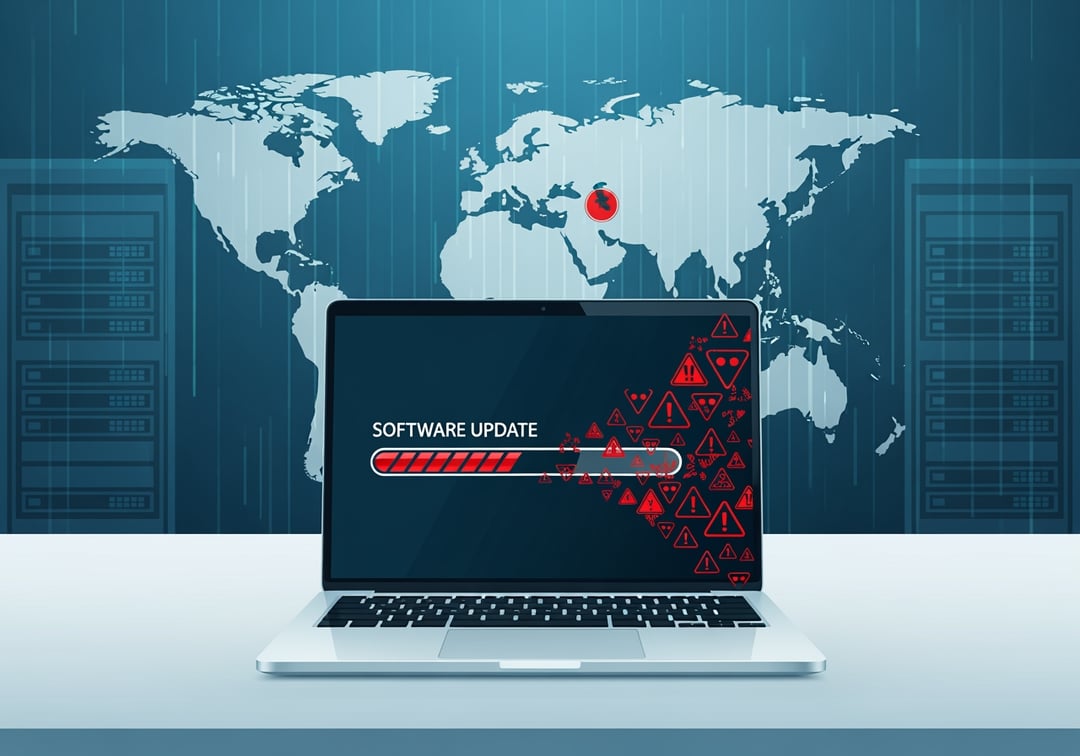
What happened: eScan update server hijacked to distribute malware
MicroWorld Technologies (the company behind the eScan antivirus program) began receiving customer reports about issues related to eScan. After an internal investigation, the company said an unidentified threat actor gained unauthorized access to one of its regional update server configurations and used that position to distribute a malicious update.
According to the company statement reported by BleepingComputer, the incident involved an incorrect file being placed into the update distribution path—described as a patch configuration binary/corrupt update—which ultimately meant customers pulling updates from the affected infrastructure received a malware-laced update.
The timeframe: a limited, roughly two-hour window
The distribution window was described as limited to January 20, 2026, and the same reporting notes it was roughly two hours. That matters, because it strongly suggests exposure was constrained to:
- customers who updated during that specific window, and
- customers whose devices were pulling updates from the affected regional server cluster.
MicroWorld Technologies did not specify how many customers were impacted, and it’s not clear how many endpoints downloaded the malicious update during that timeframe.
What was compromised (and what wasn’t)
The compromised component: regional update server cluster configuration
MicroWorld Technologies’ investigation concluded the attacker infiltrated a regional update server configuration and used it as a delivery mechanism to push out the wrong (malicious) file to users downloading updates from that cluster.
This is the core risk of “trusted channel” compromise: when the update pipeline is abused, the malware arrives wearing the uniform you’re trained to trust.
The eScan product itself was not tampered with
MicroWorld Technologies stated the eScan product itself was not tampered with, and that victims appear limited to a specific regional cluster rather than the entire eScan ecosystem.
That distinction doesn’t make the incident “small,” but it does narrow the scope to the update distribution layer, not a full product compromise across all users.
What the malicious payload is: CONSCTLX multi-stage malware
Security researchers from Morphisec analyzed the malicious payload and described it as a multi-stage malware intended for both enterprise and consumer endpoints. The malware is named CONSCTLX.
Rather than acting like loud, obvious ransomware, CONSCTLX is described as something more quietly dangerous—built for staying power and follow-on delivery.
What CONSCTLX can do on an infected device
Morphisec’s analysis describes CONSCTLX as a backdoor and persistent downloader, which is a nasty combination: it can establish access and then keep pulling in additional components later.
Capabilities noted include:
- Remaining on the device (persistence)
- Running commands
- Modifying the Windows HOSTS file
- Connecting to command-and-control (C2) infrastructure
- Downloading additional payloads (acting as a persistent downloader)
In plain terms: if the backdoor lands successfully, the attacker can keep a foothold and expand what happens next—without needing to re-infect the machine the same way again.
Who’s behind the attack: currently unknown
At the time of reporting, it’s unknown who carried out the attack.
However, the reporting also references a prior context: BleepingComputer “reminds” that in 2024, North Korean cybercriminals were seen exploiting the update mechanism in eScan to infect corporate networks using various backdoors. That’s not identified as the same campaign—just relevant history that underscores why update mechanisms are such high-value targets.
Remediation steps taken by MicroWorld Technologies
MicroWorld Technologies said it took several containment and recovery actions after identifying the issue:
- The affected infrastructure was isolated
- Credentials were refreshed
- The company reached out to affected customers to support remediation efforts
The key operational signal here is that the vendor treated this as an incident requiring both technical containment (isolation, credential refresh) and customer-level cleanup support.
How to tell if you might be affected (based on the reported scope)
The information provided points to a narrow set of risk conditions:
- You were using eScan
- Your device downloaded updates from the affected regional update server cluster
- You pulled an update during the limited timeframe on January 20, 2026 (roughly two hours)
Because the reporting doesn’t list regions, server identifiers, or exact timestamps, the only definitive confirmation path mentioned is the vendor’s outreach to affected customers and the remediation process they’re offering.
Q&A
Q1) Was eScan itself compromised, or just the update delivery?
MicroWorld Technologies stated the eScan product itself was not tampered with. The incident involved unauthorized access to a regional update server configuration and a malicious/incorrect file being placed in the update distribution path.
Q2) What is CONSCTLX, and why is it dangerous?
CONSCTLX is described by Morphisec as a multi-stage malware that acts as a backdoor and persistent downloader. It can run commands, modify the Windows HOSTS file, connect to C2 infrastructure, and pull additional payloads, enabling ongoing attacker access.
Q3) Who is affected by the malicious update?
Impacted users appear limited to customers downloading updates from a specific regional server cluster during a limited window on January 20, 2026 (roughly two hours). The exact number of impacted customers wasn’t disclosed.
Q3) Who is affected by the malicious update?
Impacted users appear limited to customers downloading updates from a specific regional server cluster during a limited window on January 20, 2026 (roughly two hours). The exact number of impacted customers wasn’t disclosed.