
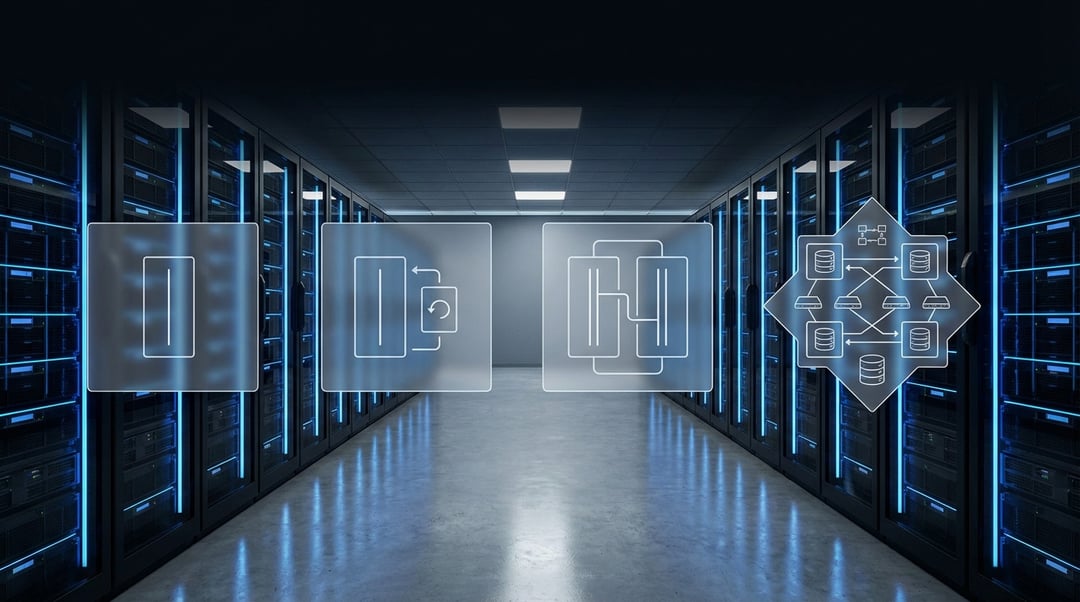
Data center tiers in plain English: what they measure (and what they don’t)
When people say “Tier 1” or “Tier 4,” they’re usually trying to answer one question. How hard will it be for this data center to stay online when something needs work or something breaks?
A tier rating focuses on the building’s critical infrastructure. That includes power, cooling, and the paths that deliver them. In other words, tiers describe the facility’s ability to support IT equipment reliably.
Tiers do not automatically guarantee your website or application stays up. Your service can still go down because of a bad deployment, an overloaded database, a misconfigured firewall, or a single server that has no backup. A Tier 4 facility can host a Tier 1 application. Plenty do.
To understand the differences between Tier 1, Tier 2, Tier 3, and Tier 4, you only need to know a few terms.
- N: the minimum capacity needed to run the load.
- N+1: you have one extra “spare” component.
- 2N: you have two independent sets of capacity.
- Single point of failure: one component that can take everything down.
A Simple Way to Understand Tier 1, Tier 2, Tier 3, and Tier 4
Forget the marketing language for a moment. Data center tiers boil down to two practical questions.
- Can the site stay online during planned maintenance?
- Can the site stay online during an unplanned failure?
Maintenance matters because mature operators maintain constantly. They service UPS systems, generators, chillers, switchgear, and more. If maintenance forces downtime, you can expect regular interruptions.
Failures matter because real infrastructure fails. Breakers trip. Pumps seize. A utility feed drops. A tier mainly describes how gracefully the facility handles that reality.
Redundancy helps. Distribution paths matter just as much. You can buy an extra UPS yet still run all power through one path. That single path can still ruin your day.
Tier 1 data center explained: the “basic but functional” tier
A Tier 1 data center typically uses a single path for power and cooling. It also has limited redundancy, if any. Think of it like a house with one electrical panel and one HVAC system. It works. It just does not provide many options when you need repairs.
In plain English, Tier 1 means this. Planned maintenance often requires downtime. An unplanned failure can also cause downtime because there is little backup capacity.
Tier 1 fits non-critical workloads. Development environments often live here. Internal tools can live here too, especially when people can tolerate an outage.
The hidden cost shows up later. If you need to patch, expand, or replace major components, you schedule downtime. That downtime may cost more than the savings that attracted you in the first place.
Tier 2 data center explained: redundancy without full flexibility
A Tier 2 data center adds redundant components, often described as N+1. You might have an extra UPS module, an extra pump, or an extra generator. That spare component reduces the chance that one piece of equipment failure stops everything.
However, Tier 2 commonly still uses a single distribution path for power and cooling. That detail changes the lived experience. You can have backups and still face downtime during certain maintenance events because the path itself cannot stay active while you work on it.
Tier 2 makes sense for organizations that want fewer surprises. They still accept planned downtime occasionally. They just want to avoid outages caused by predictable single-component failures.
The most common misunderstanding sounds like this. “Tier 2 has redundancy so we’ll have no downtime.” Redundancy reduces risk. It does not eliminate it.
Tier 3 data center explained: the “maintenance without downtime” tier
A Tier 3 data center usually marks a big step up because it targets concurrent maintainability. That phrase sounds academic. The idea stays simple.
You can perform planned maintenance on key systems without shutting down the IT load.
Tier 3 designs typically include multiple power and cooling paths. They also include redundancy sized so that taking one component out of service does not drop capacity below what the load needs.
In day-to-day operations, Tier 3 feels calmer. Maintenance becomes routine instead of a high-stakes event. That operational rhythm matters because data centers do not “set and forget.” They run like industrial plants.
Tier 3 often fits customer-facing services, e-commerce, SaaS, and serious enterprise workloads. It also fits many colocation customers who want strong availability without paying for the most extreme design.
Tier 4 data center explained: fault tolerance for single failures
A Tier 4 data center aims for fault tolerance. In plain English, a single unplanned failure should not interrupt operations.
Tier 4 designs use independent redundant systems and distribution paths. They also emphasize isolation. The redundant “side” must not share the same vulnerable point. Otherwise one incident can cut through both layers.
Tier 4 fits environments where downtime carries severe consequences. Finance, large-scale platforms, critical healthcare operations, and certain government workloads often land here.
The trade-off is cost and complexity. More infrastructure means more to operate. It also demands disciplined procedures. A highly resilient building cannot compensate for sloppy change management.
How to choose the right tier
Start with outcomes, not labels.
- If you can tolerate downtime for maintenance, Tier 1 or Tier 2 may fit.
- If maintenance downtime creates business risk, Tier 3 becomes compelling.
- If even a single failure causing downtime becomes unacceptable, Tier 4 enters the conversation.
A practical way to decide uses simple math. What does one hour of downtime cost in lost revenue, productivity, and trust? If that number shocks you, treat it as a design requirement. Then work backward into a tier choice and an application strategy.
Also remember the uncomfortable truth. Facility tier is only one layer. Network diversity, backup strategy, multi-region design, and operational maturity often decide your real uptime.
Common mistakes people make when talking about data center tiers
Many teams assume tiers measure “overall reliability.” They don’t. Tiers describe the facility’s infrastructure topology and maintainability behaviors. Your application still needs redundancy. Your network still needs diversity. Your people still need process.
Another common mistake is prestige buying. Tier 4 may sound like the best, but it’s often unnecessary. Spending too much on facility resilience can drain budgets needed for backups, monitoring, disaster recovery tests, and capacity planning.
Finally, watch out for vague claims. Ask what “redundant” means. Ask whether the facility supports maintenance without downtime. Ask whether it truly tolerates a single failure. Clear answers signal a serious operator.
Conclusion: data center tiers, explained without the fog
If you remember one thing, remember this. Tiers describes how a data center handles maintenance and failures.
Tier 1 and Tier 2 can work for non-critical systems. Tier 3 usually fits most serious production needs because it supports planned work without downtime. Tier 4 targets organizations that must survive a single failure without interruption.


