
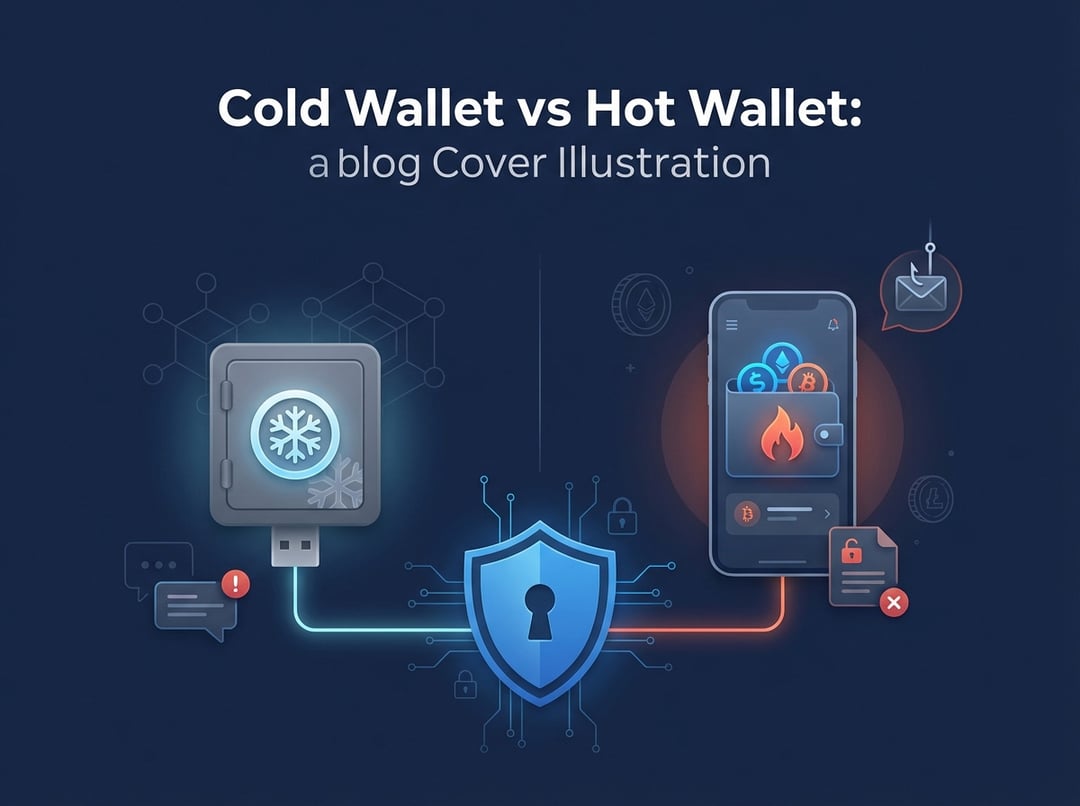
Crypto feels weirdly unfair sometimes. You can do everything “right” for months, then one rushed click or one fake support DM empties a wallet in seconds. That is why crypto security basics matter. Not as a checklist you skim once, but as a system you run every time you move money.
This guide breaks down cold wallets, hot wallets, and common scams at an intermediate level. Expect clear tradeoffs, practical setups, and a few blunt rules that save people real money.
Crypto Security Basics, Explained Like a System
Security in crypto fails in two main ways.
First, key compromise. Someone gets the ability to sign transactions as you. That can happen through malware, seed phrase theft, or sloppy backups.
Second, user deception. You still control your keys, yet you sign the wrong transaction. Think malicious approvals, fake sites, and “harmless” signatures that are not harmless.
A clean way to think about crypto security basics is a layered stack:
- Identity layer: email security, SIM protection, password manager, strong 2FA.
- Device layer: OS updates, browser hygiene, avoiding sketchy downloads.
- Wallet layer: hot wallet versus cold wallet, seed phrase storage, passphrases.
- Transaction layer: verifying addresses, understanding approvals, reading what you sign.
Consequently, you do not need perfection in any single layer. You need friction in all the layers attackers rely on.
Cold Wallets vs Hot Wallets: The Core Tradeoff
Hot wallets: fast, flexible, and exposed
A hot wallet stores or accesses your private keys on a device that touches the internet. That includes browser extension wallets, mobile wallets, and most desktop wallets.
Hot wallets shine when you transact often. They make DeFi and swaps painless. They also widen your attack surface because the same device that signs transactions also browses the web.
The biggest hot wallet risks look like this:
- You install the wrong extension or a fake update.
- Your browser gets compromised.
- You approve a malicious contract that drains tokens later.
Cold wallets: isolation-first signing
A cold wallet keeps keys in an environment designed to stay isolated from everyday internet risk. In practice, most people mean a hardware wallet.
Cold storage reduces the chance that typical malware can steal your keys. However, it does not magically protect you from signing something malicious. If you approve a bad spender or sign away access, the cold wallet will faithfully execute your mistake.
So the real principle is simple.
Hot wallet equals convenience-first signing. Cold wallet equals isolation-first signing.
How to Choose Between Cold Wallets and Hot Wallets
If you want a decision rule that actually holds up, use three variables: risk, frequency, and complexity.
- If you hold meaningful amounts and transact rarely, prioritize a cold wallet.
- If you trade daily or interact with DeFi often, you will need a hot wallet.
- If you use bridges or new protocols, assume a higher scam surface.
The best intermediate pattern is the two-wallet setup.
1) Hot wallet as a checking account
Keep a small, refillable balance. Connect it to dApps. Assume it is the wallet that gets tested.
2) Cold wallet as a savings vault
Hold the long-term assets here. Keep interactions minimal. Use it to receive funds and to send to trusted destinations.
Furthermore, many intermediate users benefit from a third wallet. Call it a quarantine wallet. Use it for airdrops, unknown sites, and experiments. It keeps curiosity from turning into catastrophe.
Setting Up a Cold Wallet Safely
A cold wallet setup fails most often at purchase and backup time.
Buy hardware wallets from the manufacturer or an authorized reseller. Avoid used devices. Initialize the wallet yourself. Do not accept a device that arrives “preconfigured.”
Then get serious about the seed phrase.
Seed phrase rules in crypto security basics are non-negotiable:
- Never type it into a website.
- Never store it in screenshots, notes apps, or cloud drives.
- Never share it with “support” or “admin” accounts.
For backups, you have two realistic options. Paper works but it burns and it gets wet. Metal backups resist disaster but they increase the stakes if someone finds them. Either way, store backups in boring places and use physical separation. Two copies in two locations beats one copy in a “perfect” hiding spot.
PINs and passphrases deserve a sober warning. A passphrase can protect you if someone finds your seed. It also locks you out permanently if you forget it. Add complexity only if you can maintain it for years.
Setting Up a Hot Wallet Safely
Hot wallet safety starts before you even install the wallet.
Keep your operating system updated. Keep your browser updated. Use a dedicated browser profile for crypto. Even better, use a dedicated device if you move substantial funds.
Be ruthless with extensions. Random coupon tools and “AI helpers” do not belong in the same browser that signs transactions.
Now the most overlooked topic in crypto security basics: token approvals.
Approvals let a smart contract spend your tokens later. That convenience becomes a liability when you approve the wrong contract or you approve unlimited spending. Prefer exact approvals when possible. Periodically review and revoke allowances you no longer need.
Useful tools:
- Revoke.cash to review and revoke approvals: https://revoke.cash/
- Etherscan token approval checker for Ethereum: https://etherscan.io/tokenapprovalchecker
- MetaMask guidance on revoking approvals: https://support.metamask.io/more-web3/learn/how-to-revoke-smart-contract-allowances-token-approvals/
Common Crypto Scams You Should Expect
Scams work because they target your attention. They create urgency, confusion, and social pressure. Here are the patterns that keep working.
Seed phrase phishing and fake support
This happens on Discord, Telegram, X, and email. The scammer’s goal stays the same. They want your seed phrase. They call it “wallet sync” or “validation” or “security verification.”
No legitimate support agent needs your seed phrase. Ever.
The FTC has extensive consumer guidance on crypto scams and reporting pathways, which is worth reading even if you think you are “too experienced” to fall for it: https://consumer.ftc.gov/articles/what-know-about-cryptocurrency-scams
Address poisoning and clipboard hijacking
Address poisoning relies on your habits. Attackers send small transactions so their address appears in your history. Later, you copy the “recent” address and send real funds to the attacker.
Clipboard hijackers are worse. Malware swaps the address you copied with an attacker’s address.
Defensive habit: verify the first and last characters of the address before sending. For large transfers, send a small test transaction first.
Malicious dApps and drainers
A drainer rarely needs your seed phrase. It needs you to sign something that grants permissions. Red flags include countdown timers, “claim now” language, and prompts that request broad access without a clear reason.
Use a quarantine wallet for unknown sites. Refuse blind signing when the prompt feels vague.
Investment, romance, and “guaranteed yield” fraud
These scams feel personal because they are personal. They often build trust slowly, then introduce a “platform” with fake charts and fake withdrawals.
The FBI highlights cryptocurrency investment fraud patterns and reporting guidance here: https://www.fbi.gov/how-we-can-help-you/victim-services/national-crimes-and-victim-resources/cryptocurrency-investment-fraud
If returns look smooth in a volatile market, assume manipulation.
A Practical Transaction Checklist
Before you connect:
- Confirm the exact domain. Bookmark it.
- Cross-check official links from multiple sources.
Before you sign:
- Read what the transaction requests.
- Ask one question: “What is the worst-case outcome if this is malicious?”
Before you send:
- Verify the address visually.
- Test small before you send big.
For broader phishing fundamentals, CISA’s guidance on recognizing and resisting phishing attempts is solid and applies directly to crypto: https://www.cisa.gov/secure-our-world/recognize-and-report-phishing
If You Think You’ve Been Compromised
Move fast and think in containment.
Disconnect the wallet from sites. Revoke approvals. If you suspect the seed phrase leaked, treat that wallet as permanently unsafe. Create a new wallet on a trusted setup and migrate assets.
Save transaction hashes and URLs. Report impersonation accounts. Do not negotiate with “support” in DMs.
The Bottom Line
Cold wallets reduce key theft risk. Hot wallets keep you operational. Scams exploit rushed decisions.
So here is the simplest version of crypto security basics that holds up over time: slow down before you sign. Add separation between “spending” and “savings.” And never hand your keys to anyone, even if they sound official.