
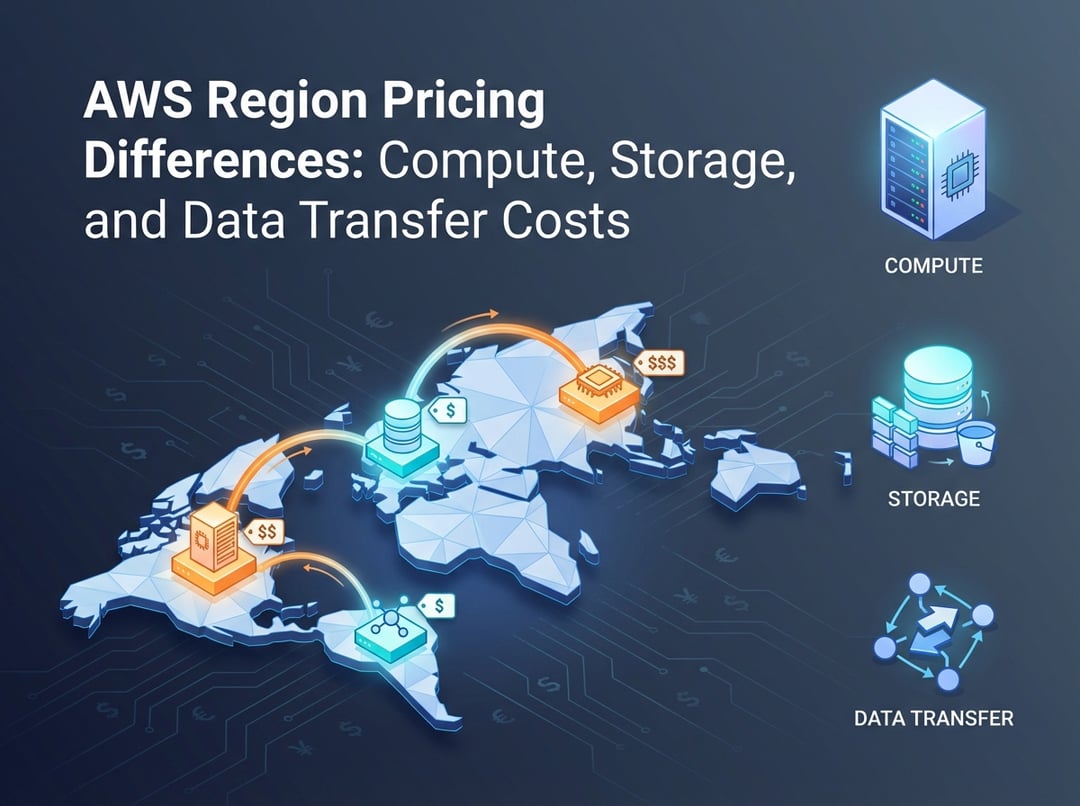
When people say “AWS Region pricing differences,” they usually mean this: you can deploy the same type of resource in two Regions and pay different rates. That variance shows up across common building blocks like compute, storage, and network transfer. It also shows up indirectly through the services and instance types that are available in each Region.
Why does this happen? AWS ties pricing to local operating conditions, which include energy costs, real estate, connectivity, and taxes. Consequently, Region choice behaves like a built-in “market multiplier” on your architecture. AWS also explicitly recommends considering Region cost differences as part of cost optimization, not as an afterthought in procurement (AWS Well-Architected Cost Optimization).
Compute costs by Region: why the instance price can mislead
Compute feels like the easiest comparison because EC2 publishes clear per-hour rates. That clarity can turn into a trap.
What actually shifts EC2 cost across Regions
On-Demand rates vary by Region. That part is obvious. The less obvious drivers can matter more:
- Instance family availability differs by Region, which forces substitutes. Substitutes can change price and performance.
- Savings Plans utilization changes when teams spread workloads across many Regions. Waste grows when commitments do not match usage.
- Spot market depth varies by Region, which affects how reliably you can harvest discount capacity.
Even if you “win” on hourly price, you still need the system to perform. If latency pushes you to overprovision, your cheap Region stops looking cheap.
The hidden compute multipliers
Compute rarely ships alone. EBS attaches to EC2, and your design choices drag storage and network spend along for the ride. Licensing can also dominate the bill. A Windows-heavy fleet can erase small Regional differences in base compute pricing. Operational costs also rise when you run more Regions than you need. You add more pipelines, more monitoring surfaces, and more failure modes.
AWS has even cautioned against simplistic comparisons that ignore what is actually included and what assumptions a comparison tool makes (Be careful when comparing AWS costs).
Storage costs by Region: the “gravity tax” you pay when data moves
Storage pricing varies by Region, but the bigger issue is architectural. Data attracts compute, analytics, backups, and users. When you separate data from the systems that use it, you pay a gravity tax in transfer, replication, and complexity.
S3: pricing goes beyond just storage
S3 costs do not stop at per-GB-month. You also pay for requests, data retrieval (for certain storage classes), and data transfer. If you store data in a cheaper Region but your application runs elsewhere, the “savings” often reappear as network charges and higher latency.
Here’s a common example: you keep a media library in Region A to save on storage costs, but your web app runs in Region B to be closer to users. Every page view then pulls data across regions, so your bill shifts quietly from storage costs to data transfer fees.
EBS and snapshots: where storage and compute collide
EBS stays in the same Region as the instances that use it. Snapshots can multiply cost when you keep many copies, retain them too long, or replicate across Regions for disaster recovery. If you plan multi-Region recovery tests, model those drills. They generate real data movement, not theoretical movement.
Data transfer costs by Region: the bill that ambushes “cheap compute”
If Region shopping has a villain, it is data transfer. Many teams underestimate it because it appears later, and it often shows up as many small line items.
The three transfer categories you must model
- Inbound from the internet: often free, but confirm per service and path.
- Outbound to the internet: frequently expensive at scale.
- Inter-AZ and inter-Region: can become the dominant cost in distributed systems.
AWS provides a useful architecture-level view of how common designs generate transfer charges (Overview of data transfer costs).
Why cross-Region transfer confuses people
Cross-Region traffic typically bills on the sending side. That means you can see “free-looking” inbound lines and still pay heavily for outbound from the source. If your system replicates data, runs cross-Region analytics, or performs large backfills, you must model those flows explicitly. AWS’s Cost and Usage Report documentation helps explain how these charges appear in billing exports (CUR data transfer charges).
AWS has reduced some inter-Region transfer pricing over time, which helps. Still, architectures that minimize data movement remain the safest hedge against future growth (DTIR price reduction).
A practical method to choose Regions without getting fooled
A durable approach beats a one-off comparison.
1) Start with non-negotiables
Lock constraints first: latency needs, data residency, and service availability. If compliance forces a Region, pricing becomes a tuning exercise inside that boundary.
2) Model workload unit economics
Avoid “monthly total cost” estimates that hide drivers. Use units you can reason about:
- cost per 1M requests served
- cost per GB delivered to users
- cost per GB replicated
- cost per TB processed in batch windows
3) Stress-test the network assumptions
List every place data crosses a boundary: AZ, Region, VPC-to-VPC, and internet egress. Then price the worst week, not the average week. Backfills and incident recovery create ugly spikes.
4) Validate with tools, then verify in billing
Use the AWS Pricing Calculator for candidate Regions. After deployment, validate reality with CUR and clear tagging. AWS frames Region selection as a cost best practice, but only measurement makes it real (Well-Architected Region cost guidance).


