
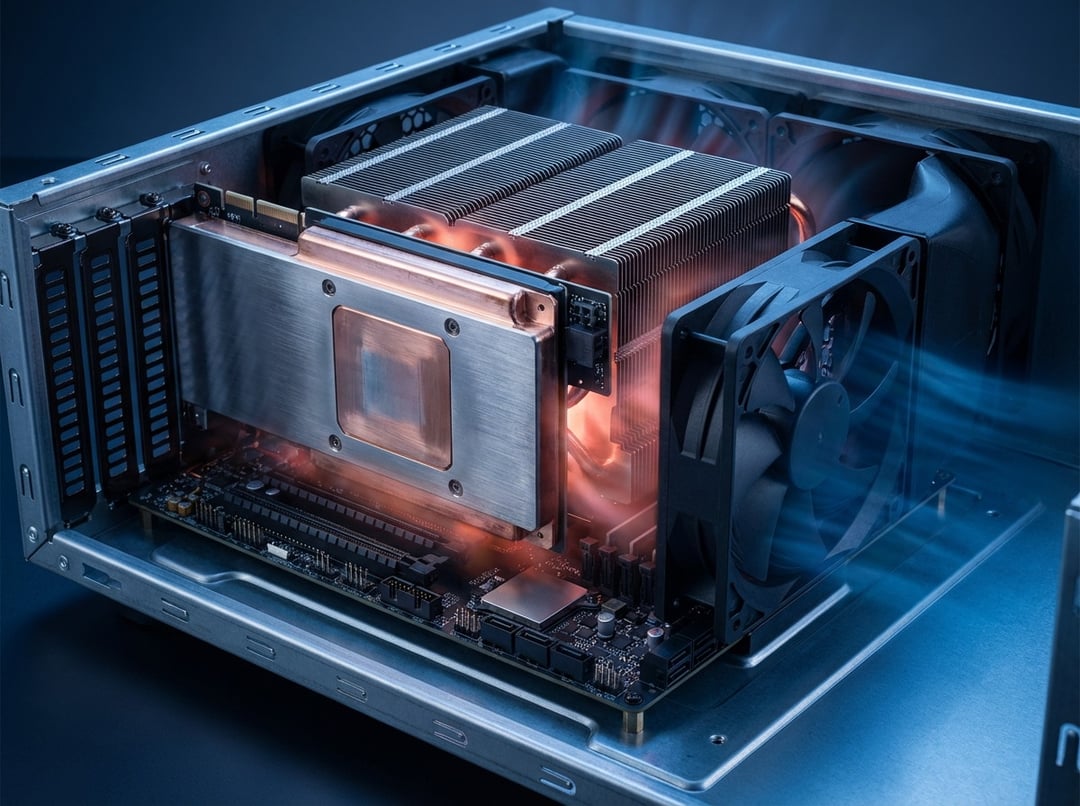
1,000W Air-Cooled Vapor Chamber Built for Extreme RTX Power Draw
There’s something kind of wild about seeing “1,000W” next to “air-cooled.” We’re used to numbers like that meaning custom loops, thick radiators, and a tangle of tubing. But Akasa is stepping into that space with a vapor chamber GPU cooler rated for up to 1,000 watts — and it’s designed to tame NVIDIA’s most power-hungry cards.
Top-tier GPUs like the GeForce RTX 5090 can push around 600W under full load. That’s already serious heat. Step into workstation territory with cards like the NVIDIA RTX PRO 6000, and you’re looking at even higher thermal output thanks to increased core and memory counts.
Akasa’s approach? Stick with air — but make it industrial.
Instead of traditional consumer-style heat pipes and fans, this is a server-class vapor chamber module built for environments where airflow is aggressive and noise simply doesn’t matter.
Why Cooling 600W–1,000W GPUs Is Such a Challenge
Aftermarket BIOS and Extreme Overclocking Push GPUs Beyond Limits
High-end GPUs don’t just run hot at stock settings. With aftermarket BIOS tweaks and extreme overclocking, power draw can spike dramatically. There have even been reports of modified RTX 5090 BIOS configurations pushing toward 2,000W scenarios in extreme overclocking circles.
When you’re dealing with that kind of thermal output, traditional triple-fan coolers start to look small. Even liquid cooling, while effective, adds cost and complexity.
That’s the gap Akasa seems to be targeting:
High-wattage cooling without the expense and maintenance of liquid systems.
Liquid Cooling Dominates — But Air Still Has Advantages
Liquid cooling is often the go-to for high-performance GPUs, especially in data centers and enthusiast builds. It moves heat efficiently and handles sustained workloads well.
But air cooling is:
- More cost-effective
- Simpler to deploy
- Easier to maintain
- More power-efficient in certain setups
For large-scale deployments, especially in structured airflow environments, air cooling still makes a lot of sense.
Akasa’s new vapor chamber designs lean into that practicality.
Server-Grade Heatsink Design With High-Airflow Ducting
A Massive, Utilitarian Metal Construction
This isn’t a flashy RGB cooler. It’s described as a huge piece of metalwork — chunky, industrial, and built for performance over aesthetics.
The internal vapor chamber distributes heat across a large surface area, allowing high-pressure airflow to carry it away efficiently. There’s no integrated fan attached to the cooler itself.
And that’s intentional.
Designed for System-Level High-Powered Fans
Instead of bundling fans directly onto the GPU cooler, this design assumes:
- Powerful system fans
- Structured ducting
- Directed airflow in rack or server environments
Air is pumped exactly where it’s needed. Noise levels? Not a concern.
This makes perfect sense in data centers and embedded systems — environments where airflow engineering matters more than acoustics.
Targeted at RTX 5090 and RTX PRO 6000-Class GPUs
Although it’s positioned for data center use, the cooler is reportedly targeted at:
- NVIDIA GeForce RTX 5090
- NVIDIA RTX PRO 6000-class cards
That detail matters.
It suggests this isn’t strictly limited to massive server stacks. There’s room — at least in theory — for these cooling modules to appear on high-end consumer or workstation cards.
And that opens the door for something interesting.
Potential for Modding and Enthusiast Applications
An air-cooled 1,000W GPU cooler is the kind of thing that makes hardware modders curious.
In a consumer setup, it would likely require:
- Custom airflow solutions
- Case modifications
- High-static-pressure system fans
But imagine pairing a cooler rated for 1,000W with a “mere” 600W RTX 5090. The thermal headroom alone could be compelling for overclocking experiments.
It’s easy to picture tech YouTubers getting their hands on one and stress-testing it just to see what happens.
Embedded World 2026 Showcase and Future Details
Akasa is set to showcase these new GPU cooling designs at Embedded World 2026 in Nuremberg, Germany, with more technical details expected during the event.
That means specifications, compatibility insights, and possibly real-world thermal performance data could soon follow.
For now, what stands out is simple:
A serious attempt to push air cooling into territory usually reserved for liquid solutions.