
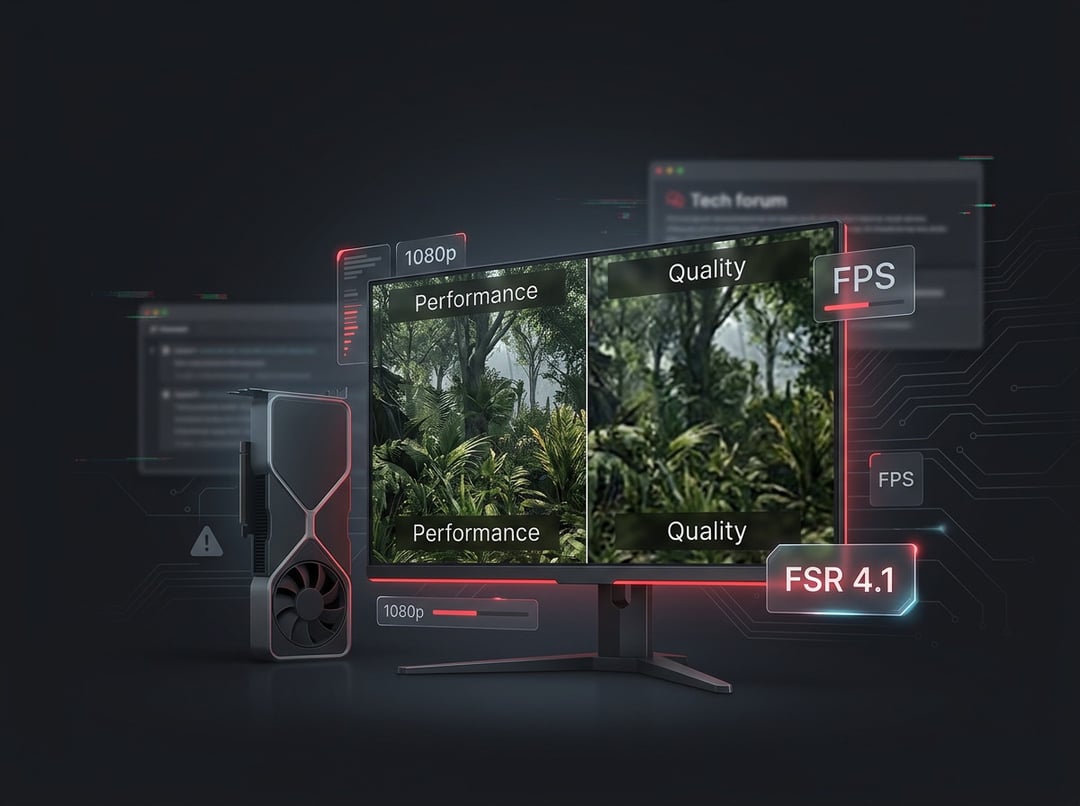
What the leaked AMD FSR 4.1 suggests about upscaling quality vs Nvidia DLSS 4.5
AMD’s FSR 4 is described as a strong upscaling algorithm—but not one that clearly beats Nvidia’s DLSS 4.5. The leak around FSR 4.1 changes the conversation a bit, because early testing shared alongside a beta DLL points to noticeable image-quality improvements, especially in the lower-quality presets where upscalers typically get exposed.
Based on the leak, FSR 4.1 could make the FSR vs DLSS matchup feel closer to a coin flip in certain scenarios, particularly when you’re chasing performance and can’t afford to run the cleanest quality mode all the time.
Leaked FSR 4.1 beta DLL: what appeared and where it came from
The FSR 4.1 DLL isn’t officially released. Instead, a user on the Guru3D forums (identified as “The Creator”) posted a beta DLL, plus screenshots and performance numbers. A separate report highlighted the findings and framed them as early but meaningful, with visual comparisons suggesting real improvements rather than minor tuning.
The important nuance: this is still a leak. There’s no official validation, no official changelog, and no official support path—just community-shared materials and early impressions.
Games reportedly showing better detail with FSR 4.1 upscaling
Early comparisons mentioned multiple big-name titles where the leaked FSR 4.1 build appears to improve detail rendering at the same quality settings, including:
Monster Hunter Wilds
FSR 4.1 reportedly resolves more fine detail than earlier FSR versions at comparable settings, which matters in scenes that are dense or visually busy.
Cyberpunk 2077
The leak suggests better reconstruction of small details—exactly the sort of situation where weaker upscaling can look smeary or unstable.
The Last of Us Part II
The testing indicates improved detail retention versus prior FSR behavior at identical preset levels.
Stellar Blade
FSR 4.1 is said to deliver clearer detail than earlier iterations, especially where thin elements and texture complexity make artifacts more obvious.
Where the FSR 4.1 improvements look most obvious: foliage and thin textures
One of the most practical takeaways from the leak is where the gains show up. The reported improvements are “particularly noticeable” in:
- Foliage (leaves, branches, fine vegetation)
- Thinner textures (small, narrow, high-frequency detail)
And honestly, that’s exactly where upscaling tends to break immersion first. You can forgive a little softness on a wall. But shimmering foliage or messy thin detail? That’s the stuff your eyes lock onto immediately.
Ultra Performance mode reportedly approaching Quality mode (FSR 4 vs FSR 4.1)
The leak claims something pretty aggressive: in some cases, the visual difference is so large that Ultra Performance mode with FSR 4.1 can look as good as Quality mode with FSR 4.
That’s a big deal if it holds up broadly, because Ultra Performance is typically the “last resort” preset—useful when you need frames, but usually costly in clarity. If FSR 4.1 genuinely lifts that floor, it changes how comfortable people might feel using the faster modes.
Why 1080p image quality improvements matter more than 4K frame boosts
The leak emphasizes that these gains appear most apparent at lower resolutions like 1080p—which is also where this kind of technology is often most needed. Sure, higher FPS at 4K is nice. But the more meaningful impact is when upscaling can help the broader base of players running:
- 1080p, often on lower-end GPUs
- A growing number of 1440p setups
In other words: if FSR 4.1 makes Performance-oriented modes look better at 1080p, that’s not a niche win. That’s a “most gamers” win.
RX 9000-series exclusivity: the biggest limitation in the leak
Here’s the catch the leak highlights: most of these improvements are said to be available only on RX 9000-series graphics cards.
RX 7000-series experiments exist, but stability and results aren’t guaranteed
Some users reportedly got the leaked DLL working on RX 7000 GPUs (including models like the 7900 XT and 7900 XTX), but it’s described as:
- Less stable
- Performance results not guaranteed
Community frustration: “bad blood” over support and access
The leak points to real tension here. RX 7000 owners want access to the newer algorithms in a meaningful way—even if the benefit isn’t identical to what RX 9000 gets. The stability issues and unclear support story add fuel to that frustration.
Trying the leaked FSR 4.1 DLL: what PC users are told to do (and why it’s risky)
If someone wants to try the DLL anyway, the guidance is presented as straightforward—but with a clear warning.
Safety warning about random forum files
The article explicitly cautions that it cannot vouch for the veracity or safety of files coming from “a random internet forum user.” That’s not just legal cover; it’s practical reality. A DLL from an unverified source is a risk, full stop.
Replacement location and filename mentioned in the leak
The described method is:
- Download the file
- Find
amdxcffx64.dllin the System32 folder - Replace it with the downloaded version
That’s the full process as stated—simple steps, but with potentially non-simple consequences if anything goes wrong.