
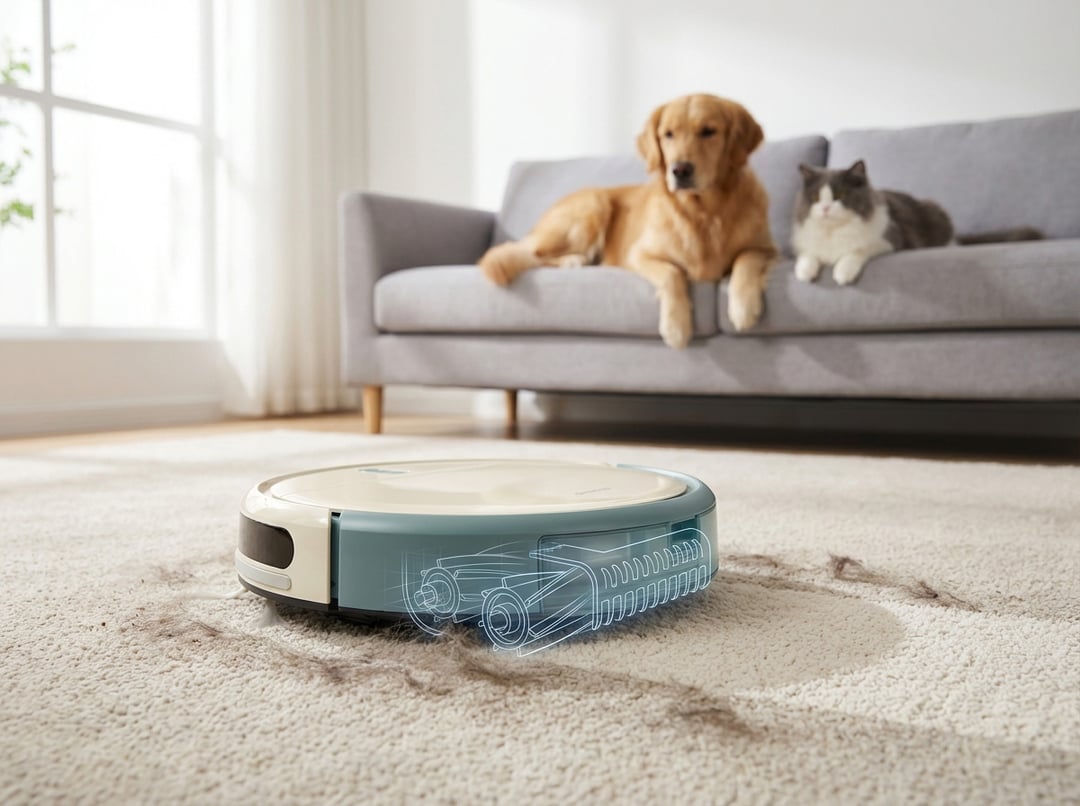
How We Chose the Best Robot Vacuums for Pet Hair on Carpet (Without Tangles)

Best Robot Vacuums for Pet Hair on Carpet (No-Tangle Picks)

How We Chose the Best Robot Vacuums for Pet Hair on Carpet (Without Tangles)

Pet hair on carpet behaves like Velcro with an attitude. It mats down into the pile. It migrates to edges. It wraps around anything that spins. So “Best Robot Vacuums for Pet Hair on Carpet: Picks That Don’t Tangle” really means two things at once: the robot must pull fur out of carpet and avoid turning its brush roll into a felted hair donut.

I focused on three practical dimensions.

First, brush architecture. Rubber rollers and self-cleaning brushroll systems resist wrap because hair slides off instead of knotting. iRobot explicitly designs its Dual Multi-Surface Rubber Brushes to “avoid getting tangled with pet hair” on models like the Roomba j7+ and s9+.

Second, carpet mechanics. On carpet, suction alone rarely wins. You need agitation that “combs” the pile plus a clean airflow path so the fur actually reaches the bin.

Third, maintenance reality. “Doesn’t tangle” should mean “tangles less and is faster to clear.” It never means “zero maintenance,” especially if you live with a husky, a Maine Coon, or one of those dogs that sheds emotionally.

iRobot Roomba j7+

If you want a robot vacuum that doesn’t tangle with pet hair and also behaves like a competent roommate, the Roomba j7+ hits a sweet spot. It pairs iRobot’s dual rubber roller system with smarter navigation that helps it avoid common floor chaos. Less chaos means fewer stalls. Fewer stalls means fewer hair snarls where a brush chews the same spot like a nervous habit.

The j7+ also matters for carpet because it combines rollers that keep contact across floor types with a self-empty base. That dock does more than save you a trip to the trash. A fuller bin reduces airflow. Reduced airflow lowers pickup. Lower pickup leaves more hair behind. The self-empty loop cuts that slow decline.

Best for: mixed carpet levels, daily shedding, and people who hate fiddling.

Pros

Rubber dual rollers reduce hair wrap

Smart avoidance reduces stuck incidents

Auto-empty keeps airflow steadier

Strong everyday carpet pickup

Cons

Replacement parts can cost more

Not built for very high-pile carpet

Can sound loud in boost modes

Verdict

Balanced pick for most homes with carpet and pets plus fewer hair-wrap headaches.

Roborock S8 Pro Ultra

Roborock markets the S8 Pro Ultra around hands-off ownership. The reason pet owners care is simpler: fewer interventions means fewer chances you yank hair out of a brush roll with your fingers like you’re defusing a tiny bomb.

Its key carpet advantage comes from a dual rubber brush system. Roborock states the dual rubber brushes “ensure fewer hair tangles” and it pairs that with a carpet strategy that boosts performance when it detects carpet. In plain terms, it tries to lift more, pull harder, and avoid dragging a damp mop onto your carpet.

This is not just about convenience. Consistent automation keeps your carpet from reaching the “fur blanket” threshold. Once hair compacts into carpet, you usually need an upright vacuum to reset the situation.

Best for: larger homes, mixed surfaces, and people who want maximum automation.

Pros

Dual rubber rollers reduce tangles

Great navigation and zone control

Dock automates empty and mop care

Strong routine cleaning consistency

Cons

High upfront cost

Dock upkeep still takes attention

Deep carpet hair may need extra passes

Verdict

Premium choice for automation-heavy cleaning with fewer tangles and strong carpet routines.

Shark (self-empty lineup)

Shark’s self-cleaning brushroll concept targets the ugliest scenario for carpet owners: long hair mixing with pet fur, twisting into a rope, then cinching tight at the brush ends. In that situation, even a powerful motor can lose. The brush keeps spinning. The hair keeps winding. Your cleaning session becomes a maintenance session.

A Shark with a self-empty base and a hair-wrap-resistant brushroll often delivers a very human benefit. It keeps the “gross work” smaller and more predictable. You still do maintenance. You just do less emergency maintenance.

This pick works best when you treat it like a daily sweeper, not a deep-cleaning miracle. Run it often. Keep filters clean. Clear the roller ends before they become a problem.

Best for: budget-conscious homes with long hair plus pets on carpet.

Pros

Hair-wrap tech reduces roller snarls

Self-empty models cut daily emptying

Strong value for the feature set

Parts and support widely available

Cons

Mapping can feel less precise

App quality varies by model

Filters need frequent attention

Verdict

Great value if you want anti-wrap help and less hair-handling without luxury pricing.

Eufy (dual-turbine carpet-forward models)

Some homes do not need a robot that “extracts” hair from deep carpet. They need one that stops tumble-fur from forming along baseboards and under beds. That’s where a midrange Eufy-style approach makes sense: solid suction, simple routing, fewer moving parts, and fewer things to babysit.

These models often perform best on low to medium pile. They grab surface fur and tracked-in grit. They also benefit from frequent runs because they keep the load small. Small loads reduce tangles. That’s the boring secret.

Best for: apartments, smaller carpeted zones, and moderate shedding.

Pros

Strong suction for surface fur

Simple daily operation

Often quieter than premium bots

Good value for smaller homes

Cons

Many lack full-size auto-empty docks

Deep carpet hair may remain embedded

More frequent bin emptying needed

Verdict

Smart midrange pick for routine fur pickup on carpet if deep extraction is not required.

iRobot Roomba s9+

When people say “I need the best robot vacuum for dog hair on carpet,” they often mean “my carpet looks like my dog exploded.” In that world, the Roomba s9+ earns its spot because iRobot designed it for aggressive carpet cleaning. iRobot notes it uses larger Dual Multi-Surface Rubber Brushes that flex and “avoid getting tangled with pet hair”.

The caveat is practical. This is a carpet-first machine with a bigger personality. It can be louder. It can feel more intense. You buy it for performance, not subtlety.

Pair it with a schedule that runs often enough to prevent buildup, because even a strong robot struggles once hair compacts into the pile.

Best for: heavy shedding, high-traffic carpet lanes, and performance-first buyers.

Pros

Excellent carpet pickup for pet hair

Rubber brushes reduce hair wrap

Self-empty keeps suction more stable

Strong edge cleaning performance

Cons

Expensive compared with newer rivals

Larger footprint affects tight spaces

Noise can be noticeable

Verdict

Choose it for serious carpet pickup with reduced tangling, then accept the premium tradeoffs.

Automation-first docked robots (Roborock Qrevo-class)

Not every pet owner needs the most powerful carpet cleaner. Most people just want reliable performance. If fur doesn’t build up, there are fewer tangles. Fewer tangles mean your robot vacuum can stick to its schedule. In everyday life, this consistent routine is more important than maximum suction power.

Automatic docking systems are great for this. They help your robot run regularly, keep the dustbins from filling up too quickly, and prevent your floors from ever getting out of control.

Best for: busy households with mixed floors and multiple daily messes.

Pros

Strong automation supports daily schedules

Good zoning for carpet-heavy rooms

Less manual emptying and handling

Consistent maintenance cleaning

Cons

Deep carpet extraction can vary

Docks still need periodic cleaning

Some hair wrap still happens

Verdict

Ideal when consistency beats peak power and you want less daily involvement.

What “Doesn’t Tangle” Really Means (And What It Never Means)

A robot vacuum that doesn’t tangle with pet hair usually wins in two ways. It uses materials that resist wrapping, like rubber rollers, and it uses geometry that sheds hair before it tightens. Conversely, bristle-heavy rollers can grab hair like a bottle brush. That grip helps agitation, yet it also invites knots.

However, no system escapes physics. Hair will migrate to the roller ends. It will catch on seams. It will collect around caster wheels. Treat anti-tangle as a reduction strategy, not a promise.

Buying Guide: Choose the Right Robot Vacuum for Pet Hair on Carpet

Start with your carpet. Low-pile carpet rewards navigation and steady airflow. Medium-pile needs a brush system that keeps contact and lifts fur consistently. High-pile and shag remain difficult for many robots, which means you should plan a hybrid workflow: robot for maintenance, upright for resets.

Then factor in your pets. Long-haired cats and double-coated dogs create ropey bundles that punish weak brush designs. Multiple pets also amplify volume, which makes auto-empty less optional.

Finally, match the robot to your tolerance for upkeep. If you will not clean a brush weekly, choose a model engineered to resist wrap, and choose a dock that reduces bin chores.

Setup and Maintenance That Prevents Tangles on Carpet

In week one, run mapping first, set keep-out zones, and remove fringe rugs that act like hair nets. Start with shorter daily runs. That keeps the brush from plowing through a week of accumulation in one heroic session.

Weekly, do a fast routine: check brush ends, wipe sensors, tap the filter, and clear the front caster. This takes minutes, yet it prevents the slow slide into clogged airflow and half-clean carpets.